02 Architecture
Status: draft M0. Normative for the structure of services/server/.
Terms: 00-glossary.md. Tables: 03-data-model.md.
Events and sync: 04-sync-protocol.md. Actions:
05-actions.md. Decisions: ADR 0004 to 0009, see the
ADR index.
Diagrams: ../architecture/README.md.
Notation: REST paths are written without a version prefix; 06-api.md defines the prefix. Limits, deadlines and targets appear in the text only by name. The default values of this chapter are in section 22, all others in the chapter that owns the name.
1. Guardrails
| Guardrail | Origin | Consequence for the architecture |
|---|---|---|
| An instance first runs on a single host, later in a cloud. | B1, B12 | One binary with roles. PostgreSQL and object storage are the only state. No broker, no cache service, no service mesh. |
| Permissions apply to every request and every delivery. | B7, 05 | A single decision point authorize in the module authz. Every route proves that it has checked its action (section 9.3). |
| No event is lost, no write request takes effect twice. | B8, 04 | Commit-ordered event_log, cursors, idempotency in the same transaction (ADR 0009). |
| Agents, plugins and apps never run in the server process. | B6, B10 | The public API is the only extension point. The server knows agents only as principals, runs only as objects. |
| Infrastructure is replaceable. | B3, B4, B9, B11, B12 | Hexagonal modules: domain logic knows only ports, drivers are adapters (ADR 0008). |
| Operation by one person must be enough. | B1 | Few parts, one configuration path, failure modes with a clear response (section 14). |
2. Context (C4 level 1)
Diagram: c4-1-context.svg (source c4-1-context.mmd).

| Party | Kind | Interface to the instance | Trust |
|---|---|---|---|
| Member | person | apps over REST and the gateway WebSocket | only own grants |
| Owner | person | apps and web console, administration with step-up | everything except other people's direct messages (05, R-AZ-02) |
| Instance operator | person | containers, configuration, server commands bothy ... |
host access; no access through the API without own grants |
| Bot developer | person | public API, SDK, app manifest | none; her apps get scopes and grants |
| Identity provider | external | OIDC (auth code with PKCE), JWKS of the provider | for the identity, after the signature check |
| Reverse proxy | external, run by the instance operator | HTTPS, WebSocket, optional identity headers | headers only when the server listens exclusively on loopback (B9) |
| Push services | external | HTTPS from the worker | not trusted; receive only IDs and placeholders |
| Agents (adapter with runtime) | external to the server | gateway as agent principal, REST, invocation token | not beyond their grants; check the token themselves (I3) |
| AI providers | external | used only by the runtime, never by the server | the server stores no credentials (B10, I5) |
| Integrations | external | REST with app token, incoming webhooks, outgoing webhooks | scopes and grants (B6) |
| Telemetry backends | external | OTLP through a collector | receive no content (B11) |
| Discord | external | read-only during import | source, no write-back |
| Transcription service | external, optional | port in the worker | receives audio only when the switch voice.enabled is on |
Host service bothy-host |
external, on connected hosts | outbound only: WebSocket control connection and one data connection per session (24-terminal.md) | authenticated with its own key; the server sees no terminal content (Noise) |
3. Containers (C4 level 2)
Diagram: c4-2-container.svg (source c4-2-container.mmd).

3.1 Containers
| Container | Technology | Responsibility | State | Scaling |
|---|---|---|---|---|
bothy serve --role=api |
Go, one binary, OCI image | REST, gateway WebSocket, log tail and fan-out in the process, agent consumers | only transient in memory (connections, permission cache, rate-limit buckets) | horizontal from level 2 (section 16) |
bothy serve --role=worker |
same binary and image | River jobs, event consumers (push, webhooks), file processing, maintenance | none outside the database | horizontal from level 3 |
| PostgreSQL 18 | database | all domain data, event_log, audit, River tables in the schema jobs.schema |
authoritative | vertical; read replica from level 4 |
| Object storage | file system driver (default) or S3-compatible | files, thumbnails, export packages | authoritative for bytes | through the storage service |
ClamAV clamd |
separate process, optional | malware scan via INSTREAM |
signatures | own container |
| OTel Collector | separate process | accepts OTLP, exports per backend | buffer | own container |
| Apps | Flutter (iOS, Android, macOS, Windows) | chat, outbox, local database, Notification Service Extension | local cache, never authoritative | per device |
| Web console | Flutter Web | administration, statistics and terminal (B5, ADR 0070); no chat | none | static files in the server image, served by the api process under /console/ from console.assets_dir (16-operations.md 14; M6-02) |
| Agent adapter | outside the server (reference: Hermes agent plugin, Claude Code runner) | consumer with a durable cursor, checks the invocation token, reports runs | own | run by whoever runs the runtime |
Host service bothy-host |
separate Go binary (services/host), on every connected host |
PTY per terminal session, Noise peer, profiles, self-check (24-terminal.md) | keys and scrollback buffer on the host | per host |
The secret source (file, environment, later Key Vault or Secrets Manager) is not a separate container in the diagram. api and worker read it at start and on rotation (section 13).
3.2 Roles of a process
| Part | api |
worker |
|---|---|---|
| REST endpoints, gateway WebSocket | yes | no |
| Log tail, hub, permission cache for connections | yes | no |
| Agent consumers (gateway connections of adapters) | yes | no |
Event consumers push and webhooks |
no | yes |
| River: insert jobs | yes | yes |
| River: run jobs, periodic jobs, leader election | no | yes |
internal listener server.internal_listen_addr (health, incoming webhooks from the stack) |
yes | yes |
Role all combines both in one process and is the default (server.role). Reason: an
installation on one host needs exactly one server container. The split costs only one
line of configuration, because both roles use the same binary and the same database.
3.3 Commands of the binary
One binary bothy with subcommands (ruling L1). This table is the register; other chapters
name only commands from here.
| Command | Purpose | Chapter |
|---|---|---|
bothy serve --role=api\|worker\|all |
start the server | this chapter |
bothy migrate up [--bootstrap]\|status\|validate |
migrations of the domain schema (goose) and of the River tables (rivermigrate); on the first run creates the row instance (through the port of the module instance), sets instance.schema_version and instance.min_server_version; creates the first partitions of event_log (03). up --bootstrap first creates or updates the five database roles and their grants as migrate.bootstrap_user (16 "Roles"); status only reads, validate needs no database |
ADR 0007, 16-operations.md |
bothy setup bootstrap-owner\|issue-enrollment-code |
setup: first owner by server command (system action instance.bootstrap), enrollment code for recovery |
08-identity.md |
bothy config check\|print |
check the configuration, print it redacted; check --secrets also resolves every reference *_ref through the secret provider and names per key only ok or the error code |
section 13 |
bothy import login\|logout, bothy import discord ... |
login of the import tool as a cli device through device pairing; import and read mirror through the import API (import.read, import.apply) |
22-import-migration.md |
bothy restore finalize [--relocation <manifest>] |
after a restore: new sync epoch, cursors to head_seq, stored database identity (R-DM-50), audit, in one transaction; as the schema owner and only while no bothy_app session is connected (exit 1 otherwise). --relocation takes the manifest of the final backup of a relocation without data loss: when event_log.head_seq, the audit head and sync_epoch equal it, only the identity is stored and epoch and cursors stay; a difference is exit 1 naming the field |
16-operations.md 8.4, 03-data-model.md 6.7 |
bothy secrets init\|export |
create and back up secrets: init --target DIR [--source DIR] [--owner SERVICE=UID:GID ...] [--adopt-source] reconciles the store _store/ with the source and copies per service; export --from DIR --age-recipient KEY [--age-recipient ...] [--signing-key-dir DIR] [--output FILE\|-] [--armor] writes the age-encrypted bundle (with the key store under signing-keys/); both read only their flags, without a configuration file and database |
16-operations.md 5.3, 5.4 |
bothy healthcheck --url URL [--timeout DURATION] |
health check against the internal listener for containers without a shell. --url takes only http:// with a loopback host (127.0.0.0/8, ::1, localhost), anything else is exit 2; --timeout bounds the whole request (default 5s, the timeout of the Compose healthcheck); no configuration, secrets or database; exit 0 for 2xx, else 1 with one line naming the status code or the error class |
16-operations.md |
bothy files rescan |
maintenance: have files checked again | 12-files.md |
bothy telemetry pseudonym <principal_id> [--at TIME] [--config FILE] |
pseudonym of a principal for the owner's troubleshooting: prints bothy.principal.pseudo_id for the period that contains --at (RFC 3339, retrieved 2026-10-12, default now) and the start of that period in UTC; reads telemetry.pseudonym_key_ref through the secret provider, no database |
../observability/privacy.md |
bothy dev seed |
test data, only in instance.environment = dev |
../operations/environments-and-flags.md |
Exit codes of all commands: 0 success or orderly end; 1 error (start failed, fatal
runtime error, shutdown beyond shutdown.total_timeout, negative check result); 2 invocation or
configuration error. From 3 on, codes are per command and are listed in its help: serve 3 for a
forced end by a second signal (section 15.3); setup bootstrap-owner 3 when the
setup is already complete; setup issue-enrollment-code 4 when it is not yet complete
(08-identity.md). Reason: orchestrators and scripts tell "called
incorrectly" apart from "failed at runtime" and recognize expected states without comparing text.
Output: what a script is meant to read (for example the enrollment code from setup) stands alone on
standard output; logs go to standard error.
Migrations never run implicitly at the start of serve (R-AR-16). Reason: with several nodes they would
start at the same time, and a failed step should not keep operation in a
restart loop.
4. Modules of the monolith
Diagram: c4-3-server-components.svg (source c4-3-server-components.mmd).

4.1 Rules
- A module is the package tree
services/server/internal/<module>/. It owns tables. Only this module writes and reads them via SQL (03, principle 12). Other modules go through its port. - The port is the root package
internal/<module>(section 5). Other modules import only this package, neverdomain,apporadaptersof another module. - Dependencies between modules form a directed graph without cycles (table 4.4).
- If a lower module needs data or reactions of a higher one, there are exactly two ways:
- Source port: The lower module declares an interface in its port; the higher
module implements it in an adapter. Example:
authzdeclaresStructureSource,chatimplements it. - In-tx event: The lower module publishes a domain event in the running
transaction; the higher module subscribes to it (section 8.3). Example:
messagingpublishesMessagePosted, andrunsthen decides on a run.
- Source port: The lower module declares an interface in its port; the higher
module implements it in an adapter. Example:
- Every module may use the cross-cutting ports (
internal/kernel). They are small, stable and each implemented by exactly one module (table 4.5). - Every table from 03 belongs to exactly one module. Every action from 05 is executed by exactly one
module as a use case. The permission logic of every action still lies only in
authz(B7). - Two modules own no tables:
gateway,search(03, section 2; ruling L3). They are separate modules because they have their own ports, their own dependencies and their own performance targets.statswas also planned without tables and, since the addendum of 2026-10-10, owns the minute aggregates of the own measurement (stats_minutes, ruling T7, 25-visualization.md).
4.2 Module list
| Module | Responsibility | Owns tables | Chapter |
|---|---|---|---|
instance |
instance identity, sync epoch, minimum server version, settings and branding, feature flags, server signing keys with JWKS and rotation, sequence counters | instance, instance_settings, server_signing_keys, feature_flags, sequence_counters |
06, 16, 19 |
audit |
audit log with hash chain, signed checkpoints, keys of the IP pseudonyms, query, verification, truncation with anchor | audit_events, audit_checkpoints, audit_ip_keys |
19, 20 |
authz |
authorize, permission cache, visible targets, groups, grants, permission version, I1 check, "Who has access", "View as person" |
groups, group_memberships, grants |
07 |
billing |
price table, cost postings, totals per run, thread, space, agent, reconciliation | price_table, cost_entries |
10 |
identity |
principals, people, owners, login drivers, identities, local credentials, enrollment codes, login flows, device pairing, passkeys, devices and device keys, sessions, refresh families, API tokens, step-up, access tokens | principals, users, owners, identity_providers, user_identities, local_credentials, enrollment_codes, auth_login_flows, auth_challenges, device_pairings, passkey_credentials, devices, device_keys, auth_sessions, refresh_token_families, refresh_tokens, api_tokens |
08 |
chat |
spaces, sidebar state, channels with behavior, skills, project binding, DM participants, forum tags, threads with thread sequence | spaces, user_space_states, channels, channel_skill_bindings, project_bindings, dm_participants, forum_tags, threads, thread_tags |
01, 07, 09 |
agents |
agents, backend policy and tool class (configured), reported state, consumer cursors with fencing, command register, agent sessions, dev environments (milestone) | agents, agent_consumer_cursors, commands, agent_sessions, dev_environments |
09, 10, 21 |
files |
upload sessions in parts, object storage drivers, scan, metadata removal, thumbnails, attachments, transcripts, file text extracts | files, file_upload_sessions, file_upload_parts, file_thumbnails, message_attachments, file_text_extracts |
12, 14 |
messaging |
messages, revisions, mentions, reactions, pins, templates, channel export | messages, message_revisions, mentions, reactions, pins, message_templates |
06, 14 |
runs |
trigger decision, runs and run document, steps, follow-ups, components, interactions, command execution, invocation tokens | runs, run_steps, run_followups, message_components, interactions |
09, 10 |
sync |
event log (append, tail, catch-up, redaction, partitions), snapshot, idempotency keys, read state, drafts, personal settings, cursors of the worker consumers | event_log, event_consumer_cursors, idempotency_keys, read_states, drafts, user_settings |
04, 15 |
notify |
notification levels, quiet hours, push registrations, push consumer and dispatch | notification_preferences, quiet_hours, push_registrations |
13 |
gateway |
WebSocket endpoint, gateway sessions, hub, focus, typing, forwarding of ephemeral events, agent connections, shared presence state of several nodes | gateway_presence |
04, 06 |
search |
search query over messages, thread titles and files with a permission filter, ranking | none | 14 |
stats |
statistics for console and apps: usage per space, runs, tool calls, costs, error rates; own measurement (counters in memory, flush, retention), SLO traffic light, live frame stats.live, timeline |
stats_minutes |
01, 17, 25 |
apps |
apps and manifests, installations, scopes, outgoing webhooks with consumer and delivery, incoming webhooks | apps, app_installations, webhook_subscriptions, webhook_deliveries, incoming_webhooks |
11 |
importer |
import sources, batches with origin key (import.apply), ownership list and read-only state of mirrored channels; the dry run lives in the tool |
import_sources, import_items |
22 |
privacy |
privacy requests, export and deletion through the participants of all modules, deletion journal | gdpr_requests, deletion_journal_state |
20 |
status |
status page, components, incidents, automatic checks, backup runs | status_components, status_incidents, status_incident_updates, status_incident_components, backup_runs |
16, 17 |
terminal |
hosts and pairing, declaration of the LLM login (I6), session users per person (T12), terminal sessions, terminal session tokens, control connections of the host services, relay of the streams | hosts, host_session_users, terminal_sessions |
24 |
Technical tables outside the modules (03-data-model.md, section
4.13): River creates its own tables with the prefix river_ (among others river_migration, river_job,
river_leader, river_queue) [Q6, verified]. They live in the schema jobs.schema and belong to
internal/platform/jobs. The version table of goose lives in the same schema as the
domain tables.
4.3 Ports, events and sources per module
"Port" names the inbound interfaces in the root package (excerpt; the names are proposals for the build). "Emits" are in-tx events (Go types, never serialized). "Sources" are interfaces of lower modules that the module implements.
| Module | Port (excerpt) | Emits (in-tx) | Subscribes (in-tx) | Implements sources |
|---|---|---|---|---|
instance |
Settings, Flags, Keys (signer per purpose, Signers and PublicKeys of a purpose for the outgoing webhooks, JWKS, rotation), Counters (only for the phase hooks of authz, sync, audit), Versions (read counter values without a lock, for example permission_version for the permission cache, event_seq for catch-up), Logos (upload, removal and the public variant of the logo, M3-10); declares LoginOptionsSource (login drivers and password path for the discovery), FlagUserSource (people of a rollout), FlagGroupSource (valid groups of a person for the evaluation), LogoFiles (staging, linking, release and the variant medium of logo files) |
|||
audit |
Log (query, verification), RowsVerifier (verification of a supplied chain, M7-03) |
kernel auditing.Recorder |
||
authz |
Admin (groups, grants, reconciliation of the claim groups, explanation, preview, view as person, revocation of all grants of a subject in the caller's permission change), AppScopes (scope table for the event subscriptions of an app), I1Resolver (guided flow resolve_i1, M2-21), Recipients (Readers: the candidate readers of a channel for hints, a superset that authorize decides exactly, never authorized itself, M3-19); declares PrincipalSource, CredentialSource, StructureSource, AgentPolicySource, AgentPolicySwitch (M2-21), HostSource |
kernel authorize.AccessChanged (with the triggering action; runs cancels with reason user_disabled on user.disable, otherwise with access_revoked) |
kernel authorize.Authorizer, instance.FlagGroupSource |
|
billing |
Costs (posting, correction, totals, the reconciliation Reconcile and the estimates read Estimates, M2-28), Prices |
CostsReconciled (the valid totals of runs and agent sessions after the job billing.reconcile, M2-28) |
||
identity |
Auth (login, refresh, logout, child sessions, step-up), Directory, Devices (with ActiveForUsers, the active devices of people for the consumer push, M3-19; every insert of a device row writes the durable event device.pending in its transaction when the device is pending, R-AZ-31), Tokens, Owners, PrincipalWrites (principals of agents and apps); declares AvatarFiles, AppInstallations (active installation of an app), ActingForSource (invocation token of the request, SR9), PushTargets (the push registrations of devices for the schema Device, without token, implemented by notify, M3-22) |
DeviceRevoked, SessionEnded |
kernel actor.Authenticator, authz.PrincipalSource, authz.CredentialSource (session, device, token for the check check_active, 07 section 4.2), instance.LoginOptionsSource, instance.FlagUserSource, kernel personaldata.Participant |
|
chat |
Structure (spaces, channels, read-only), Threads (create for messaging, AppendToThread, message count on deletion, close, open, move, info, UnreadCandidates: the threads of channels that can be unread, for the badge of 13 8, never authorized, M3-19), ThreadsByParent (the thread that started from a message, for the replay of an incoming webhook post in apps), AgentConfig, SearchReads (the read operations of search, never authorized, each with the visible set the coordinator passes: SearchThreadTitles, PrefixThreadTitles, ThreadsMatching, ChannelsInSpaces, Labels, HitThreads; M3-14) |
ThreadMoved, ChannelArchived, ChannelReadOnlySet, SpaceArchived |
authz.StructureSource, kernel personaldata.Participant |
|
agents |
Agents (administration, policy, tool class), Presence, Consumers (cursor, ack, takeover with fencing), Commands (register), OwnedCommands (UpsertOwned, RemoveOwned, RemoveAllOwned: the manifest commands of an app, without authorize, for the owner actions that apps authorized, M2-25), Sessions (List, Reset, Bind, Report, and for runs ForInvocation in the transaction that appends agent.invocation, AttachOnStart at queued -> running and CheckStartModel before a start stores model, M2-12), DevEnvironments (milestone), StatusAgents (the active agents with their stored presence for the status page, never authorized, M7-09); declares ConsumerFeed (the stream of the REST consumer operations, M2-07) and RunSource (the active run of a thread, its row locked, for agent_session.report, M2-12) |
AgentDisabled, SessionAttached (a report attached a session row to the active run, or bind_failed replaced it, M2-12) |
authz.AgentPolicySource (policy, tool class, readiness of the dev environment), authz.AgentPolicySwitch (the switch to organization of the guided flow, M2-21), kernel personaldata.Participant |
|
files |
Uploads (sessions, parts), Files (read, open, preview, file tickets, delete), Attachments (attach, attachments of messages, delete with the message, where a file is attached, pending state; M3-07), Transcripts, SearchReads (SearchFiles, HitFiles for search, never authorized; M3-14), StorageProbe and ScannerHealth (the checks files.storage and files.scan of the status page, M7-09); declares DraftFileSource (which files a draft of their own uploader holds, for the cleanup of never attached files, M3-08) |
FileFinalized (scan and, if applicable, transcript final; published by the one write that appends file.updated, M3-07) |
chat.ThreadMoved (copy message_attachments.channel_id) |
identity.AvatarFiles, instance.LogoFiles (both in adapters/profileimages), kernel personaldata.Participant |
messaging |
Messages (create, create a thread with its first message, edit, delete, history, SetTriggerState, anchor, AppendSystemLine (a system line with a code of messages.system_code, never reopening a closed thread, M2-12); the reads of the consumer push LastAnchorBefore, AnchorOf, LastAgentMessageBefore and Newest, never authorized, M3-19), Reactions, Pins, Templates, Mentions (list, unread per thread), Export, SearchReads (SearchMessages, HitMessages for search, never authorized; M3-14); declares ComponentReader and ComponentWriter (the source ports of the components of a card, M2-15); Messages also offers LockCard, ComponentsChanged, PrincipalOf and Authors (the authors of several messages, read without a check, M2-25) for runs |
MessagePosted, MessageDeleted |
chat.ThreadMoved |
kernel personaldata.Participant |
runs |
Runs (read, context, start, resume, patch, end, cancel, overview), Delivery (delivery preparation with I2, guard rules and token; called by the agent consumer engine of gateway before every invocation-bearing event, on the WebSocket and in the REST poll pollAgentEvents, which the same engine serves, M2-08), Interactions (createInteraction, respondToInteraction, updateComponent, M2-15; DisableAuthoredBy: disables the active components of an author's cards without a run, for app.suspend and app.uninstall, M2-25), CommandExec (including autocompletion, M2-17); declares AutocompleteRelay (M2-17), AppDispatcher (the way to an app and the request to its delivery.interactions_url with its outcome, M2-25) |
messaging.MessagePosted, messaging.MessageDeleted (deletes the components of a deleted card, M2-15), files.FileFinalized (write the held-back invocation: ReleaseInvocation, M3-07), agents.AgentDisabled, agents.SessionAttached (sets runs.agent_session_id; with bind_failed the system line agent_session.resume_failed, M2-12), chat.ChannelReadOnlySet, billing.CostsReconciled (sets the cost columns of its runs and hands the session totals to agents.Sessions.ApplyCostTotals, M2-28), kernel authorize.AccessChanged |
messaging.ComponentReader and messaging.ComponentWriter (in internal/runs/adapters/messagingsource, M2-15), agents.RunSource (M2-12), identity.ActingForSource (in adapters/actingfor), kernel personaldata.Participant |
|
sync |
Tail, CatchUp, Snapshot, Consumers (worker cursors, with ConsumerLossHandler for a retention loss), LogReader (one event by seq and the smallest retained seq for delivery jobs), History (ResourceEvents and PersonalEvents: retained events of one resource or one audience in commit order for worker consumers, M3-19), ReadStates, ReadPositions (PositionsFor and PositionsOfUser: stored read positions of people the caller selected, M3-19), Drafts, Settings |
messaging.MessagePosted (clear the draft), chat.ThreadMoved (copies of channel_id) |
kernel eventlog.Appender, kernel eventlog.Redactor, kernel idempotency.Store, files.DraftFileSource (M3-08), kernel personaldata.Participant |
|
notify |
Preferences, QuietHours, PushRegistrations (Active: the active registrations of people without token, M3-19; Register, Unregister and Preview: registration, removal and preview fetch of registerPush, unregisterPush and getPushPreview, M3-22); owns the worker consumer push (a sync.ConsumerHandler, 13 12, M3-19) |
identity.DeviceRevoked, identity.SessionEnded (deactivate the registrations of the session), chat.ChannelArchived, chat.SpaceArchived, messaging.MessagePosted (automatic following of 13 3.2, after the subscribers of runs and sync, M3-19) |
kernel personaldata.Participant, identity.PushTargets (M3-22) |
|
gateway |
none for other modules | kernel eventlog.EphemeralPublisher; implements sources: agents.ConsumerFeed (M2-07), runs.AutocompleteRelay (M2-17), kernel presence.View (M3-23) |
||
search |
Search, Probe (the test query search.query of the status page, M7-09) |
|||
stats |
Stats (queries, timeline, traffic light, backend view), Live (base frame per interval, filter per receiver), SLIWindows (the sums of an sli.* metric over a window for the checks of the status page, M7-09) |
kernel measure.Recorder |
||
apps |
Apps, Webhooks (apps.Webhooks: subscriptions, deliveries, redelivery, ResumeInstallation), IncomingWebhooks |
chat.ChannelArchived |
identity.AppInstallations, runs.AppDispatcher (in adapters/appdispatch, M2-25) |
|
importer |
Imports (sources, batches through import.apply) |
|||
privacy |
Requests |
collects all kernel personaldata.Participant |
||
status |
Status, BackupRuns (for bothy-backupd) |
agents.AgentDisabled |
||
terminal |
Hosts (administration, pairing, declaration), Sessions (open, attach, close, list), Relay (stream and host connections, only in the adapter wsrelay) |
kernel authorize.AccessChanged, identity.DeviceRevoked, identity.SessionEnded (end sessions; M2-46: app.Subscribers, bound in the terminal step of internal/wire, D-M2-46-16) |
authz.HostSource (the host's state, assignee, LLM declaration, server host) |
The port Transcripts of files answers the effective transcription mode (Mode), starts a
server transcript (Request, requestTranscription) and stores the transcript of the operator
agent (Submit, submitTranscript); files declares the outgoing ports Transcriber (the
transcription service, adapter openai_compatible over platform/egress) and VoiceSwitch (the
switch voice.enabled, bound in internal/wire to instance.Flags) (M3-09).
4.4 Allowed dependencies
"May use" means: code of this module may import the port of the named module. Everything else is forbidden and fails in the gate (section 7).
| Module | May use | Reason per edge |
|---|---|---|
instance |
nothing | foundation |
billing |
nothing | cost rows carry copies of thread, channel, space and agent (03); no lookup needed |
audit |
instance |
counter audit_seq |
authz |
instance |
counter permission_version; all other data through source ports |
identity |
instance, authz |
signing keys for access tokens; implements PrincipalSource and CredentialSource |
chat |
identity, authz |
the operator is an active agent principal, DM participants are people; implements StructureSource |
agents |
identity, authz, chat |
create the agent principal, the credential holder is a person; implements AgentPolicySource; thread for sessions, where commands apply |
files |
identity, chat, instance |
implements AvatarFiles and LogoFiles; check the upload channel; subscription chat.ThreadMoved for the copy message_attachments.channel_id; space of the message's channel for the scope of file.updated of an attached file (M3-07) |
messaging |
identity, chat, files |
resolve mentions; thread sequence and reopening; bind and read attachments (files.Attachments; delete them with the message, M3-07) |
status |
agents, audit, stats, files, search |
agent presence as a status component; the restore test verifies the audit chain of the restored copy with the verification of audit.verify (audit.RowsVerifier, M7-03); the checks of the status page read the own measurement, the storage probe, the scanner health and the test query (M7-09) |
runs |
instance, chat, agents, messaging, billing, files |
sign the token; operator, mention rule, project binding; policy and session; anchor and trigger_state; post costs; write the held invocation on files.FileFinalized and read the attachment state (M3-07) |
search |
chat, messaging, files |
thread titles, messages, file names and transcripts |
importer |
identity, chat, agents, messaging, files |
creates people, structure, messages, earlier session references and files; sets the read-only state of the mirrored channels |
privacy |
identity, files |
data subject; store the export package |
sync |
instance, identity, chat, agents, messaging, runs, files |
counter event_seq; principal of the snapshot (handle, display name); snapshot from structure, presence, active runs; subscription to messages; implements files.DraftFileSource; drafts protect the files of their author, 12 12 (M3-08) |
stats |
chat, agents, messaging, runs, billing, files, apps, notify |
reads metrics through ports; files, apps and notify for the StatsSource ports of storage, scans, webhook deliveries and push registrations (M6-05) |
notify |
identity, chat, messaging, sync, authz, files |
devices and time zone; target path for settings; mentions; read state; candidates with read permission for notifications; attachments and fetch tickets for the preview |
apps |
instance, identity, authz, chat, agents, messaging, runs, sync |
webhook signing key; app principal and tokens; revoke the grants of the app at the uninstall; scope table for event subscriptions; target of the incoming webhooks; commands of apps; messages from webhooks; implements runs.AppDispatcher; disables the components of an app on app.suspend and app.uninstall; consumer for outgoing webhooks |
gateway |
chat, agents, runs, sync, stats |
thread to channel for focus and typing; consumer cursor and presence; run patches and delivery preparation; tail, catch-up, snapshot; live frame for stats.subscribe |
terminal |
instance, identity, authz, agents |
signer for terminal session tokens (purpose terminal) and instance_id of the pairHost response; people, devices, owners, consumption of the step-up, pairing codes (format and HMAC through identity, M2-41); grants on hosts and I6; readiness of the dev environment (milestone) |
Tiers (from the bottom): instance, billing · audit, authz · identity · chat · agents,
files · messaging, status, terminal · runs, search, importer, privacy · sync ·
notify, apps · stats · gateway. Every edge points downward.
In addition, for all modules: kernel yes, platform only in adapters, api (generated code)
only in adapters, River only in platform/jobs.
Until a later ticket builds the implementation of a source port, internal/wire wires that port
with an empty source that knows nothing; authorize then decides fail closed (no
structure, no active device). The ticket of the implementation replaces the empty source (PLAN,
tickets of the modules identity, chat, agents).
4.5 Cross-cutting ports (internal/kernel)
| Package | Purpose | Implemented by | Used by |
|---|---|---|---|
kernel/ids |
generate and check UUIDv7 (03, R-DM-01) | kernel itself | all |
kernel/clock |
time source, replaceable in tests | kernel itself | all |
kernel/errs |
error kinds with a stable code (section 14.1) | kernel itself | all |
kernel/textcheck |
check of display texts per SEC-IN-4 (invalid UTF-8, control characters, bidi control characters); no length check | kernel itself | domain packages of all modules with display texts |
kernel/reqmeta |
correlation_id (trace ID of the request, written as a UUID, not a UUIDv7) and client IP of the request in the context; standard library only |
platform/httpserver sets the values |
audit, sync, platform/* |
kernel/jose |
read, build and verify compact JWS (ES256, EdDSA, RS256, PS256), read JWK and compute its fingerprint per RFC 7638; standard library only (ADR 0067) |
kernel itself | identity (DPoP, access tokens, step-up, ID tokens, client assertion), instance (JWKS, verification of checkpoints), audit, later runs |
kernel/designkeys |
allowed keys of the design system as data: category colors, accents, space icons; generated from design/build/tokens.resolved.json (PLAN M1-46) |
generator | instance (branding), chat (spaces, tags) |
kernel/searchkit |
Stateless library of the search (14-search.md 10, M3-14): query and page types shared by the coordinator and the read operations of messaging, chat and files, the keyset position, the configured limits, the random highlight markers and the split of a headline into segments; standard library and kernel/ids only |
kernel itself | search, messaging, chat, files |
kernel/statskit |
Stateless input rule of the statistics sources (M6-05): the bucket sizes and time zone a statistics read accepts and the equal length of its parallel lists, validation_failed otherwise, and the internal_error of a failed read; standard library and kernel/errs only |
kernel itself | chat, messaging, runs, billing, files, apps (their StatsSource) |
kernel/searchlang |
Validated language configuration of full-text search: search.languages and search.locale_map, the configuration of a locale's first language subtag, the query languages and every configuration the server uses (14-search.md 3.1, M3-13); standard library only |
kernel itself | identity (language of new messages and threads), wire (checks, start check), later search (M3-14) and files (M3-15) |
kernel/actor |
principal of a request (ID, kind, device, session, step-up time, scopes); Authenticator with Revalidate (check an already verified principal again without new proof: session, device, token, status; closes gateway connections after the revocation of tokens and agents, which have no session.revoked) |
identity |
platform/httpserver, gateway |
kernel/authorize |
actions (generated from docs/spec/actions.yaml, ADR 0049), resource descriptor (with an optional second target, 07 section 4.2), Decision, Authorizer (Authorize, Scope for lists, Observe for events of the log), filter mode Filter(ctx) for elements of lists, search and snapshot (no denial in the audit, 07 section 4.2), delivery mode Delivery(ctx) of the gateway (filter mode plus permission snapshot from Observe instead of one read query per event), in-tx event AccessChanged, the port TriggerHolders (WithTrigger: which people have effective trigger on a channel at decision time, for the trust marks of the run context, M2-13). Registry collects the event types, WebSocket ops and terminal channel ops a binary emits and accepts; modules fill it through Register in their port, and the start checks it against the closed catalogue of authz (M1-25) |
authz |
all |
kernel/txn |
Unit of Work, phases before the commit, in-tx event bus (section 8); the option StatementTimeout replaces database.statement_timeout of the outermost unit (the search sets search.statement_timeout with it, M3-14) |
platform/pg; phase hooks of authz, sync, audit |
all app packages |
kernel/eventlog |
Appender for durable events, Redactor for redacting the payloads of a deleted message (03, section 6.5), EphemeralPublisher for ephemeral ones |
sync or gateway respectively |
all; Redactor only messaging (and files with M3) |
kernel/auditing |
Recorder: in the transaction or separately (for denials after a rollback) |
audit |
all |
kernel/idempotency |
Store for Idempotency-Key in the Unit of Work |
sync |
platform/httpserver |
kernel/personaldata |
Participant: export and deletion per module for a person |
modules with tables of personal data | privacy |
kernel/retention |
Participant (Class, Tables, Purge(cutoff, batch)): removal of the expired rows of the own tables of one retention class; Registry and Run, which the jobs retention.<class> call, and their job arguments (20-privacy.md 4.1, M7-05) |
identity, instance, notify, terminal (security), messaging (content), apps (transient), audit (audit), billing (cost), status (ops, M7-09) |
wire |
kernel/measure |
Recorder.Record(metric, key, value) of the own measurement; only counters in memory, never blocking (25-visualization.md, section 3) |
stats |
messaging, runs, billing, agents, notify, gateway, platform/httpserver |
kernel/presence |
View: the live gateway connections of people per device with focus and idle (13 12 point 4), and None, which reports no connection; a kernel port because notify and gateway are on the same top layer (M3-19) |
gateway (M3-23; until then the push path of notify falls back to None) |
notify |
kernel/ids checks only IDs per R-DM-01. correlation_id is not a UUIDv7 and is never checked with
kernel/ids; it comes only from kernel/reqmeta or the span context.
kernel depends on nothing in the project. Reasons: every module needs these ports; as module edges
they would create cycles (every module calls authorize, authz needs events and audit).
4.6 Actions per module
Every action from 05-actions.md belongs to exactly one module. A test compares this table with the catalogue (section 7.3).
| Module | Actions |
|---|---|
instance |
instance.discovery.read, console.csp_report, instance.read, instance.settings.read, instance.settings.update, instance.branding.update, feature_flag.read, feature_flag.update, signing_key.rotate, signing_key.transition |
audit |
audit.read, audit.verify |
authz |
access.explain, access.hints.read, access.preview, access.view_as, group.read, group.create, group.update, group.delete, group.member.add, group.member.remove, group.member.expire, group.member.sync, grant.read, grant.create, grant.revoke, grant.expire |
identity |
instance.bootstrap, auth.login.begin, auth.login.complete, auth.token.refresh, auth.logout, auth.step_up, identity_provider.read, identity_provider.manage, owner.add, owner.remove, owner.recover, self.read, user.read, user.create, user.update, user.disable, user.enable, self.profile.update, identity.read, identity.link, identity.unlink, local_credential.set, passkey.register, passkey.revoke, device.list, device.approve, device.revoke, device.expire, session.list, session.revoke, session.extension.create, token.list, token.create, token.revoke, access.view_as.end |
chat |
space.read, space.create, space.update, space.reorder, space.archive, space.operator.set, sidebar.update, channel.read, channel.create, channel.update, channel.reorder, channel.behavior.read, channel.behavior.update, channel.operator.set, channel.project.bind, channel.read_only.set, channel.archive, forum_tag.manage, dm.create, dm.leave, thread.read, thread.title.update, thread.close, thread.reopen, thread.move, thread.tags.set, agent.config.read |
agents |
agent.read, agent.create, agent.update, agent.disable, agent.enable, agent.billing_mode.set, agent.billing_mode.set_all, agent.credential_holder.set, agent.tool_class.set, agent.heartbeat, agent.events.consume, agent.triggerers.read, agent_session.read, agent_session.reset, agent_session.bind, agent_session.report, command.read, command.register, command.remove, dev_environment.read, dev_environment.manage, dev_environment.report |
files |
file.upload, file.read, file.delete, file.transcribe, file.transcript.submit |
messaging |
thread.create, message.read, message.create, message.update, message.delete, message.revisions.read, reaction.add, reaction.remove, pin.create, pin.delete, mention.list, template.read, template.manage, export.channel |
runs |
agent.invoke, run.read, run.overview.read, run.context.read, run.start, run.token.renew, run.update, run.finish, run.cancel, run.followup.create, component.update, interaction.create, interaction.respond, command.autocomplete, command.autocomplete.respond, command.invoke |
billing |
cost.read.thread, cost.read.aggregate, price.read, price.manage, cost.reconcile, cost.reconcile.read, cost.reconcile.submit |
sync |
read_state.update, read_state.mark_unread, draft.read, draft.write, settings.read, settings.update, sync.snapshot.read, events.catch_up |
notify |
notification_pref.update, quiet_hours.update, push.register, push.unregister, push.deliver |
gateway |
gateway.connect, gateway.focus, typing.start |
search |
search.query |
stats |
stats.read, client_metrics.submit |
apps |
app.read, app.install, app.scopes.update, app.suspend, app.resume, app.uninstall, webhook_out.read, webhook_out.manage, webhook_out.redeliver, webhook_out.deliver, webhook_out.transition, webhook_in.read, webhook_in.create, webhook_in.revoke, webhook_in.post |
importer |
import.read, import.manage, import.apply |
privacy |
gdpr.request.create, gdpr.request.read, gdpr.request.decide, gdpr.export.download |
status |
status.public.read, status.read, status.manage |
terminal |
host.read, host.manage, host.pair, host.connect, terminal.open, terminal.attach, terminal.stream, terminal.read_own, terminal.close, terminal.terminate |
Rationale for borderline cases:
agent.invokebelongs toruns, because the result is always a run, a follow-up or a command invocation.authzstill evaluates the rules from 05 section 5.agent.config.readbelongs tochat, because the prompt, skills and project binding live there.thread.createbelongs tomessaging: a new thread (forum post or thread from a message) comes into being with its first message, andchatmust not usemessaging.chatcreates the row through the portThreadsand does not checkthread.createagain; only tags withrestrictedare checked bychatwiththread.tags.set, because onlychatknows the tags (05, rowthread.create).chatitself creates the main thread of a new channel as part ofchannel.create(R-DM-11).instance.bootstrapandowner.recoverbelong toidentity, because they write people, owners, identities and enrollment codes;instanceonly setssetup_completed_atthrough its port.command.invokeandcommand.autocompletebelong toruns(delivery to the agent withagent.invoke), the register (command.register,command.remove,command.read) toagents.export.channelbelongs tomessaging, and the export streams NDJSON without storing a package; export packages infilesbelong only to the privacy export ofprivacy(M7-06) (ruling D-M3-11-8 in docs/decisions.d/M3-11.md).client_metrics.submitbelongs tostats: the endpoint accepts metrics without content and passes them on to telemetry (ADR 0057); it writes no table.- The dev environment actions belong to
agents, because the environment is bound to a runner agent (milestone).
4.7 Event types and WebSocket ops per module
An event type has exactly one producing module. The receive action is in 05 section 6.
| Module | Durable events | Ephemeral events | WebSocket ops (client to server) |
|---|---|---|---|
instance |
instance.updated |
||
audit |
|||
authz |
grant.changed, group.changed, access.changed, access.expiring |
||
identity |
user.updated, session.revoked, device.pending |
||
chat |
thread.created, thread.updated, thread.closed, thread.reopened, thread.moved, thread.moved_out, space.created, space.updated, space.archived, channel.created, channel.updated, channel.settings_changed, channel.archived, sidebar.updated, agent.config_changed |
||
agents |
agent_session.changed, command.changed, agent.updated |
agent.presence_changed |
ack |
files |
file.updated |
||
messaging |
message.created, message.updated, message.deleted, reaction.added, reaction.removed, pin.added, pin.removed |
||
runs |
run.state_changed, agent.invocation, agent.followup, run.cancel_requested, interaction.created, command.invoked |
run.updated, command.autocomplete_requested |
run.update, command.autocomplete_result |
billing |
|||
sync |
read_state.updated, draft.updated, draft.deleted, settings.updated |
||
notify |
notification_pref.updated, quiet_hours.updated |
notification.created |
|
apps |
|||
status |
status.updated |
||
privacy |
gdpr.request_updated, gdpr.request_due |
||
importer |
import.progress |
||
gateway |
typing.started |
identify, resume, heartbeat, reauth, focus, typing.start, typing.stop |
|
search |
|||
stats |
stats.live |
stats.subscribe, stats.unsubscribe (through the shared WebSocket hub) |
|
terminal |
host.updated, terminal_session.changed |
host.presence_changed |
none on the shared WebSocket; separate connections with their own ops (05, section 7) |
messaging produces message.updated for trigger_state, even when runs triggers the change
(through Messages.SetTriggerState). Reason: one event type, one producer, one payload definition.
The same holds for a change of the components of a card (M2-15): runs changes the rows of
message_components and calls Messages.ComponentsChanged, which raises messages.version by
one and appends message.updated with the card and its current components.
5. Layers within a module
| Layer | Package | Contains | May import | Must not |
|---|---|---|---|---|
| Port | internal/<module> |
Inbound interfaces, command and result types (DTOs), in-tx events, declared source ports | kernel |
domain, app, adapters, other modules, third-party libraries |
| Domain | internal/<module>/domain |
Entities, value objects, state machines (for example run transitions), invariants, pure functions | Packages from kernel-core (kernel/ids, kernel/clock, kernel/errs, kernel/textcheck, kernel/reqmeta, kernel/jose, kernel/designkeys, kernel/searchlang, kernel/searchkit) |
Input and output, SQL, HTTP, context with a transaction, third-party libraries |
| Application | internal/<module>/app |
Use cases: authorize, Unit of Work, call the domain, append events; outbound ports (repository, clock, external service) as interfaces |
own port, own domain, kernel, ports of allowed modules |
adapters, platform, api, third-party libraries |
| Adapter | internal/<module>/adapters/<kind> |
postgres (sqlc code and repository), httpapi (part of the generated server interface), others such as objectstore, clamav, apns |
everything of the own module, kernel, platform, api, ports of allowed modules, approved third-party libraries |
app or domain of other modules |
Rules with reasons:
- The port contains its own DTOs instead of domain types. Reason: the domain stays changeable without breaking other modules, and a module can later move behind a process boundary (section 16).
- The application layer knows no third-party library. Reason: use cases are testable with fakes without a database; a driver change only affects adapters.
- HTTP handlers are adapters. Every module implements the part of the generated
StrictServerInterfacethat belongs to its operations.internal/wireembeds all module handlers in one struct; the compiler checks that the interface is complete and that no operation is implemented twice (duplicate methods are ambiguous under embedding and do not satisfy the interface). - Third-party libraries are approved per adapter kind (list in
modules.yaml, section 7.1). Example: onlygateway/adaptersmay importgithub.com/coder/websocket. - Metrics: a use case records metrics through an outbound port
(
internal/<module>/app/metrics.go, with a no-op implementation for unit tests); the OpenTelemetry implementation lives ininternal/<module>/adapters/otelmetrics. Platform packages record directly throughplatform/otel. Reason: rule 2; names and attributes come only from the signal catalogue (signals.md).
6. Code layout
services/server/
  go.mod                      module path github.com/OWNER/bothy/services/server until V1 (PLAN P-05)
  cmd/bothy/                  main: subcommands serve, migrate, setup, config
  api/
    rest/                     generated from docs/api/openapi.yaml (oapi-codegen: std-http-server, strict-server)
    ws/                       frame and payload types from docs/api/asyncapi.yaml (tool: 06-api.md)
    routes/                   generated: operationId -> action, rate-limit class; op -> action
  architecture/
    modules.yaml              module register: tables, actions, dependencies, third-party libraries
  migrations/                 goose SQL, embedded in the binary (ADR 0007)
  internal/
    kernel/                   cross-cutting ports (section 4.5), without dependencies within the project
    platform/                 technology without domain logic
      config/ secrets/ pg/ httpserver/ ratelimit/ jobs/ otel/ health/ lifecycle/ egress/ buildinfo/
      jsoncanon/
    wire/                     wiring per role, registration of the in-tx subscribers
    <module>/                 port (root package)
      domain/
      app/
      adapters/
        postgres/             queries/*.sql, sqlcgen/ (generated), repository
        httpapi/              handlers for the operations of the module
        ...                   other adapters of the module
      README.md               purpose, ports, dependencies, tables, chapters
  test/                       test support across module boundaries: harness/ (real server, M1-71),
                              integration/, leak/, contract/, canary/, smoke/; sdkserver/ (real server
                              for the SDK tests, build tag sdkserver, M2-29); chaos/ (build tag perf,
                              M1-72); terminal/ (conformance suite of the terminal, M2-48: suite, stack,
                              device, e2e, scenarios/, catalogue.yaml, profiles.yaml); agents/
                              (conformance suite of the agents with fake agent, M2-31); guide/
                              (check run of the guide docs/guides/connect-agent.md, M2-37)
  perf/                       load tests (build tag perf) and internal/report (thresholds from section 22 and from 14 section 15)
  tools/archgen/              generator: architecture/modules.yaml -> .go-arch-lint.yml
  tools/flagcheck/            gate: registration of the feature flags against VERSION (ADR 0064)
  sqlc.yaml                   one entry per module, schema from migrations/
  .go-arch-lint.yml           generated from architecture/modules.yaml
services/host/                host service bothy-host (own Go module, own version; 24-terminal.md)
  cmd/bothy-host/             main: subcommands install, pair, doctor, run, restart, session-user,
                              pty-helper (24 section 2.2, 16 section 4.4; M2-42), confirm-agent (M2-45)
  internal/                   noise, frame, fingerprint (M2-38); buildinfo, clock (+ clocktest), config, state,
                              hostos (+ hostostest: the fake operating system), doctor (HD1 to HD11), localchan
                              (local channel, admin endpoint), helper (pty-helper), install (plans, units/),
                              startup (run, the Control port), pairing (M2-42); control (+ controltest, M2-43);
                              session (+ sessiontest: fake server and Go test device), pty, profiles, confirm
                              (M2-45)
  test/platform/              platform suite (build tag platform), only on disposable machines (M2-42);
                              the marker guard (M2-48)
  test/noisedevice/           Noise sidecar of the Go test device of the terminal suite (M2-48)
  testdata/fakeclaude/        stand-in for claude auth status in the tests of HD6 (M2-42)
  testdata/noise/             test vectors, Go and Dart recordings, fingerprint vectors (24, 5.2, 14)
  .go-arch-lint.yml           maintained by hand, one component per package (no module register)
Test helpers that tests of several packages use live in the tree of the component whose types they
build, so that the architecture gate assigns them to a component: internal/platform/<p>/<p>test
(for example pgtest, httpservertest) and internal/<module>/adapters/<module>test (for example
identitytest with device keys, DPoP proofs and a real login). Only _test.go files import them; a
test (go list -deps ./cmd/bothy) keeps them out of the binary. test/** and perf/** form the
component testsupport (7.1): it may use everything, no production component may use it,
and the coverage per Go module (quality.coverage.go_min_percent, 23) does not count it, because it
is test code itself; nor do generated files (*.gen.go). Functional subareas of a module
(OIDC, flags, console) are files or subpackages of domain, app and adapters, never
separate packages next to them; a package without a component fails in the gate (7.1).
Places that carry the product name (Baseline section 1, ADR 0044; so that a change stays cheap), by kind:
- Server: Go module path in
go.mod; binarybothy(cmd/bothy); prefix of the environment variablesBOTHY_; names of the images (bothy-server,bothy-postgres,bothy-backupd) and paths in the container (/run/bothy,/var/lib/bothy); roles of the database (bothy_*). - Host service (24-terminal.md): Go module path under
services/host; binary, service and user namebothy-host; state folder (/var/lib/bothy-host,%ProgramData%\bothy-host); protocol identifiersbothy-terminal/1(Noise prologue) andbothy-host-fp/1(fingerprint); release componenthost. Since M2-42: program folders/opt/bothy-host/bin/,/Library/Application Support/bothy-host/bin/and%ProgramFiles%\bothy-host\; configuration folders/etc/bothy-host/,/Library/Application Support/bothy-host/and%ProgramFiles%\bothy-host\; systemd unitsbothy-host.service,bothy-host-helper-<name>.socketand.service; launchd labelsbothy-hostandbothy-host.helper.<name>; Windows servicesbothy-hostandbothy-host-helper-<name>and the virtual accountNT SERVICE\bothy-host; channel endpoints/run/bothy-host/,/Library/Application Support/bothy-host/run/and the pipesbothy-host-adminandbothy-host-helper-<name>. Since M2-45: the confirmation endpoints/run/bothy-host-confirm/confirm.sock,/Library/Application Support/bothy-host/confirm/confirm.sockand the pipebothy-host-confirm; the folder.config/bothy-hostin the home of a session user (claudewith the configuration of the coding agent atorganization, on macOSrunwith the run file of the live sessions). - Packages of the apps: Dart packages with the prefix
bothy_(bothy_viz,bothy_noise). - SDKs: Python distribution
bothy-sdk, import packagebothy_sdk, npm packagebothy-sdk(not published until OQ-17 is decided). - Hermes adapter (09-agents.md 17): Python distribution
bothy-hermes-adapter, import packagebothy_hermes_adapter, default valuebothyofhermes_adapter.platform_key. - Grafana plugin (25-visualization.md, section 8): folder and
release component
grafana-bothy-live, plugin IDbothy-live-panel, dashboardbothy-live. - Cross-cutting: prefix of the telemetry, alert and SLO names (
bothy.,bothy_,Bothy); prefix of the API tokens and pairing codesbothy_with the gitleaks rule (ADR 0061); default value of the settingbranding.product_name. - Tools and operations: identifiers with the prefix
bothy-(Semgrep rules, workflows, dashboards, SLOs, Compose services, temporary names); the name alone as a value of the default configuration (database and service name, components); display names in the tools (NOTICE, documentation site, project and quality gate in SonarQube, title of gitleaks, dashboards and folder in Grafana, design preview). Fixed and never renamed: the advisory lock keysbothyjobandbothyboo(a new value would let two server versions migrate at the same time).
This list is the only one; a test (PLAN M1-46, tools/ci/tests/test_product_name_places.py)
allows the name in code and configuration (without docs/, Markdown and code generated from the
documentation) only in these forms: module path, whole path segment, prefix (bothy-, bothy_,
bothy., BOTHY_), alert name Bothy<Name> (only the names of the alert rules and the examples
of the alert tooling), binary before a subcommand (in cmd/bothy also as the command word and in
identifiers), whole value outside the client code (apps/, packages/) and display name in the
tool files named above. Prose in comments and texts for people do not name it. A change of the
name does not silently change the protocol identifiers: they are part of the terminal protocol
and change only with a new protocol version.
7. Automatic check of the rules
7.1 Module register as the source
services/server/architecture/modules.yaml is the only source for module boundaries (ADR 0050).
From it come the go-arch-lint configuration, the checks from 7.3 and the alignment with
tables 4.2, 4.4, 4.6 and 4.7 of this chapter. Format (normative; later tickets add
entries, never fields):
# SPDX-License-Identifier: Apache-2.0
version: 1
exclude: [tools]                  # directories that go-arch-lint does not check (tools)
kernel:
  core: [ids, clock, errs, textcheck, reqmeta, jose, designkeys, searchlang, searchkit, statskit]   # usable by every package
  ports: [actor, authorize, txn, eventlog, auditing, idempotency, personaldata, measure]
platform:                         # one component per platform package
  jobs: {depends_on: [pg], vendors: [river]}
  pg: {vendors: [pgx]}
wire: {vendors: []}
cmd: {vendors: []}
api: {vendors: []}               # with the first generated code (M1-17)
testsupport: {paths: [test, perf]}   # test code across module boundaries; may use everything, nothing may use it
modules:
  chat:
    tables: [spaces, user_space_states, channels, channel_skill_bindings, project_bindings,
             dm_participants, forum_tags, threads, thread_tags]
    actions: [space.read, space.create, thread.move, agent.config.read]   # complete in the register
    events: [thread.created, channel.created]                              # complete in the register
    ephemeral_events: []
    ws_ops: []
    depends_on: [identity, authz]
    adapter_vendors: [pgx, otel]
  # identity, authz and the other modules: entries like chat, omitted here
vendors:                          # <group>: import paths
  otel: [go.opentelemetry.io/otel, go.opentelemetry.io/otel/**]
  pgx: [github.com/jackc/pgx/v5, github.com/jackc/pgx/v5/**]
  river: [github.com/riverqueue/river, github.com/riverqueue/river/**]
Rules: modules appear in the order of the levels from 4.4; tables, actions, events,
ephemeral_events, ws_ops and depends_on follow tables 4.2, 4.6, 4.7 and 4.4. The
generator rejects unknown fields, duplicate entries, unknown modules or vendor groups, and
cycles. It also rejects keys and values that are not plain strings (tagged, for example with
!!binary, or written without quotes so that a YAML 1.1 reader such as PyYAML does not read them
as a string, for example no, on or 1:20, and also y, n, yes, no, on and off in
any case), a version that is not written in decimal, entries in testsupport.paths under
internal, cmd or api, entries in exclude that match internal, cmd, api or another
directory of the module as a string prefix (go-arch-lint skips every path that starts with the
entry, for in that is all of internal/; both would take product code out of the gate), and
vendor patterns that are not a Go import path: the first element is a domain with a dot, the
others contain only letters, digits, -, ., _ and ~, and ** stands only at the end after
a domain and one more fixed element. Reason: go-arch-lint turns every pattern into a regular
expression and escapes only . and /, and github.com/** would
allow almost every library (go-arch-lint v1.19.0 source:
exclude as a string prefix,
pattern to regular expression,
retrieved 2026-10-12; TestRunRejectsExcludePrefixOfOtherDirectories and
TestArchLintVendorPatternIsLiteral hold both). A ticket that introduces a platform package or a third-party library adds its
entry and its vendor group in the same change; a package without an entry fails in
make arch ("not attached to any component").
The optional top-level section migrations: {used_by: [<platform package>, ...]} (M1-12) makes
the package migrations, the embedded SQL migrations of ADR 0007, a component of its own that
uses nothing; wire, cmd and the platform packages listed in used_by may use it (the server
register lists pg, which runs them and builds the test databases from them).
7.2 go-arch-lint
Tool: go-arch-lint (MIT), currently v1.19.0 from 2026-09-07 [Q8, verified]. The generator
tools/archgen creates from modules.yaml four components per module (<m>, <m>-domain,
<m>-app, <m>-adapters), one component platform-<p> per platform package, plus wire, cmd,
api and testsupport (all project and third-party dependencies allowed, in no mayDependOn
of another component), and the rules from section 5. Reason for one component per platform package:
only this way can a third-party library be limited to exactly one package (River only in
platform/jobs, section 12.1). Generated excerpt for chat:
version: 3
workdir: .
allow:
  depOnAnyVendor: false
  ignoreNotFoundComponents: true
exclude: [tools]
excludeFiles: ["^.*_test\\.go$"]
vendors:
  v-otel:  { in: [go.opentelemetry.io/otel, go.opentelemetry.io/otel/**] }
  v-pgx:   { in: [github.com/jackc/pgx/v5, github.com/jackc/pgx/v5/**] }
  v-river: { in: [github.com/riverqueue/river, github.com/riverqueue/river/**] }
components:
  kernel-core:   { in: [internal/kernel/ids, internal/kernel/clock, internal/kernel/errs,
                        internal/kernel/textcheck, internal/kernel/reqmeta, internal/kernel/jose,
                        internal/kernel/designkeys, internal/kernel/searchlang,
                        internal/kernel/searchkit, internal/kernel/statskit] }
  kernel-ports:  { in: [internal/kernel/actor, internal/kernel/authorize, internal/kernel/txn,
                        internal/kernel/eventlog, internal/kernel/auditing,
                        internal/kernel/idempotency, internal/kernel/personaldata,
                        internal/kernel/measure] }
  platform-jobs: { in: [internal/platform/jobs, internal/platform/jobs/**] }
  platform-pg:   { in: [internal/platform/pg, internal/platform/pg/**] }
  wire:          { in: [internal/wire, internal/wire/**] }
  cmd:           { in: cmd/** }
  api:           { in: api/** }
  chat:          { in: internal/chat }
  chat-domain:   { in: [internal/chat/domain, internal/chat/domain/**] }
  chat-app:      { in: [internal/chat/app, internal/chat/app/**] }
  chat-adapters: { in: internal/chat/adapters/** }
commonComponents: [kernel-core]
deps:
  kernel-core:   { mayDependOn: [kernel-core] }
  platform-jobs: { mayDependOn: [platform-jobs, kernel-ports, platform-pg], canUse: [v-river] }
  platform-pg:   { mayDependOn: [platform-pg, kernel-ports], canUse: [v-pgx] }
  chat:          { mayDependOn: [chat, kernel-ports] }
  chat-domain:   { mayDependOn: [chat-domain] }
  chat-app:      { mayDependOn: [chat-app, chat, chat-domain, kernel-ports, identity, authz] }
  chat-adapters: { mayDependOn: [chat-adapters, chat, chat-app, chat-domain, kernel-ports,
                                 platform-jobs, platform-pg, api, identity, authz],
                   canUse: [v-pgx, v-otel] }
The excerpt is a part of what tools/archgen generates from the example in 7.1; the test
TestChapter02ExamplesMatchGenerator checks example and excerpt against the generator.
Every component names itself first in its mayDependOn: go-arch-lint allows a component to
import its own packages only then or when it is listed under commonComponents, and the layout
from section 6 needs this (subpackages of domain, app and adapters,
adapters/postgres/sqlcgen, the test helpers platform/<p>/<p>test and adapters/<module>test,
api/routes calls api/rest). kernel-core is listed under commonComponents and so would not
need the entry; it keeps it for the uniform rule. In addition, wire may use all module,
platform and kernel components and, when the register has an api entry, api; cmd only
wire, platform and kernel-ports. <m>-domain may use only itself and kernel-core.
kernel-ports has no entry under deps, because go-arch-lint rejects an empty mayDependOn,
and so may use only kernel-core: the kernel ports do not use each other. Section 4.5 says
only that kernel depends on nothing in the project; the narrower reading applies until a
ticket justifies an edge between two ports and adjusts this rule in the same change.
ignoreNotFoundComponents: true admits components whose patterns do not yet match a directory
(<m>-domain, <m>-app and <m>-adapters before the first use case, testsupport before
test/ and perf/); without the setting, go-arch-lint v1.19.0 aborts for every such pattern
(syntax,
"ignore not found components (default false)", retrieved 2026-10-12). A package without a
component and an unknown component name in mayDependOn still fail (checked on 2026-10-11 in
M1-05, ruling M1-05/3; TestArchLintPackageWithoutComponent holds the first).
make arch rejects every symbolic link below the module before go-arch-lint runs: go-arch-lint
does not follow a linked directory and assigns it by the path of the link, but the Go compiler
builds the code behind it (reproduced on 2026-10-11 in M1-05 with go-arch-lint v1.19.0, ruling
M1-05/24; tools/ci/tests/test_make_server_gates.py holds the rejection). Only editor lock
files are exempt: links named .#* whose target does not exist; nothing can be built behind
them. Because go-arch-lint v1.19.0 aborts at every dangling link below a component with **
(reproduced on 2026-10-11 in M1-05), make arch then checks a copy of the module without these
names and names the files of the module in its messages; the Go compiler skips files whose name
starts with a dot anyway ("Directory and file names that begin with "." or "_" are ignored by
the go tool", go command, Package lists and
patterns, retrieved 2026-10-12;
ruling M1-05/27).
Checked on 2026-10-10 on a skeleton with all modules from section 4.2 (Go 1.27.2, go-arch-lint
v1.19.0): a clean skeleton yields "No warnings found", exit code 0. Four inserted violations were
all reported, exit code 1: chat/domain imports pgx; chat/app imports the port of
messaging; messaging/app imports runs/app; a new package chat/util without a component
("not attached to any component"). The last point is intended: new packages must go into the
register. Since M1-05, the tests in tools/archgen confirm the form with platform components on a
skeleton with a platform package and a driver stub: TestArchLintSkeletonClean (exit code 0)
and the four violations TestArchLintDomainImportsDriver, TestArchLintAppImportsForeignPort,
TestArchLintAppImportsForeignApp (there messaging/app imports the app of the allowed module
chat) and TestArchLintPackageWithoutComponent (exit code 1 with the package path), plus
TestArchLintTestSupport for the component testsupport, TestArchLintChapter02Layout (the
layout from section 6 with several packages per component, exit code 0) and
TestArchLintLayersStayClosed (domain uses its own adapters or app, port uses its own domain,
app uses a subpackage of a foreign app, a kernel port uses another one: exit code 1)
(ADR 0050, "Confirmation").
7.3 Other checks in the gate
| Check | What it holds | Implementation (ticket) |
|---|---|---|
| Table ownership | SQL of a module names only its own tables (principle 12 of 03) | Pass over adapters/postgres/queries/*.sql, table names against modules.yaml |
| Completeness | every table from 03 and every action from 05 exactly once in the register | make register-check (M1-06): alignment of the register with 03 and actions.yaml, also event types and ops; the alignment with the migrations comes with the first schema |
| Routes and ops | every operation has a known action; its handler lives in the module that owns the action | Startup check of the server and a test over the generated route table |
| In-tx subscriptions | every subscription is an allowed direction (a higher module subscribes to a lower one) | Golden file of the registrations in internal/wire; the registration derives publisher and subscriber from the Go packages, not from declarations |
| Counter access | only the phase hooks of authz, sync, audit use instance.Counters |
Phase guard in Counters (runtime, 8.2) and a static test: only instance, wire and the packages of the registered hooks reference Counters |
| Docs alignment | tables 4.2, 4.4, 4.6, 4.7 of this chapter match the register | make register-check (M1-06): compares the machine columns, not the prose; also holds 4.5, the component diagram and the module READMEs |
| Generated files current | .go-arch-lint.yml, sqlc code, API code match their source |
Regenerate and git diff --exit-code |
8. Transactions and Unit of Work
8.1 Flow
Every write use case runs in exactly one database transaction, READ COMMITTED (03,
principle 11). kernel/txn puts it into the context. If a use case calls a port of another
module, that module writes in the same transaction (ambient transaction). Only platform/pg
opens and ends transactions.
Phases (diagram flow-event-path.svg):

- Begin. For permission changes (option
RightsChange),platform/pgfirst calls the phase hook ofauthz. It lockssequence_counters('permission_version')throughinstance.Counters, increments it (03, 6.3) and records the visible targets of the affected parties before the change.RightsChangenames the affected parties directly (principals, for example the subject of a grant) or a target (space or channel, for example when archiving); for a target,authzdetermines the affected parties itself: subjects of valid grants on the target and its ancestors (groups resolved), active owners and the agents that serve as operator of the target under the operator rule. If the use case learns of further affected parties during the work (for example the new operator), it reports them before writing (04, section 8.2). - Work. Write domain rows, publish in-tx events, append durable events (buffered in the context, still without a number).
- Before the commit, fixed order:
authz(phase hook): only for a permission change. Check I1 (03, 6.4), compute the difference of the visible targets before and after, appendaccess.changed, publish the in-tx eventAccessChanged. Subscribers (for examplerunsfor cancellations) still run here inside the transaction.sync(phase hook): lockevent_seqand increase it by the number of events, writeevent_log, readpermission_version(after the lock, so that the value matches the commit order),pg_notify('event_log', <highest seq>).audit(phase hook): lockaudit_seq, extend the hash chain.
- Commit. Then the response to the caller.
platform/pg knows no domain modules. kernel/txn defines the phases and the registry
txn.Registry (SetHook, Subscribe, Seal); internal/wire registers the hooks of authz
(phase 1 and 3.1), sync (3.2) and audit (3.3) and all subscribers in exactly one place and
seals the registry before the first Unit of Work; platform/pg calls the hooks in this
order. Hooks and subscribers are functions or method values of the owning module, never
closures in internal/wire; the registry derives their module from the Go package and rejects them
otherwise. Reason: the golden file should show the real owner. RightsChange applies only to the
outermost Unit of Work; in-tx events and durable events arise only in the phases "Work" and
3.1.
A veto in phase 2 or 3.1 (domain error, I1 violation) rolls everything back. Rejections that must
go into the audit are written afterwards by auditing.Recorder in a separate transaction (03, 6.4).
8.2 Lock order
The order from 03 section 6.3 is enforced by the Unit of Work, not by the individual
use case: only these phase hooks lock counters through instance.Counters; no other module calls
Counters. In addition, Counters checks the phase at runtime (permission_version only in
phase 1, event_seq only in 3.2, audit_seq only in 3.3; otherwise error kind internal), and a
static test limits the packages that name Counters (7.3). A module locks several rows of the same
table in ascending id. If a transaction fails with a deadlock (40P01) or a
lock timeout (55P03), platform/pg retries the whole Unit of Work at most
database.tx_retry_max times. This is safe because the Unit of Work has been fully rolled back and
contains no external calls. Exception: the store reports waiting on the idempotency key (8.4)
as request_in_progress, not as a retryable 55P03; otherwise the retry would multiply
the wait time.
8.3 In-Tx events
- Types live in the port of the publishing module, cross-cutting events in
kernel(authorize.AccessChanged). - Delivery is synchronous, in the order of registration, in the same transaction. A subscriber may write, append durable events and prevent the commit with an error.
- Registration only in
internal/wire, as one list. A golden file records it; every change is visible in the diff. Every subscriber gets its own OTel spantxn.subscribe <Subscriber>withbothy.outcome(okorveto) (signals.md, section 5.2). - Reason for synchronous instead of asynchronous: the consequences (create a run, clear the draft,
cancel a run on revocation) must be atomic with the cause. What does not need to be atomic goes
through the
event_log(section 11).
8.4 Idempotency in the Unit of Work
- Messages and interactions: the pair of author and
client_msg_idorclient_interaction_idaccording to 04 section 5.1. - All other write operations with
Idempotency-Key: a stage of the HTTP chain (platform/httpserver, storekernel/idempotency.Storefromsync) opens the Unit of Work, creates the row inidempotency_keyswithin_progress, calls the use case (which joins the transaction), on2xxstores status and response body, and commits everything together. Final error responses (06, section 7, item 2) have no effect: the Unit of Work rolls back, and the response is stored afterwards in a separate short transaction. A concurrent retry waits on the primary key until the first transaction ends, and then reads the stored response. If the wait ends withdatabase.lock_timeout, the server answers409 request_in_progress(04, 5.2) and stores nothing. - Exception (M2-41): a final error response that the handler marks with
idempotency.KeepEffectOnFinalkeeps its effect; the stage stores it withStore.Completein the same transaction and commits both together. Only409 fingerprint_mismatchofconfirmHostis marked, because every failed attempt must count even with a key (TM-T19); a marked401or5xxstill rolls back (docs/DECISIONS.md D-M2-41-7). - Rights changes behind the stage (M1-31): the stage opens its unit with
txn.AllowLateRightsChange(). The use case declares its rights change in its nested unit as everywhere else; that nested unit then runs the rights begin hook (phase 1), its work and the rights check (phase 3.1) inside the stage's transaction, and sync and audit run once at the end. The stage has written only its key row by then, sopermission_versionis still the first domain lock (section "Lock order"); a second rights change in the same unit is refused. - Reason: key and effect arise in one transaction. A crash in between leaves no key without an effect and no effect without a key.
8.5 What never happens in a transaction
No outbound network calls (object storage, push services, webhooks, identity providers,
clamd, transcription) inside a database transaction. Outbound consequences arise after the
commit through an event consumer or a River job that was inserted with InsertTx in the same
transaction [Q5, verified]. Reason: long transactions hold locks, lengthen the
serialized commit phase at the event_seq counter and make retries unsafe.
9. Request path
Diagram: flow-request-path.svg.

9.1 Chain in the api node
Outer part, for every request on the public listener before routing:
| Step | Place | Task |
|---|---|---|
| 1 | platform/httpserver |
Catch panics (500 internal_error, stack only in the log) |
| 2 | platform/otel |
Server span through otelhttp (inbound traceparent according to 17, section 3), correlation_id from the trace ID, access log without contents, query and tokens |
| 3 | platform/httpserver |
Base headers (SEC-HDR-1, Correlation-Id), client IP from trusted proxies in kernel/reqmeta |
| 4 | net/http router |
Find the operation; no pattern: 404 not_found, wrong method: 405 method_not_allowed with Allow |
Per route, wrapped around the handler of every operation (pattern and operation are known):
| Step | Place | Task |
|---|---|---|
| 5 | platform/httpserver |
Operation with action and rate-limit class from api/routes into the context; limits per route class: http.max_json_body_bytes or file.max_upload_bytes, deadline http.request_timeout or http.transfer_timeout; response writer with the proof check (9.3). The two operations with action webhook_in.post have the body limit webhook_in.max_body_bytes (Operation.BodyLimit); a declared Content-Length above it is refused at step 11 instead of here, so the token check of step 8a answers first (11 section 8.4: token before size) |
| 6 | platform/httpserver |
CORS (SEC-CORS-1, SEC-CORS-2) |
| 7 | kernel/actor (from identity) |
Check the access token with DPoP or the API token, session, device, principal status, and the invocation token from Invocation-Token through identity.ActingForSource (SR9); without credentials: principal anonymous. Operations with action webhook_in.post (Operation.AnonymousCredentials) skip the credentials precheck and the authenticator and stay anonymous, whatever Authorization holds |
| 8 | platform/ratelimit |
Token bucket of the class, 429 with Retry-After |
| 8a | apps/adapters/httpapi (TokenStage at httpserver.StageWebhookToken, installed by internal/wire) |
Only for action webhook_in.post: apps checks the token of the incoming webhook (11 section 8.4), from the path value token (postIncomingWebhook) or from Authorization: Bearer (postIncomingWebhookWithBearer). A failed check answers 404 not_found and keeps one token of rl.public_auth of the client IP (ratelimit.Limiter.FailedCredentialGuard); while that bucket is empty the answer is 429 without a check. Success replaces the anonymous actor with the webhook actor |
| 9 | platform/httpserver (httpserver.NewMaintenanceStage at httpserver.StageMaintenance, installed by internal/wire only with server.maintenance_mode = read_only) |
Maintenance mode (05, rule 9; ADR 0065): an action with effect write without an exception, or whose exception does not hold at request time (an agent's run in running, read through the port runs.RunningRuns and the threads of chat), gets 503 maintenance with Retry-After (server.maintenance_retry_after), counted in bothy.maintenance.rejected and never audited; an exception continues with txn.WithWriteInMaintenance, every other request with read-only units of work (M7-08) |
| 10 | platform/httpserver |
Idempotency-Key (8.4) |
| 11 | platform/httpserver |
Media type; JSON guard: duplicate keys, invalid UTF-8, nesting beyond http.max_json_depth (SEC-IN-2) |
| 12 | platform/httpserver |
Required If-Match (428 precondition_required) |
| 13 | api/rest (generated) |
Validate the request against the schema (SEC-IN-1) |
| 14 | platform/httpserver |
Install the check log for the proof (9.3) |
| 15 | <module>/adapters/httpapi, <module>/app |
Build the DTO, use case with authorize, Unit of Work, domain, repository; map the response |
Every step reports errors as application/problem+json (section 14.1). Reason for the
order: body limit and deadline depend on the route class, and that is only known after
routing; throttling runs before the expensive part (decoding, schema, database), but
after authentication, because most classes count per principal (05, section 3).
Against floods of invalid credentials before throttling: if in step 7 the check of presented
credentials fails (401 except token_expired and use_dpop_nonce, which are normal flows),
the request consumes a token from rl.public_auth of the client IP. If this bucket is empty,
step 7 answers requests with credentials from this client IP with 429, without checking the
credentials (05, section 3). Reason: every check costs a signature verification, and without
this rule it would be unbounded.
The internal listener (3.2) serves only the two operations with action webhook_in.post, through
a chain of its own with the same per-route steps: it has no trusted proxies, so the client IP of
step 3 is the peer address and forwarded headers are never read
(19-security.md, R-SE-09), and it has its own rate limiter, so
rl.webhook_in and rl.public_auth count per listener.
9.2 404 instead of 403
A use case loads the resource before it calls authorize, and on not_found returns the same
error as for a missing resource. Same response, same body, same code paths up to
the error (05, test 4).
9.3 Proof of the check
kernel/authorize logs every check in the request context (action, kind, decision); every
implementation of Authorizer writes one entry per Authorize and Scope. The
response writer from step 5 checks on the first WriteHeader or Write: on success (status
below 400) at least one check with the action of the route must have taken place; lists
count through Scope. If it is missing, the writer discards the headers and body of the handler,
sends 500 internal_error (cause authz_not_checked only in log and metric, 14.1), increments
bothy.authz.errors with bothy.reason = authz_not_checked
(signals.md), and tests fail.
Responses from 400 upward pass through unchanged. Reason for the place: the strict middleware sees
a typed response object, not the status. Reason: B7 requires that every route
checks. The lint rule in the spec holds only the declaration; this proof holds the execution.
The gateway upgrade GET /api/v1/gateway is the one route marked as authorized in-band
(AuthorizedInBand, M1-64): it passes only steps 1 to 4, because identify and resume
authenticate and authorize on the connection (R-SY-01). The same proof applies per op there: the
gateway dispatcher runs every op with its own check log and, after a successful handler, requires a
check of the op's action (05 "WebSocket ops and action"); a missing check closes the connection with
4000 and raises bothy.authz.errors with bothy.reason = authz_not_checked.
10. Gateway
The gateway is part of the role api. Per connection, one read and one write goroutine run. The
writer reads from a bounded queue (sync.outbound_queue_max) and writes with the deadline
gateway.write_timeout. If the queue overflows or a write misses the deadline,
the server closes with 4014 (04, 6.4 and 7.2). It drops ephemeral events when the queue is
full (04, 7.2 item 6).
Gateway sessions live only in the memory of the node. A resume on another node ends with
4006; the client does identify with its cursor and receives the same catch-up (R-AR-11,
diagram seq-3-reconnect.svg). Reason: a
shared session store would be another state; the difference between resume and
identify is only the size of the snapshot and the restored focus.
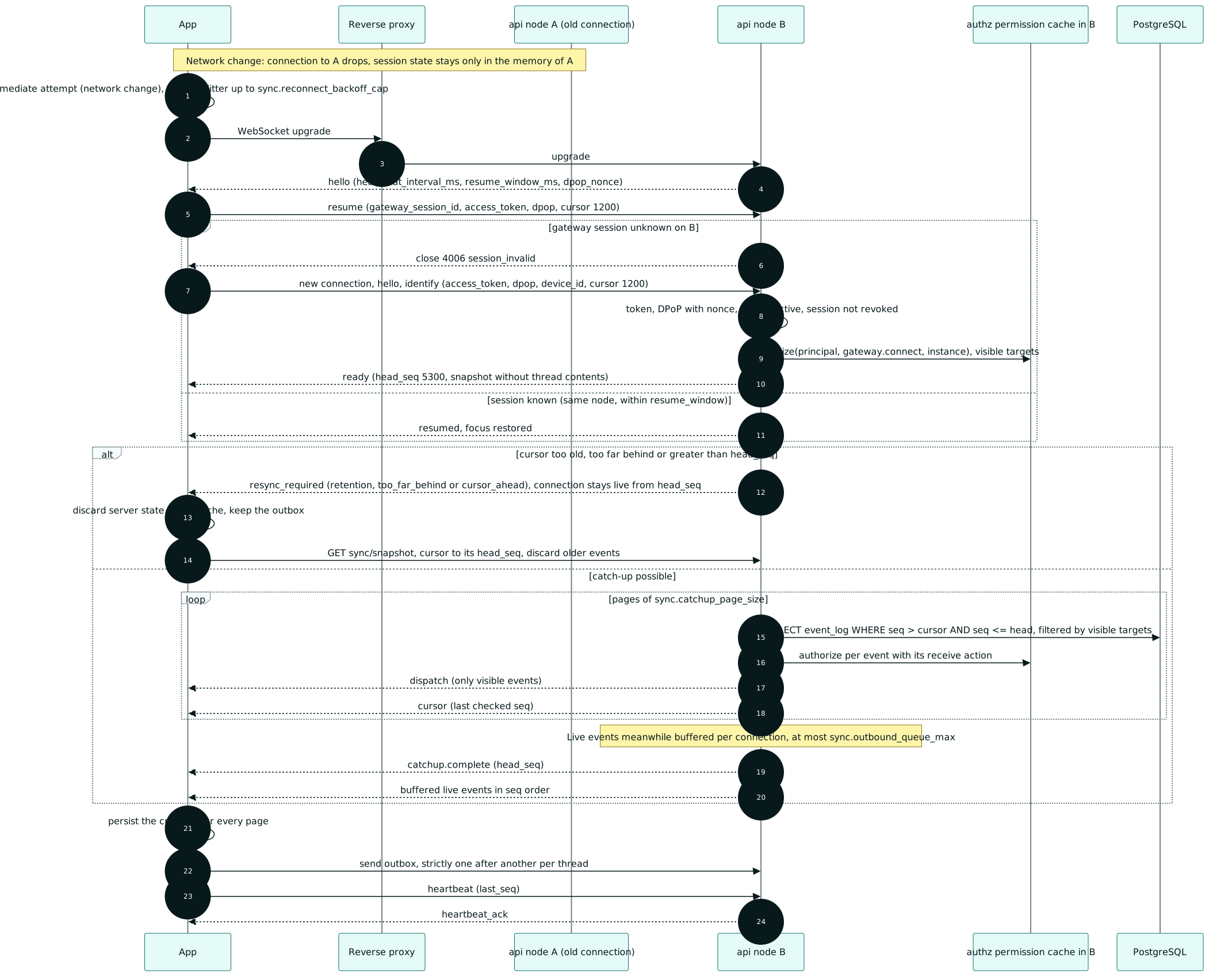
Agent connections are consumers with a durable cursor (agent_consumer_cursors, 04 section
15). The gateway hands personal invocation events (agent.invocation, agent.followup,
interaction.created, command.invoked) to runs.Delivery before sending. There, agent.invoke
with current permissions, I2 and the signing of the invocation token take place (04, 15.3). If the
check fails, runs sets the run to failed in a separate transaction and the gateway sends nothing.
The REST poll goes through the same engine and the same call; a refused event counts as checked and
next_cursor covers it, an event whose preparation failed with an error is not sent and comes
again with the next delivery (M2-08).
An agent consumer connection reads the log through its own runner, up to the hub position (the
highest seq the log tail of the process has passed), and is woken by the hub after each event
(M2-07).
The ops stats.subscribe and stats.unsubscribe (M6-15) are handled by the gateway on the port
stats.Live of the node: the subscription check (stats.live_enabled, stats.read on the
instance or the space, people only), one slot of at most stats.live_max_subscribers per node,
the subscription in the gateway session, which resume restores after the same check. The node's
builder hands each base frame to the gateway, which filters it per subscribed connection and offers
it to that connection only, after sync.Admit with stats.read (25, section 5).
11. Event path
Diagram: flow-event-path.svg.
11.1 Writing
As in section 8.1. pg_notify carries only the highest seq, never contents. PostgreSQL delivers
the notification only after the commit [Q1, verified].
11.2 Log tail per api process
- Exactly one reader per process (
sync.Tail) with its own, non-pooled connection forLISTEN event_log. It holdslocal_headand readsevent_log WHERE seq > local_head ORDER BY seq LIMIT sync.tail_batch_size. - The wake-up signal is
NOTIFY; in addition it reads everysync.log_poll_interval. If theLISTENconnection is lost, it reconnects with backoff up todatabase.listen_reconnect_backoff_capand reads fromlocal_head. Becauseseqis gapless, nothing is lost in the process. - It passes events in
seqorder to the permission cache and then to the hub, in one goroutine. Reason: order is only easy to guarantee when one reader produces it. - Third consumer (M2-44, D-M2-44-7): after the hub every event goes to the observer of the
terminal relay (
Relay.ObserveLogEvent, non-blocking). For aterminal_session.changedwhose payload hasstate = closedit closes the device stream (StreamCodeForEnd, theclose_reasonas close reason) and the data connection (4100), drops the slot without writing its counters and sendssession.closeto the host service. Every end of a session, from any module and any process (a worker or another node), commits a row ofevent_log, so it reaches the connections and the host service without an after-commit hook (txnhas none).
11.3 Permission cache
The cache lives in authz, per process, per principal, keyed by permission_version. The
log tail reports every access.changed through Authorizer.Observe before the hub distributes
later events (R-SY-02). Entries carry a validity until the earliest expiry of an involved
grant or membership and are recomputed afterwards. Structural changes
(channel.created, channel.updated with read-only, channel.archived, space.archived,
thread.moved) are also applied by the cache in log order; archiving additionally brings
a new permission version (04, section 8.1). Catch-up additionally filters by fully visible spaces, so that events
of new channels are not missing (04, section 7.2).
11.4 Hub and delivery
- The hub holds indexes: channel to connections, principal to connections, thread to focused connections.
- For every event it determines the candidates through the indexes and calls, per candidate,
authorize(recipient, receive_action, resource)from the cache. Only then does it put the frame into the queue of the connection. The hub never blocks on a connection. - Connections in catch-up buffer live events and send them after
catchup.complete(04, 7.2). - Agent consumer connections take no durable dispatch from the hub: each reads the log through its own runner up to the hub position and is woken by the hub after each event (M2-07).
11.5 Worker consumers (push, webhooks)
Outbound consequences arise in the worker from the log, not in the write path (R-AR-08):
- Per consumer name (
push,webhooks) there is one cursor row inevent_consumer_cursors(03, ADR 0051). - One round: open a transaction, lock the row with
FOR UPDATE SKIP LOCKED(if another worker is already running, the round ends at once), read up toconsumer.batch_sizeevents from the cursor, determine the recipients per event and insert River jobs withInsertTx, advance the cursor, commit. - The wake-up signal is the same
NOTIFY event_log; in addition everyconsumer.poll_interval. - Jobs check
push.deliverorwebhook_out.deliveragain before sending (05, R-AZ-11).
Reason against inserting jobs in the write path: the write path would have to know every
consequence; a new consumer would change every producer. The log already is the outbox. A round
creates jobs exactly once, because cursor and jobs commit in one transaction. webhook_deliveries
additionally has the unique key (subscription_id, event_seq) (03).
Rules of the frame (M2-01, DECISIONS.md D-M2-01-1 to D-M2-01-9):
- Start at the head. In the roles
workerandallthe start inserts, before the first round, the row of every registered consumer that has none, withlast_seq = max(seq)of the log. A new consumer therefore never replays retained events, like the first connection of an agent consumer (04, 15.1 item 2). No migration inserts rows; names that are not registered have no row. When two workers start together, one row wins. - Gaps. When the events from
last_seq + 1on are missing because retention detached their partition (the first number read equalsmin(seq)), the round processes frommin(seq)and writes the error lineevent consumer lost events to retention; the events cannot come back, and a webhook subscription detects its own gap (11, section 6). Any other gap is a bug (04, 3.2 items 3 and 4): the round rolls back, the cursor never passes the gap, the consumer stalls and the alarm reports it. - Failures. A handler error or panic, a database error and a gap roll back the whole round:
no job, no cursor move, the next attempt at the next wake or poll. No event is ever skipped.
The first failed round after a success writes
event consumer round failed, the next successevent consumer recovered. Consumers are independent; a stalled consumer holds back no other. - No durable events in a round. A handler that appends an event fails the round: the
consumer would read its own output, and the round would take the lock of the counter
event_seq(11.7). - One
LISTENconnection per process for all consumers, apart from the log tail's (application namebothy-consumer-wake), reconnected with a backoff fromconsumer.poll_intervalup todatabase.listen_reconnect_backoff_cap. After a full batch the next round starts at once. Every role exportsbothy.event.consumer.lagandbothy.event.consumer.pending_ageper consumer (signals.md 4.2); the alarmBothyEventConsumerLagfires atconsumer.pending_alert_after, which is strictly belowsync.event_retention(13, item 4).
11.6 Ephemeral events
| Event | Created in | One node | Several nodes (cluster.mode = multi) |
|---|---|---|---|
typing.started |
gateway (op typing.start) |
directly to the hub | additionally NOTIFY ephemeral with thread ID and principal ID |
run.updated |
runs (patch stored, transaction without event_log; the stall marking of runs.stall_check, also from a separate worker, M2-51) |
hub coalesces per sync.run_patch_coalesce_interval |
NOTIFY ephemeral with run ID and version; the other node loads the run document and sends run.updated with snapshot |
agent.presence_changed |
agents (heartbeat) |
directly to the hub | NOTIFY ephemeral with agent ID and state |
Replacement of a device connection (4017, 04 section 6.1) |
gateway (identify, resume) |
directly to the older connection | NOTIFY ephemeral with device ID and gateway session |
stats.live |
stats (builder of the node, one base frame per stats.live_interval) |
filtered per subscribed connection and offered to that one connection | built on every node from its own subscriptions and the shared tables; no cross-node path (rates come from stats_minutes, the member connections is left out, 25 section 5.2) |
notification.created |
notify (job notify.gateway_send) |
directly to the hub (role all) |
NOTIFY ephemeral with recipient, notification ID, kind code, quiet, count and the thread, message and target IDs; the node that holds a connection of the recipient sends the hint. A separate worker sends it this way in every cluster.mode (M7-17) |
Reason: R-Stack allows LISTEN/NOTIFY only as a wake-up signal without content. Run contents
therefore do not go through NOTIFY; the receiving node reads them from the database. A single
process of role all in mode single leaves the channel ephemeral out, because every NOTIFY
takes an instance-wide lock at commit [Q2, verified] and one process does not need it (03,
section 6.6); with separate roles the worker sends hints and the api nodes listen on it in
every mode, and the other signals need mode multi (D-M7-17-7). notification.created
takes the same path with IDs.
As built (M7-17, docs/decisions.d/M7-17.md D-M7-17-1 to D-M7-17-5):
- Payload. One JSON object per
NOTIFYwithkind(prefixgateway.:gateway.typing,gateway.run,gateway.agent_presence,gateway.device,gateway.consumer,gateway.hint),node(the process instance, a UUIDv7 new at every start) and exactly the members of its kind: IDs as canonical UUIDs, the run version, and lower-case codes of the 05 schemas (agent state, billing mode, hint kind), never a text. A receiver drops a malformed payload with one log record and ignores the signals of its own node; a signal that arrives late, twice or out of order changes nothing wrong, because the receiver reads state from the database or from its own memory. - One
LISTEN ephemeralconnection per process (componentephemeral_listener, application namebothy-ephemeral) with two routes, the gateway's and the terminal's; each ignores the kinds of the other. A process in roleapiholds it in everycluster.mode(a separateworkersends hints through it); roleallonly withmulti; roleworkernever. typing.startedis rebuilt on the receiving node with the place of the thread andexpires_at= now plussync.typing_ttl;run.updatedgoes into the coalescer of the receiving node, which sends the run document assnapshotat the end of its window.- Device replacement: every binding of a device's session to a connection gets a UUIDv7; the
node that holds an older binding of the device under another gateway session closes it with
4017. - Agent consumers: a takeover (identify or a new REST poll window) sends
gateway.consumer; the other nodes save the acknowledgement of their connections of that agent at once with the guarded statement of 03 and close with4015the ones whose row is gone; without the signal the next save does the same. command.autocomplete_requestedstays on its node: it carries an invocation token, which never goes throughNOTIFY, and the answer must reach the waiting request of the same process. When no connection of the owning agent is on the node of the request, the request ends at once with an empty result (R-AG-14, "never hangs"). An agent consumer holds one connection across all nodes (a second one closes the first with4015), so with several api nodes autocomplete answers only requests that reach the node of that connection; a design across nodes is open (D-M7-17-5).
Terminal signals (M2-47, D-M2-47-3, D-M2-47-4; 24-terminal.md, section 9). The
module terminal sends its own internal signals on the channel ephemeral: terminal.session_open
(host and session ID), terminal.host_close (host ID), terminal.host_present and
terminal.host_gone (host and connection ID) and terminal.session_paired (host and session ID).
They are no event types of 05, so the table above has no rows for them. With one node a use case
hands its signal to the local handler after the commit; with several nodes it stages
NOTIFY ephemeral in its transaction (presence and pairing go out in their own statement), and
every node, the sender included, receives it. The end of a terminal session goes through the log
tail (11.2), not through these signals. Since M7-17 the module terminal shares the one
LISTEN ephemeral connection of the process with the gateway; the namespaced kinds (prefix
terminal.) allow that.
11.7 Cost of serialization
All transactions with durable events serialize at the end on event_seq (04, 3.2).
The additional NOTIFY lock at commit falls into the same section and lengthens it
[derived from Q2 and 04]. Transactions without an event (run patches, heartbeat storage)
take neither a counter nor NOTIFY. The target perf.event_commit_min_per_s holds the throughput
(section 17).
12. Background jobs (River)
12.1 Usage
- River (MPL-2.0) only in
internal/platform/jobs; modules define job arguments and handlers against an interface of its own inplatform/jobs. Reason: River is 0.x; a breaking change then affects one package. - Tables in their own schema
jobs.schema; migration throughrivermigrateinbothy migrate[Q7, verified]. - Role
apiuses a pure insert client (withoutStart, without queues); it does not take part in leader election [Q5, verified]. Roleworkerruns jobs, periodic jobs and maintenance. - No Pro features (R-Stack). For flows with several steps, a job chains the next one
via
InsertTx. - Job arguments contain only IDs, never contents or secrets. Reason:
river_jobis another storage location; deletion and data protection stay with the domain tables. Enforced at registration: the argument type is a struct whose exported fields are onlykernel/ids.ID,[]kernel/ids.IDorint64(sequence numbers and versions), so a string, byte slice, map, interface, pointer or nested struct fails the start (jobs.ValidateArgsType, M1-14).
12.2 Queues
| Queue | Content | Concurrency |
|---|---|---|
default |
short domain jobs | jobs.queue.default.max_workers |
files |
scan, thumbnails, transcription (CPU, memory) | jobs.queue.files.max_workers |
delivery |
push, webhooks (network) | jobs.queue.delivery.max_workers |
maintenance |
cleanup, partitions, checks | jobs.queue.maintenance.max_workers |
privacy |
export and erasure | jobs.queue.privacy.max_workers |
Reason for separate queues: many thumbnails or a large GDPR export must not delay push
and webhooks. Imports do not run as a job in the server, but in the tool
bothy import through the API (22-import-migration.md, section 2).
The scan and processing jobs of imported files stand on the queue files with the lowest River
job priority, while every other job keeps the default (highest) priority: a worker fetches the
available jobs of a queue by priority first, so live uploads are never queued behind an import,
without a separate queue (12-files.md 11).
In maintenance mode (server.maintenance_mode = read_only,
ADR 0065) the worker processes only the consumers
push and webhooks (ADR 0051),
the queue delivery and the job runs.cancel_timeout; their transactions are exempt from the
read-only Unit of Work. All other queues and periodic jobs pause and only continue
after the restart without the mode, or, during a move, on the target from the copied state.
Reason: every other job would write state that would be missing on the target.
As built (M7-08): the job runtime fetches only from the queues delivery and maintenance,
registers no periodic job and runs the kinds of the queue delivery and runs.cancel_timeout
with txn.WithWriteInMaintenance; a job of another kind on the queue maintenance is held with
River's snooze for server.maintenance_retry_after without using an attempt (jobs.Maintenance).
The consumers run over a unit of work that is always exempt (txn.ExemptInMaintenance). Every
other unit of work of the process begins READ ONLY, and PostgreSQL's 25006 becomes 503
maintenance (pg.UnitConfig.ReadOnly).
12.3 Job catalogue
| Job | Module | Trigger | Queue | Domain rule in |
|---|---|---|---|---|
files.scan |
files |
InsertTx when an upload completes |
files |
12 |
files.thumbnail |
files |
after clean or skipped: image originals (12 7.1), thumbnails (12 7.3), dimensions and duration of MP4 and QuickTime |
files |
12 |
files.extract_text |
files |
after clean or skipped, purpose attachment, supported type (in the transaction that makes the file deliverable; M3-15) |
files |
14 |
files.extract_text_refresh |
files |
periodic every search.extract.refresh_interval and once at the start: re-extracts rows of older extractor versions in batches (M3-15) |
maintenance |
14 |
files.transcribe |
files |
file.transcribe with server transcription |
files |
09, 12 |
files.cleanup_pending |
files |
periodic every file.gc_interval and at worker start: expiry of open sessions, never attached files, failed and blocked rows, catch-up of purges, temporary files of the file system driver, deletion backlog (M3-08) |
maintenance |
12 |
files.purge_objects |
files |
InsertTx when a file is deleted or becomes failed or blocked; caught up by files.cleanup_pending (M3-08) |
maintenance |
12, 20 |
notify.push_send |
notify |
consumer push (one job per active registration of a hint), the flush notify.coalesce_flush and the badge sync notify.badge_sync; a retry inserts the same args with the next attempt (M3-19) |
delivery |
13 |
notify.gateway_send |
notify |
consumer push (gateway route of a hint) and the flush notify.coalesce_flush: one unique job per hint and recipient, which publishes notification.created after the commit (M3-23) |
delivery |
13 |
notify.coalesce_window |
notify |
consumer push or the flush notify.coalesce_flush: a send that opens a bundling window inserts it unique per (recipient, thread, window end), scheduled at the window end; its handler does nothing (13 4.5, M3-19) |
delivery |
13 |
notify.coalesce_flush |
notify |
consumer push: the first message hint collected in an open window inserts it unique, scheduled at the window end; it sends the unread count or nothing (13 4.5, M3-19) |
delivery |
13 |
notify.badge_sync |
notify |
consumer push: a read_state.updated that lowers the badge number inserts it unique per person and time, now or at the end of a pending notify.badge_sync_hold (13 8, M3-19) |
delivery |
13 |
notify.badge_sync_hold |
notify |
the job notify.badge_sync: inserted unique per person and end at now plus notify.badge_sync_min_interval; its handler does nothing (13 8, M3-19) |
delivery |
13 |
apps.webhook_deliver |
apps |
one attempt of a subscription (args: the subscription only, M2-26): a round of the consumer webhooks, the chain after a finished delivery, a scheduled retry, the lease wake-up after webhook.delivery_timeout, an owner resume or re-enable, webhook_out.redeliver and app.resume; jobs of one subscription serialize on its row lock |
delivery |
11 |
runs.cancel_timeout |
runs |
scheduled with InsertTx per run.cancel_requested that does not end the run at once, at now plus agent.cancel_grace (args: the run only): a run still queued, running or waiting_input then ends cancelled with cancel_timeout; an ended run is left as it is (M2-09, D-M2-09-17) |
maintenance |
09 |
runs.stall_check |
runs |
periodic, agent.presence_timeout: fails runs in running or waiting_input with interrupted or stale from the persisted heartbeat (09 section 5.5), never retried; agent_unavailable stays with runs.queued_expiry (M2-09, D-M2-09-19); sets stall_warned_at for runs in running without progress since run.stall_after (addendum of 2026-10-24, M2-51) |
maintenance |
09 |
runs.component_expiry |
runs |
scheduled with InsertTx per card message at its earliest expires_at (args: the message only), by the card's creation and by a reactivation through updateComponent; the handler sets the due active components expired with one message.updated and schedules itself again for the next expires_at; not periodic, because an interval of component.default_ttl would leave components active for up to a whole period, and correctness never depends on the job (M2-15) |
maintenance |
09 |
runs.app_dispatch |
runs |
InsertTx on command.invoked and interaction.created for an app (args, IDs only: event, app, invoker and the installation of an invoking app, channel, thread, command or interaction; M2-25): re-checks the invocation with the rights of that moment without an audit entry, then hands the event of an app with delivery.interactions_url to runs.AppDispatcher and sets the interaction state by the outcome; an app on the gateway way gets nothing from the job; River's default attempts only for faults before the request, after it the job always ends (09 section 1 point 5) |
default |
11 |
runs.invocation_hold_timeout |
runs |
scheduled, file.invocation_hold_max or voice.transcript_hold_max |
default |
04, 12 |
runs.queued_expiry |
runs |
scheduled with InsertTx in the transaction that creates the run, at queued_at plus run.queued_max_age (args: the run only): a run still queued then fails with agent_unavailable; a run not yet due (the key was raised) schedules the job again (M2-08) |
default |
09 |
authz.expiry_reminder |
authz |
periodic, access.expiring before expiry |
maintenance |
07 |
authz.expiry_sweep |
authz |
periodic, access.changed after expiry (system actions grant.expire, group.member.expire) |
maintenance |
07 |
identity.auth_cleanup |
identity |
periodic every auth.cleanup_interval: delete expired rows of auth_challenges, auth_login_flows and device_pairings; revoke pending devices after auth.device_pending_ttl, and paired devices that were never picked up and unused devices after auth.device_inactive_revoke_after (system action device.expire); the decision per request never depends on the job |
maintenance |
08, 20 |
instance.key_rotation |
instance |
periodic, states next to retired |
maintenance |
19 |
sync.partition_maintenance |
sync |
periodic every sync.partition_maintenance_interval and at the start of the worker: create sync.event_log_partitions_ahead partitions ahead of the head, detach after sync.event_retention, never the partition with the head (03 event_log); bothy migrate up calls the same routine |
maintenance |
03, 04 |
sync.idempotency_cleanup |
sync |
periodic every sync.idempotency_cleanup_interval, deletes expired rows in batches of sync.idempotency_cleanup_batch_size |
maintenance |
04 |
audit.chain_verify |
audit |
periodic every audit.checkpoint_interval: recompute the section since the last checkpoint, only then sign the next checkpoint, store it and deposit it at audit.checkpoint_sink; a break ends without a checkpoint and without a retry (never sign an unchecked chain) |
maintenance |
19 |
privacy.export, privacy.erase |
privacy |
approval of a privacy request | privacy |
20 |
billing.reconcile |
billing |
cost.reconcile (manual) and cost.reconcile.submit (reconciliation app): the request stores the reconciled entries; the job (args: the run IDs only) applies them to the totals on runs and sessions through the in-transaction event billing.CostsReconciled and reads its state again on every run, so a repeat has no second effect; never periodic, because the server fetches no billing data and holds no admin key (ADR 0055) |
default |
10 |
status.probe |
status |
periodic every status.check_interval and at the start of the worker (M7-09): keeps the standard components and one component per active agent, runs the checks of 16 12, sets the automatic states and opens and resolves the automatic incidents |
maintenance |
16 |
retention.<class> |
owning module | periodic every retention.job_interval per class security, content, transient, audit and cost (M7-05) and ops (M7-09: resolved incidents and backup runs, never the latest succeeded run of a kind): runs the participants of the kernel port retention of the class in the owning modules, batches of retention.batch_size rows per table in short transactions, at most retention.job_interval per run; retention.audit trims the audit log as the maintenance role bothy_maint with the anchor entry audit.retention_trim and destroys the IP keys (20 4.1, 4.5) |
maintenance |
20 |
stats.retention |
stats |
periodic every hour and at the start of the worker (M6-13, D-M6-13-6): create the daily partitions of stats_minutes for today and tomorrow (UTC), detach and drop partitions whose day ended before now - retention.stats_minutes (plain DETACH, bounded by database.lock_timeout); a flush that meets a day without a partition creates it itself; replaces the general retention.<class> for the class stats, because the table is partitioned |
maintenance |
25 |
terminal.sweep |
terminal |
periodic every terminal.sweep_interval and once at the start of the worker (roles worker and all); M2-46 (D-M2-46-8, D-M2-46-9): no actor (system); it reads every session that is not closed with the state of its host and ends each in its own unit of work (host row, then session row, the verdict decided again on the locked rows) through the one end function of the module (terminal.terminate) with the first match in this order: host not active (host_disabled, host_retired, host_rekeyed); login session revoked or past expires_at (session_revoked); opening past the last grant plus terminal.open_timeout (open_failed with open_timeout; the last grant is the UUIDv7 time of token_jti), except on a host reporting require_local_confirm; terminal.max_session_duration after opened_at (max_duration); terminal.detach_grace after detached_at (detach_expired); the latest of the stored last_input_at, started_at and opened_at plus terminal.idle_timeout plus terminal.idle_grace (idle_timeout). Fallback for the check in the relay, in case a node failed. An expired pairing code is not discarded: 03 hosts requires pairing_code_hash while state = 'pairing', so the code stays stored until the next code or the retirement and is rejected at redemption (pairing_expires_at, 24 3.2) |
maintenance |
24 |
The job files.transcribe is also inserted in the transaction that sends a voice message in the
effective mode service (12-files.md 8.2), and it runs at most
voice.transcription_max_attempts attempts (M3-09).
12.4 Rules for jobs
- Every job is repeatable without a double effect (check of the state before the effect, unique
keys such as
(subscription_id, event_seq)). - Every job passes its context on and returns
ctx.Err()on cancellation; anilcounts as success in River [Q4, verified]. - External calls have a deadline (
egress.timeoutor a name of its own in the domain chapter). - River handles retries with backoff; domain chapters with a rule of their own (webhooks:
webhook.retry_backoff_base,webhook.retry_backoff_cap) set their own retry rule. - Otherwise the defaults of the pinned River version apply for job deadline, fetch interval,
retry backoff and maximum number of attempts; the README of
platform/jobsnames them together with the version. A job with different needs sets a named value of its domain chapter. Reason: a name of its own without a need would be a second source for the same value. One River default is off: the nightly reindexer, becausebothy_appowns no index of River and the reindex could only fail (16 "Roles"; docs/DECISIONS.md M1-14). - SQL in jobs runs in the same Unit of Work as in the request path, that is with
database.statement_timeoutanddatabase.lock_timeout. A job splits long work into batches (rule 1). Migrations set onlymigrate.lock_timeoutper step (upgrade.md, rule M6).
13. Configuration loading
The basis is ADR 0011 (12-Factor, secret provider; operations team). This chapter defines how the server loads.
- Two kinds of values.
- Configuration (instance operator): addresses, limits, deadlines, drivers, secret references. Applies from start; a change needs a restart.
- Settings (owner):
instance_settingsandfeature_flagsin the database. Changed through the API with audit, effective immediately, eventinstance.updated. Reason for the separation: infrastructure belongs to the instance operator, domain matters to the owner, and only settings need a permission check.
- Sources, precedence from low to high: built-in defaults (in the schema,
internal/wire/configkeys_*.go, equal to the chapter table of the key) < file (--configorBOTHY_CONFIG_FILE, YAML, nested like the names) < environment (BOTHY_plus the name in upper case,.becomes__, examplesync.event_retentionbecomesBOTHY_SYNC__EVENT_RETENTION) < command line (only--roleand--config). The mapping is reversible (ADR 0011, 16-operations.md 5.1). - Secrets only as a reference in keys ending in
_ref(for exampledatabase.password_ref). The secret provider resolves them at start. Values never appear in logs, error texts orbothy config print(there only the reference appears; onlybothy config check --secretsresolves and names per keyokor the error code). The provider is created only ininternal/wireandcmd/bothy; modules get values through theirConfigor a narrow interface and read neither files nor the environment themselves. - Check at start, fail fast: unknown keys and unknown
BOTHY_variables abort (typos would otherwise be silent; exceptions in 16-operations.md 5.1); types and ranges; cross conditions. Cross conditions today:http.max_json_body_bytesstrictly greater thanmessage.max_content_bytes(the envelope of a message is small compared to the gap between the defaults; a value of its own for it would be a guess without a measurement);server.internal_listen_addrandserver.listen_addrshare no port other than0when their hosts are equal or one of the hosts is empty,0.0.0.0or::(also with an IPv6 zone; an IPv4-mapped IPv6 address counts as its IPv4 address). Port0may occur twice, because tests bind port 0.consumer.pending_alert_afteris strictly belowsync.event_retention(cross-checkconsumer_alert_below_retention, M2-01), so the alarmBothyEventConsumerLagfires while a stalled worker consumer can still catch up.webhook.retry_backoff_baseis at mostwebhook.retry_backoff_cap(cross-checkwebhook_backoff_order, M2-26), andwebhook.retry_max_ageis strictly belowsync.event_retention(cross-checkwebhook_retry_within_retention, M2-26), because a retry needs its event in the log.push.apns.team_id,push.apns.key_idandpush.apns.topicsare set together or not at all, withpush.apns.private_key_refset when they are, and no topic is empty or repeated (cross-checkpush_apns_complete, M3-20), because a partial APNs configuration would start without sending to Apple. Withfile.storage.driver = fs,file.fs.rootis an absolute path in clean form (no.or..element, no trailing/; cross-checkfile_fs_root_absolute, M3-01), because a relative root would depend on the working directory of the process; withs3the root is not read. Withfile.storage.driver = s3the cross-checkfile_s3(M3-02) holdsfile.s3.endpoint(set, an absolutehttporhttpsURL with a host and without user info, query, fragment or a path other than/),file.s3.bucket(set, S3 bucket naming rules),file.s3.region(set),file.s3.prefix(empty or the key grammar of 12-files.md 4.1),file.s3.use_path_style(true when the endpoint host is an IP address),file.s3.checksum_mode(when_supportedonly with anhttpsendpoint) andegress.allowed_hosts(anhttpendpoint needs an entry withallow_privatefor the request host and port, because the egress client allowshttponly there, 19-security.md SEC-NET-2); withfsnofile.s3.*value is read.file.gc_intervalis strictly belowprivacy.object_delete_delay(cross-checkobject_delete_delay_gc, M3-08), because the catch-up offiles.cleanup_pendingmust run at least once inside the delay. The entries ofsearch.languagesare unique, unqualified lower-case PostgreSQL identifiers and neversimple(checksearch_languages); every key ofsearch.locale_mapis a first language subtag in lower-case ASCII letters and every value is listed insearch.languagesor issimple(checksearch_locale_map, the start error of 14-search.md 3.1; M3-13).file.scan.clamd_addressisunix://followed by an absolute path in every scan mode (cross-checkclamd_address_unix, 19-security.md SEC-TLS-5, M3-04), and withfile.scan.mode = required,file.max_upload_bytesis at mostfile.scan.clamd_stream_max_bytes, the mirror of the clamd optionStreamMaxLength(cross-checkscan_stream_limit, 12-files.md 5.4, M3-04). A non-emptypush.fcm.project_idholds only lower-case letters, digits and hyphens and starts with a letter (cross-checkpush_fcm_project_id, 13-push-notifications.md 5.2, M3-21), because the value becomes a path segment of the FCM send URL; the message names the key. In addition the loader checks a rule for a single key that no type expresses:secrets.diris an absolute path in clean form (no.or.., no double or trailing/), not/, without a NUL character and without<, as the secret provider requires; a wrong value is a problem ofsecrets.diralone, not of the references that use<secrets.dir>. Likewiseserver.public_urland every entry ofapi.cors_allowed_originsare an origin (schemehttporhttps, host, optional port, no path, no query, no fragment; M1-18), because the chain builds the DPoPhtufrom this origin and comparesOriginexactly. The rule "identity headers only with a loopback listener" is not a configuration check, because the driver is a setting of the owner in the database; it applies at readiness (16-operations.md 4.3). Messages name the key and the source, never the value. - Typed per module. Every module and every platform package has its own
Configstruct in its own package;internal/wirefills it fromplatform/config(binding via struct tags). Modules never read environment variables. A key enters the schema with the ticket that builds its first user; until then the configuration reference lists it as "planned" with a milestone. Reason: testability, one place for checks and no key without an effect. - No reloading during operation except secret rotation (signing keys, webhook secrets), which the secret provider reports. Reason: predictable behavior; half-applied limits are harder to diagnose than a restart.
bothy config checkruns steps 2 to 4 without starting and writes, for every key*_refwhose effective reference usesenv:, a warning to standard error; with--secretsit also resolves every reference*_refthrough the secret provider (linesecret <key>: okorsecret <key>: <error code>, exit code 1 when one fails).push.fcm.service_account_refis resolved only whenpush.fcm.project_idis set (FCM enabled), because its default points at a file that an instance without FCM does not have (M3-21).bothy config printshows the effective values with the source per key.
14. Error and timeout strategy
14.1 Error kinds
kernel/errs knows these kinds. Every error carries a stable public code from the
closed list in 06-api.md, section 5; the kind follows from the code, never from the
caller. 06 defines type URIs and bodies according to RFC 9457 (ADR 0015). The gateway uses the
same codes in the op error.
| Kind | HTTP | Codes from 06 (examples) |
|---|---|---|
bad_request |
400 |
validation_failed, malformed_request, cursor_invalid |
unauthenticated |
401 |
unauthenticated, token_expired, invalid_dpop_proof |
step_up_required |
401 |
step_up_required |
forbidden |
403 |
forbidden, scope_missing, channel_read_only |
not_found |
404 |
not_found (also without read permission) |
method_not_allowed |
405 |
method_not_allowed |
conflict |
409 |
conflict, already_started, request_in_progress |
invariant_violation |
409 |
i1_violation, last_owner |
gone |
410 |
message_deleted, resync_required |
precondition_failed |
412 |
version_conflict |
too_large |
413 |
payload_too_large |
unsupported_media_type |
415 |
unsupported_media_type |
range_not_satisfiable |
416 |
range_not_satisfiable |
unprocessable |
422 |
idempotency_key_reuse |
precondition_required |
428 |
precondition_required |
rate_limited |
429 |
rate_limited with Retry-After |
internal |
500 |
internal_error |
unavailable |
503 |
unavailable, maintenance, always with Retry-After (http.unavailable_retry_after; maintenance with server.maintenance_retry_after, M7-08) |
Reasons for a denial (level_insufficient, capability_missing and so on, 07 section 4.1) are
not codes: they appear in the audit and, where 06 provides for it, in the extension reason; the
code is forbidden. Internal causes are identifiers for log and metric, never part of a response:
authz_not_checked, unknown_action (both 500 internal_error), db_pool_exhausted,
shutting_down, deadline_exceeded, dependency_unavailable (all 503 unavailable). Reason:
06 holds the closed set of public codes, and internal states do not belong in responses.
Internal details (SQL errors, stack) appear only in the log with correlation_id, never in the
response.
14.2 Deadlines
| Place | Deadline | Reason |
|---|---|---|
| reading headers | http.read_header_timeout |
protection against slow clients |
| normal request (context) | http.request_timeout |
limits waiting time and resources |
upload and download (via ResponseController) |
http.transfer_timeout |
large files |
| keep-alive idle | http.idle_timeout |
release connections |
| getting a connection from the pool | database.acquire_timeout |
overload becomes 503, not a queue |
| SQL statement | database.statement_timeout (per transaction via SET LOCAL) |
no query outlier blocks |
| search statement | search.statement_timeout (per unit of work of a search via SET LOCAL, option txn.StatementTimeout; 14-search.md 7) |
a search answers 503 unavailable with reason search_timeout instead of holding a connection |
| waiting for a lock | database.lock_timeout |
counter locks never unbounded |
| open transaction without work | database.idle_in_tx_timeout |
protects the serialized commit phase |
| WebSocket write | gateway.write_timeout |
slow readers do not block |
| outbound calls | egress.timeout (19-security.md) or a name of the domain chapter |
every network call has a deadline |
The context of an aborted client cancels the transaction. If it has already committed, idempotency covers the client's retry.
14.3 Retries
- In the request path: only the whole Unit of Work on
40P01and55P03(section 8.2). Afterdatabase.tx_retry_maxretries it ends with error kindunavailable(503 unavailablewithRetry-After); the database error appears only in the log. No retry of external calls in the request path (there are none there). - In jobs: River with backoff; domain chapters can set their own rules.
- Clients retry according to 04 (outbox, full jitter).
14.4 Failure of a dependency
| Dependency | Behavior | Kind |
|---|---|---|
| PostgreSQL | api reports not ready, requests 503; gateway keeps connections, delivers nothing; worker pauses; recovery without intervention |
fail closed |
LISTEN connection |
reconnect with backoff, polling bridges the gap; no loss (gapless seq) |
soft |
LISTEN ephemeral connection (terminal since M2-47, gateway since M7-17) |
reconnect at once, then every database.listen_reconnect_backoff_cap; after LISTEN succeeded again a reconciliation of the node's connections against the host states; ends of sessions still arrive through the log tail; gateway signals lost in the gap stay lost (at most once), the next flush of gateway_presence and the next save of a consumer restore presence and the consumer takeover, while a missed replacement of a device connection leaves both connections open until the next reconnect; no readiness check (24, section 9) |
soft |
| object storage | upload and download 503; messages without files continue |
partial |
| clamd | scan jobs retry; files stay pending and are not served |
fail closed |
| push services | jobs retry; message path unaffected | soft |
| webhook targets | retries up to the limit, then subscription disabled (03) |
soft |
| OTel Collector | discard data and count it; never block (R-Telemetrie) | fail open |
| identity provider | new login impossible; existing sessions continue | partial |
| secret provider | start aborts; rotation fails: the old value stays, alert | fail fast |
| transcription service | job retries, then transcript_status = failed |
soft |
14.5 Panics
Caught per request, per job and per connection: request 500, job as an error to River,
connection closed with 4000. A panic in the handler of a worker consumer becomes the error of
its round, which rolls back (11.5 item 7); a panic in the frame of the consumers itself ends the
process. A panic in the log tail or the hub ends the process with an error
code, because a process without fan-out would not be ready but would still hold connections. The
orchestrator restarts, clients resume according to 04.
15. Start and graceful shutdown
15.1 Start
- Load and check the configuration (section 13), start telemetry.
- Resolve secrets. The internal listener opens now, so that the orchestrator sees
/healthzand/readyzfails withstartupwhile the start is running. Every role also checks the key storesecrets.signing_key_dir(owned by the service user, mode0700, writable) and ends the start otherwise (ADR 0066, M1-32). - Reach the database, for at most
startup.dependency_waitwith backoff; then abort. - Check the schema version: the binary knows the smallest required version. If the database is
older, the start aborts with a pointer to
bothy migrate up(exit code1). Newer versions are allowed, because migrations are built by expand and contract (ADR 0007). River's migrations injobs.schemamust be complete as well; otherwise the start aborts with the same hint (checked in step 8 for every role, M1-14). Then the text search of the database (M3-13, 14-search.md 3.1): every configuration ofsearch.languagesandsearch.locale_map(plussimple) must exist on the search path, and the database must fold the case of non-ASCII letters (16-operations.md 7.2); otherwise the start aborts with exit code1before any public listener, and the message names the key and the entry, never the configured name. - Load the instance (if the row is missing: abort with a pointer to
bothy migrate up). Withoutsetup_completed_atthe server starts completely, but answers only health checks and discovery, everything else with503 setup_required(08, section 4); it checks the state per request until it is set, and needs no restart after setup./readyzdoes not depend on setup, otherwise an orchestrator would never open the way to redeeming the code. Ifinstance.min_server_versionrequires a newer version than its own, the process keeps running, but never becomes ready:/readyzfails withschema_requires_newer_server. The same holds for the start lock of R-DM-50 (16-operations.md 8.4, M7-04): unlessdatabase.restore_guardisoff, a database identity (pg_control_system().system_identifier,pg_control_checkpoint().timeline_id) that differs from the one stored ininstancekeeps every role not ready withrestore_not_finalizedand logs once thatbothy restore finalizemust run; the process then skips step 8 (no log tail, presence tracker, terminal reconcile, River, worker consumers or public listener), so it takes no writes and delivers nothing. An empty stored identity never blocks. - Ensure signing keys: every purpose without an
activekey gets one (19-security.md, section 10; ADR 0066). Keys whose private file is missing from the key store are retired first, so the purpose gets a fresh active key; when the key store holds the file of none of the unretired keys (a new or wrong volume, a restore without the key store), the start ends with an error instead, unlesssigning_key.accept_lost_keysis set (19-security.md, section 16). This runs after audit, sync, authz and identity (steps 6a to 6d ofinternal/wire), whose unit of work recordssigning_key.transition. - Register routes and check the route metadata: every operation has a known action, otherwise
abort (05, rule 3). Roles
apiandallwith one node (M2-44, D-M2-44-9): before the public listener opens, the terminal module ends every session inopeningwithopen_failedandopen_timeoutand sets everyactivesessiondetached, one unit of work per session in ascendingid, because the relay slots and connections lived only in the memory of the previous process. With several nodes (cluster.mode = multi, M2-47) this step does nothing. - Role
api: start the log tail, setlocal_headto the current head, open the public listener, then theLISTEN ephemeralconnection of the process (componentephemeral_listener, M7-17; roleallonly withcluster.mode = multi, 11.6). Roleworker: start River and the consumers. - Report ready.
Reason for aborting on a schema that is too old, but "not ready" on min_server_version: a binary
in front of a schema that is too old does not find its tables; continuing to run would be of no
use. A binary that is too old in front of a newer schema (going back across more than one version)
could run, but must not; as a process that is not ready it shows the reason on /readyz and does
not keep the orchestrator in a restart loop (R-AR-16).
15.2 Health
On the internal listener server.internal_listen_addr, not in the public API
(R-AR-13, Ruling L2); 16-operations.md, section 4.2 defines the paths and error codes:
/healthz(alive): the process answers. If the log tail, the hub (api) or the River client (worker) fails unexpectedly, the process exits with exit code1(section 14.5); that is why/healthzneeds no check of its own for this. The same holds for the runner of the worker consumers (worker, M2-01); a failing round is no such end (11.5 item 7)./readyz(ready): start completed (startup), database reachable (database), version matching the schema (schema_requires_newer_server), the database identity as stored or the restore finalized (restore_not_finalized, 16 8.4), one active signing key per purpose (signing_keys), no shutdown started (shutting_down). The domain chapters bring further checks (for exampletrusted_header_requires_loopback, 16 section 4.3). Response format: 16, section 4.2.
Reason for the separate listener: health needs no login and no action, but must not be publicly reachable. That is why health has no entry in the action catalogue (05, R-AZ-22).
15.3 Shutdown
The signals SIGTERM and SIGINT start it, a second signal ends immediately (exit code 3).
Total deadline shutdown.total_timeout; each step runs at most with its own budget and
the rest of the total deadline. During wiring, the sum of the step budgets
(shutdown.drain_delay, shutdown.http_grace, shutdown.jobs_soft_timeout,
shutdown.telemetry_flush_timeout) must not exceed shutdown.total_timeout, otherwise the
start aborts (exit code 2). The orchestrator must wait longer: Compose sets stop_grace_period
greater than shutdown.total_timeout (infra/compose/compose.yaml,
a test holds it).
Role api:
- Set
readyto false, waitshutdown.drain_delayso that the proxy sends no new requests. http.Server.Shutdownwithshutdown.http_grace: close listeners, finish running requests.Shutdowndoes not close hijacked connections such as WebSockets [Q9, verified]; therefore:- Gateway: store
acked_seqof all agent consumers immediately; close all connections with4013 server_restart(04, 6.4; clients reconnect with a random delay). Control connections of host services (24 3.5, M2-43): the sessions of each host turndetached, then the connection closes with4013; the host service reconnects after a random delay belowhost_service.reconnect_backoff_baseand keeps its PTYs untilterminal.detach_grace. The relay of the terminal (M2-44) closes every device stream and data connection with4013. Store the presence state of the agents, without an event. (Stop stepagent_presencein the phase of the connections, after the gateway's step, so no gateway heartbeat arrives later: it stops the deadline timers and flushes every unsaved heartbeat within the rest ofshutdown.total_timeout; a restart of the server is not an agent going offline.) - Stop the log tail and
LISTEN. - Flush telemetry, at most
shutdown.telemetry_flush_timeout. - Write the own measurement once (stop step
stats_flush, 25 3.4, M6-13) within the rest ofshutdown.total_timeout; keys that do not make it are counted as dropped. Then close the pool.
Role worker:
- Set
readyto false. - Consumers finish their round (commit or rollback) and start no new one. The step has no
own budget, only the rest of
shutdown.total_timeout; after it the round is cancelled and rolls back. - River: soft stop with
SoftStopTimeoutequal toshutdown.jobs_soft_timeout, after that the job contexts are canceled [Q3, Q4, verified]; canceled jobs return an error and are retried. - Flush telemetry, write the own measurement once (
stats_flush), close the pool.
Role all: api steps 1 to 4, then worker steps 2 and 3, then telemetry and pool. Reason:
first accept no new requests and events, then finish running jobs.
16. Scaling path
| Level | Setup | Trigger (measurable) | What changes |
|---|---|---|---|
| 0 | one process --role=all, PostgreSQL and object storage alongside |
default | nothing |
| 1 | api and worker separate, one database | jobs violate perf.message_create_p99, or the memory use of the jobs disturbs the api process |
only the role per container. The worker reads the live connections from gateway_presence and sends hints and the run.updated of the stall marking to the api nodes over NOTIFY ephemeral (13 12 point 4, M7-17, M2-51) |
| 2 | several api nodes behind the proxy | a node reaches perf.ws_connections_per_node or its CPU limit; rolling updates without downtime |
cluster.mode = multi: channel ephemeral, fencing of the agent consumers, rate limits per node, migrations strictly by expand and contract |
| 3 | several workers | the job backlog grows permanently (metric in 17) | nothing in the code: River distributes, consumers lock with SKIP LOCKED, periodic jobs via the River leader |
| 4 | read replica for catch-up, search, statistics | CPU of the database | read paths choose the connection; head_seq and pages from the same source; writes and invocation delivery stay on the primary |
| 5 | split off a module | criteria below | new role or separate service |
Multiple nodes in detail (level 2):
- Event log: every node has its log tail; the
NOTIFYwakes all of them. Nothing else needed. - Gateway session:
resumeon another node becomesidentify(section 10). - Agent consumers: a new
identifyon node B must end the old connection on node A (4015). When taking over, node B writes its gateway session ID into the cursor row; node A detects at the next save ofacked_seqthat the row no longer belongs to it, and closes with4015(fencing viaagent_consumer_cursors.holder_session_id, 03). A signal viaNOTIFY ephemeralspeeds this up. Until then, the event ID and the run start by compare-and-swap prevent duplicate work (04, 15.3). - Rate limits: buckets in the process. With
nnodes, up tontimes the value applies; the instance operator divides the values or sets affinity at the proxy. Reason: no shared counter service. - Presence and typing: via
NOTIFY ephemeral(section 11.6). - Presence for notifications (M7-17, R-DM-51): every process in role
api(and roleallwithmulti) writes its counted live connections intogateway_presenceeverycluster.presence_flush_interval(an upsert of all of them with a freshupdated_at, the delete of ended ones and of the rows of any node older thancluster.presence_ttl) and deletes its rows on an orderly shutdown; the push decision of theworker(and of roleallwithmulti) reads the table, ignoring rows older thancluster.presence_ttl. A failed write is logged and counted (bothy.gateway.presence.write_failures) and never blocks a connection. - Device connections: a newer
identifyorresumeof a device on any node closes the older connection with4017(section 11.6). - Signing keys: every node uses one key store
secrets.signing_key_dir(a shared volume or a writable driver per target, ADR 0066, 16 5.2); a key rotated on one node is used by every node withinsigning_key.cache_ttl. - Proxy: no sticky sessions for REST and the gateway; only the two stream paths of a terminal session are routed by a hash over the session ID (16 4.4).
- Terminal: 24-terminal.md, section 9 (M2-47).
A module is split off only when all three conditions hold:
- It has a need for resources or failure isolation that a separate role of the same binary does not solve.
- It shares no write transaction with other modules; it talks only via ports and the event log.
- A measurement from section 17 or 17-observability proves the need.
Candidates are the file processing of files (first as a separate role) and importer. Not
candidates are chat, messaging, runs, authz, sync, because they share transactions. The
limit of the pattern is the global counter event_seq: if perf.event_commit_min_per_s is not
enough, a new decision is needed (for example sequences per space) with its own ADR.
17. Performance targets
Targets are named values (section 22). A test in make perf holds every target; until it exists,
the target is "unchecked" (tickets). ADR 0063 governs when and on which environment measurements take place.
| Name | What is measured | Test |
|---|---|---|
perf.reference_profile |
environment in which the targets apply | all load tests run on it |
perf.message_create_p99 |
server time of message.create (without attachment) under perf.sustained_messages_per_s |
perf/load_messages |
perf.event_commit_min_per_s |
durable events per second with the counter pattern | perf/event_commit |
perf.fanout_local_p99 |
commit to dispatch at a connected client, same node |
perf/gateway_fanout |
perf.fanout_cross_node_p99 |
the same across two api nodes | perf/gateway_fanout_multi |
perf.invocation_delivery_p99 |
commit of the triggering message (from the occurred_at of its transaction, upper bound) to the receipt of agent.invocation with invocation token at the fake adapter (09-agents.md section 16.1), under perf.sustained_messages_per_s with a share of triggering messages (perf/README.md) |
perf/invocation |
perf.run_patch_fanout_p99 |
run.update of the fake adapter (09-agents.md section 16.1) to the first run.updated with this version at every focused client (a coalesced frame from an older base_version to a newer version counts for every version it covers), under perf.sustained_messages_per_s |
perf/run_patch |
perf.catchup_page_p99 |
one catch-up page (sync.catchup_page_size) including authorize per event |
perf/catchup |
perf.authorize_cached_p99 |
authorize from the warm cache |
benchmark BenchmarkAuthorizeCached |
perf.ws_connections_per_node |
concurrent connections of one api node with heartbeats | perf/ws_soak |
perf.ws_idle_conn_mem_max |
memory per idle connection | perf/ws_soak |
perf.idle_rss_max |
memory of an all process without load |
perf/startup |
perf.startup_ready_max |
start to ready without migrations |
perf/startup |
perf.push_handoff_p95 |
commit to handoff to the push service (fake); measured from occurred_at of the transaction of a message that mentions the recipient (an upper bound of the commit, 13 section 9 t0) to the 200 of Fake-APNs (t1), for mention hints under perf.sustained_messages_per_s, with the server in the test process (perf/README.md) |
perf/push_handoff |
The performance targets of the search (search.p95_target, search.prefix_p95_target) stand in
14 section 7; perf/search holds them in the same make perf.
18. Modules and chapters 06 to 23
| Chapter | Content | Modules |
|---|---|---|
| 06-api.md | conventions, endpoints, ops, code generation | all httpapi adapters, gateway, api/ |
| 07-permissions.md | grant model, authorize, filters, revocation |
authz, permission cache in gateway and sync |
| 08-identity.md | providers, devices, tokens, step-up, setup | identity |
| 09-agents.md | adapter contract, runs, components, commands, sessions | agents, runs, parts of chat |
| 10-backend-policy.md | I1 to I6, switching, costs | agents, authz (I1, I6), runs (I2, I3), billing, terminal (I6) |
| 11-extensions.md | apps, manifest, webhooks, SDK | apps |
| 12-files.md | upload, storage, scan, preview | files |
| 13-push-notifications.md | notification, push | notify |
| 14-search.md | full-text search | search, search vectors in messaging, chat, files |
| 15-client-architecture.md | apps, local database, sync engine | counterpart of gateway, sync |
| 16-operations.md | installation, configuration, backup | platform/config, platform/lifecycle, status |
| 17-observability.md | telemetry, SLOs, dashboards | platform/otel, stats (delimitation) |
| 18-release.md | versions, images, signatures | cmd/bothy, build |
| 19-security.md | threat model, hardening | audit, instance (keys), all adapters |
| 20-privacy.md | GDPR, retention, deletion | privacy, kernel/personaldata, retention jobs |
| 21-dev-isolation.md | multi-user dev environment | chat (project binding), runs (check ready) |
| 22-import-migration.md | Discord import | importer |
| 23-quality.md | gates, tests, tools | section 7, load tests from section 17 |
| 24-terminal.md | hosts, host service, Noise stream, I6, terminal sessions | terminal; host service services/host outside the server |
| 25-visualization.md | own measurement, live frame, visualizations, Grafana plugin | stats, kernel/measure; plugin plugins/grafana-bothy-live outside the server |
19. Decisions of this chapter
| No. | Decision | Reason |
|---|---|---|
| R-AR-01 | One binary bothy with subcommands; roles via --role. |
The baseline names the binary bothy; B1 describes the server role. One image for all roles. |
| R-AR-02 | Modules gateway and search without tables of their own; stats with exactly one table (stats_minutes). |
Their own ports, dependencies and performance targets; otherwise they would bloat sync, messaging or runs. The own measurement needs a store that belongs to no domain module (Ruling T7). |
| R-AR-03 | The port is the root package with its own DTOs. | The domain stays changeable internally; a later process boundary without rebuilding the callers. |
| R-AR-04 | Module dependencies form a graph without cycles; the reverse direction only via source ports or in-tx events. | Separability and comprehensibility; Go forbids import cycles anyway. |
| R-AR-05 | Cross-cutting ports in internal/kernel. |
Every module needs authorize, events, audit, Unit of Work; as module edges they would create cycles. |
| R-AR-06 | Ambient transaction in the context, Unit of Work with fixed phases before the commit. | Enforces the lock order from 03 centrally; modules cannot get it wrong. |
| R-AR-07 | No external calls in transactions. | Short serialized commit phase, safe retry. |
| R-AR-08 | Outbound effects via worker consumers with a cursor, not via job inserts in the write path. | Producers do not know the consumers; the log already is the outbox. |
| R-AR-09 | River only in platform/jobs, own schema, no Pro features. |
0.x dependency in one place; the domain schema stays free of foreign tables. |
| R-AR-10 | Ephemeral events across nodes only as an ID signal (NOTIFY ephemeral), only in mode multi. |
R-Stack: NOTIFY without content; every NOTIFY costs an instance-wide lock at commit. |
| R-AR-11 | Gateway sessions only in the process; another node answers resume with 4006. |
No shared session store; identify with a cursor delivers the same catch-up. |
| R-AR-12 | Rate limits in the process, per node when there are several nodes. | No further service; limits are protection, not billing. |
| R-AR-13 | Health on the internal listener outside the public API; metrics only via OTLP, no metrics endpoint (ADR 0034). | Usable without login for the orchestrator, but not public; no action in the catalogue needed. |
| R-AR-14 | Proof per request that authorize ran with the action of the route. |
Holds B7 at runtime, not only in the spec. |
| R-AR-15 | Separation of configuration (instance operator, restart) and settings (owner, database, immediate); unknown keys abort the start. | Clear responsibility; typos show up immediately. |
| R-AR-16 | Migrations only via bothy migrate, never implicitly at start; the server checks the schema version. |
No concurrent migration by several nodes, no restart loop. |
| R-AR-17 | Shutdown closes WebSockets with 4013 and saves the agent cursors before that. |
http.Server.Shutdown does not cover hijacked connections; clients resume in an orderly way. |
| R-AR-18 | In the request path, only a retry of the whole Unit of Work on deadlock and lock timeout. | Other retries belong in jobs or clients. |
| R-AR-19 | Architecture gate with go-arch-lint, configuration generated from modules.yaml (ADR 0050). |
One source for module boundaries; the tool checks packages and third-party libraries. |
| R-AR-20 | Performance targets as named values, held by load tests in make perf (ADR 0063). |
No number without a test. |
20. Alignment with the core contract
The items that this chapter had requested as additions while it was drafted are now in the core contract (integration of 2026-10-10):
| Item | Where |
|---|---|
table event_consumer_cursors for the worker consumers |
03, section 4.10; ADR 0051 |
| River tables as technical tables | 03, section 4.13 |
fencing of the agent consumers (holder_session_id) |
03 agent_consumer_cursors; 04, section 15.1 |
| catch-up with fully visible spaces; the cache follows structure events | 04, sections 7.2 and 8.1 |
expiry produces access.changed via authz.expiry_sweep |
04, section 8.2; 05 grant.expire, group.member.expire |
moving a thread: copies of channel_id, files follow the message |
03 threads; 05, section 2.2 |
path prefix /api/v1 |
04, header and section 6.1 |
| machine-readable action catalogue | docs/spec/actions.yaml (ADR 0049), checked by make catalog-check (05, rule 3) |
| health without an action, on the internal listener | 05, R-AZ-22; section 15.2 |
modules gateway, search without tables; stats with stats_minutes |
03, sections 2 and 4.15 |
agent.read for the agent itself |
05, section 4.10 |
| unique live box anchor | 03 messages, partial index on run_id |
channel ephemeral in mode multi |
03, section 6.6; 04, section 12 |
21. Open
- Tool for Go types from AsyncAPI 3.0: decided by 06-api.md; until then handwritten types with a contract test against the schemas.
- Whether
PollOnlyis needed for River under load (River's own NOTIFY load) is shown byperf/event_commit. The option exists [Q3, verified].
22. Configuration values of this chapter
Defaults. Performance targets (perf.*, place Load test) are thresholds for tests, not
runtime configuration: they have no environment name, are not in the configuration schema of the
server, and make perf reads them from this table (ADR 0063).
Listeners, role, public URL, trusted proxies and the connection data of the database
(server.*, database.host to database.max_conns) are listed in 16-operations.md;
the limits of outbound calls (egress.*) are listed in 19-security.md.
| Name | Place | Default | Meaning |
|---|---|---|---|
cluster.mode |
Server | single |
single or multi (several api nodes) |
cluster.presence_flush_interval |
Server | 2s |
interval at which a process writes the presence of its live connections into gateway_presence (M7-17) |
cluster.presence_ttl |
Server | 10s |
age after which a row of gateway_presence is ignored and deleted; more than twice cluster.presence_flush_interval |
http.read_header_timeout |
Server | 5s |
deadline for headers |
http.request_timeout |
Server | 15s |
context deadline of normal requests |
http.transfer_timeout |
Server | 10m |
deadline for upload and download |
http.idle_timeout |
Server | 120s |
idle time of keep-alive connections |
http.max_header_bytes |
Server | 65536 |
largest headers |
http.max_json_body_bytes |
Server | 1048576 |
largest JSON body; strictly greater than message.max_content_bytes (13, item 4) |
http.max_json_depth |
Server | 32 |
largest nesting depth of a JSON body (SEC-IN-2); a test holds that every request example in openapi.yaml stays below it |
http.unavailable_retry_after |
Server | 5s |
Retry-After of every 503 unavailable response (in whole seconds) |
database.acquire_timeout |
Server | 2s |
waiting for a pool connection |
database.statement_timeout |
Server | 5s |
deadline per SQL statement |
database.lock_timeout |
Server | 2s |
deadline for locks |
database.idle_in_tx_timeout |
Server | 10s |
open transaction without work |
database.tx_retry_max |
Server | 2 |
retries of the Unit of Work on 40P01 and 55P03 |
database.listen_reconnect_backoff_cap |
Server | 10s |
largest interval when re-establishing LISTEN |
startup.dependency_wait |
Server | 60s |
waiting for the database at start |
sync.log_poll_interval |
Server | 1s |
poll of the log tail without NOTIFY |
sync.tail_batch_size |
Server | 1000 |
events per read of the log tail |
sync.partition_maintenance_interval |
Server | 10m |
interval of the job sync.partition_maintenance |
sync.event_log_partitions_ahead |
Server | 3 |
partitions of event_log that are ready ahead of the head; with sync.event_log_partition_size they last longer than two intervals sync.partition_maintenance_interval at perf.event_commit_min_per_s |
gateway.write_timeout |
Server | 10s |
deadline for one WebSocket write |
consumer.batch_size |
Server | 500 |
events per round of a worker consumer |
consumer.poll_interval |
Server | 1s |
poll of a worker consumer without NOTIFY |
consumer.pending_alert_after |
Server | 15m |
age of the oldest unprocessed event of a worker consumer that raises the alarm BothyEventConsumerLag; strictly below sync.event_retention (13, item 4) |
sync.idempotency_cleanup_interval |
Server | 1h |
interval of the job sync.idempotency_cleanup |
sync.idempotency_cleanup_batch_size |
Server | 1000 |
rows per deletion batch of sync.idempotency_cleanup |
ratelimit.max_tracked_keys |
Server | 100000 |
a process holds at most this many rate-limit buckets; beyond that, full buckets are removed first, then the oldest buckets |
ratelimit.sweep_interval |
Server | 1m |
interval at which full buckets are removed (a full bucket decides like a missing one) |
jobs.schema |
Server | jobs |
PostgreSQL schema of the River tables |
jobs.queue.default.max_workers |
Server | 8 |
parallelism default |
jobs.queue.files.max_workers |
Server | 2 |
parallelism files |
jobs.queue.delivery.max_workers |
Server | 16 |
parallelism delivery |
jobs.queue.maintenance.max_workers |
Server | 2 |
parallelism maintenance |
jobs.queue.privacy.max_workers |
Server | 1 |
parallelism privacy |
shutdown.drain_delay |
Server | 5s |
waiting after ready = false |
shutdown.http_grace |
Server | 20s |
deadline for running HTTP requests |
shutdown.jobs_soft_timeout |
Server | 20s |
soft stop of River |
shutdown.telemetry_flush_timeout |
Server | 5s |
flushing telemetry |
shutdown.total_timeout |
Server | 60s |
total deadline until the end; at least the sum of the step budgets (15.3) |
perf.reference_profile |
Load test | 4 vCPU, 8 GiB RAM, SSD, PostgreSQL 18 local with fsync and synchronous_commit on, role all |
environment of the load tests; measurement modes in ADR 0063 |
perf.sustained_messages_per_s |
Load test | 200 |
sustained load for perf.message_create_p99, perf.invocation_delivery_p99 and perf.run_patch_fanout_p99; also the load of perf.push_handoff_p95 |
perf.message_create_p99 |
Load test | 150ms |
target |
perf.event_commit_min_per_s |
Load test | 1000 |
target (minimum) |
perf.fanout_local_p99 |
Load test | 200ms |
target |
perf.fanout_cross_node_p99 |
Load test | 500ms |
target |
perf.invocation_delivery_p99 |
Load test | 500ms |
target |
perf.run_patch_fanout_p99 |
Load test | 500ms |
target |
perf.catchup_page_p99 |
Load test | 250ms |
target |
perf.authorize_cached_p99 |
Load test | 100us |
target |
perf.ws_connections_per_node |
Load test | 5000 |
target (minimum) |
perf.ws_idle_conn_mem_max |
Load test | 64KiB |
target (maximum) |
perf.idle_rss_max |
Load test | 256MiB |
target (maximum) |
perf.startup_ready_max |
Load test | 5s |
target (maximum) |
perf.push_handoff_p95 |
Load test | 2s |
target |
Sources
All retrieved on 2026-10-10.
- [Q1] PostgreSQL, NOTIFY: https://www.postgresql.org/docs/current/sql-notify.html. Delivery only after the commit, payload limit. [verified]
- [Q2] Recall.ai, "Postgres LISTEN/NOTIFY does not scale": https://recall.ai/blog/postgres-listen-notify-does-not-scale. A transaction with NOTIFY takes an instance-wide lock at commit. [verified]
- [Q3] River,
client.go(fieldsPollOnly,SoftStopTimeout,FetchPollInterval): https://github.com/riverqueue/river/blob/master/client.go. [verified] - [Q4] River, Graceful Shutdown: https://riverqueue.com/docs/graceful-shutdown. Soft and hard stop; jobs must return an error on cancellation. [verified]
- [Q5] River, Insert-only clients and
InsertTx: https://riverqueue.com/docs/insert-only-clients and https://riverqueue.com/docs. [verified] - [Q6] River, migrations of the pgx driver: https://github.com/riverqueue/river/tree/master/riverdriver/riverpgxv5/migration/main (main branch). [verified]
- [Q7] River,
rivermigrate: https://pkg.go.dev/github.com/riverqueue/river/rivermigrate (v0.49.0). [verified] - [Q8] go-arch-lint, syntax: https://github.com/fe3dback/go-arch-lint/blob/master/docs/syntax/README.md; version v1.19.0 of 2026-09-07 according to https://proxy.golang.org/github.com/fe3dback/go-arch-lint/@latest. [verified]
- [Q9] Go,
http.Server.Shutdown: https://pkg.go.dev/net/http#Server.Shutdown (read in the source code of go1.27.2). [verified] - [Q10] Go,
http.Request.Pattern: https://pkg.go.dev/net/http#Request (read in the source code of go1.27.2). [verified] - [Q11] oapi-codegen runtime,
StrictHTTPMiddlewareFunc(f, operationID): https://pkg.go.dev/github.com/oapi-codegen/runtime/strictmiddleware/nethttp (v1.7.0). [verified]