24 Terminal
Status: draft M0, addendum of 2026-10-10. Normative for the module terminal, the host service
bothy-host, the terminal view of the apps and of the web console and for every check that allows
a terminal session.
Terms: 00-glossary.md. Tables: 03-data-model.md
(hosts, host_session_users, terminal_sessions, grants). Events: 04-sync-protocol.md.
Actions: 05-actions.md, section 4.14. Permissions and guard rules:
07-permissions.md (SR10, SR11, SR12). Step-up: 08-identity.md,
section 6.3. Invariant I6: 10-backend-policy.md, section 3.
Threats: ../security/threat-model.md, section 6.7.
Decisions: ADR 0068,
ADR 0070.
All limits, deadlines and intervals are named configuration values. Their default values are only in section 17.
1. Purpose and limits
The terminal is a mandatory part of the product. An authorized person opens a real terminal session on a connected host in the desktop app, in the mobile app or in the web console: a login shell or an interactive session of a coding agent (for example Claude Code).
Security is built in and cannot be switched off:
- Only people with the capability
terminalon the host open a terminal, and only with their own session user there (section 2.2). Owners have the permission implicitly, unless I6 blocks it (section 7). - Every opening requires a fresh step-up that applies to exactly this opening (section 8).
- The content runs end-to-end encrypted between device and host; the server mediates and decides, but reads nothing (section 5).
- Every session is in the audit log, with idle timeout and maximum duration (sections 10 and 12).
- On the host, the host service and the sessions run as separate users without administrator permissions. Every person has their own session user on every host, which no other person ever gets (ruling T12), and no location with code, settings or logins is writable for one session user and readable for another (ruling T13). The sessions cannot reach the keys of the host and cannot replace the PTY helper (section 2.2).
Not in this version: file transfer and clipboard over the channel, recording of content, shared sessions of several people, terminal for agents or apps, taking over a thread of the runner into the terminal (section 11.3).
Anti-goals: a way around the permission model; terminal content in the server, in telemetry, in the audit, in search, in push or in the context of an agent; a way to use the personal subscription of another person via the terminal.
2. Building blocks
2.1 Overview
| Building block | Place | Task |
|---|---|---|
Module terminal |
Server, role api |
Hosts, pairing, sessions, terminal session tokens, relay of the streams |
Host service bothy-host |
connected host (macOS, Linux, Windows; also a dev VM from 21-dev-isolation.md), service user | Keys, control connection to the server, Noise peer, self-check |
PTY helper bothy-host pty-helper |
the same host, one helper per session user, running as that user; started by the service manager of the operating system from a binary that no session user can change | PTY per session of its person, profiles, checks in the account of the sessions (HD6, HD8, HD9, HD11); knows no keys |
| Terminal view | Desktop app, mobile app, web console | Rendering, input, Noise peer, key pinning |
Package packages/bothy_noise |
Dart | Noise handshake NK, checked against public test vectors (5.2) |
flowchart LR
    C["Device of the person<br/>Terminal view"] -- "WSS /terminal/sessions/{id}/stream<br/>Noise frames" --> P["Edge<br/>Proxy with hash routing"]
    P --> S["Server<br/>Module terminal, relay"]
    H["Host service bothy-host<br/>Service user, keys"] -- "WSS /hosts/connect (control)<br/>WSS /hosts/sessions/{id}/stream (data)" --> P
    H -- "local channel per helper<br/>Plaintext frames" --> X["PTY helper per person<br/>Own session user"]
    X --> PTY["PTY: shell or<br/>coding agent"]
2.2 Host service bothy-host
- Its own small Go binary in the folder
services/host, not the server (Ruling L1 applies to the server). Its own version and its own release channel (18-release.md). - Operating system users, all without administrator privileges, each as a service of the
operating system (launchd, systemd or Windows service; 16-operations.md,
section 4.4):
- the service user
bothy-host: owns the state directory with the keys (4.2), holds control and data connections and speaks Noise; - one session user per person from
host_service.session_users: the PTY helper of this person runs under it, and with it each of their shells and each of their coding agents. No session user has read permission on the state directory.
- the service user
- A separate local channel (Unix socket or named pipe) connects the service user and each PTY helper; its access permissions admit only these two users. Over the channel run only the decrypted frames from 5.4, control commands (start session, end session, size) and the results of the checks that the helper runs (plus the identities of its working directories for HD7, item 6), never the keys of the host. Reason: A shell runs with all permissions of its user. If it ran as the service user, any person with a terminal could copy the keys, log in from elsewhere as the host and read along in every later session, including those of owners.
-
One session user per person and host, never shared (Ruling T12):
- The server holds, per host, the assignment of person to session user (
host_session_users, 03-data-model.md). The owner creates it at the confirmation (3.2) or later withhost.manage(step-up, reason, audit); whoever may read the host (host.read) sees the valid assignments. Without a valid assignment a person gets no terminal on the host, not even an owner (SR12 in 07-permissions.md;403 terminal_deniedwithreason: no_session_user). - A person has at most one valid assignment per host. A session user belongs to at most
one person, also over time: When an assignment ends, its name stays taken for this
host, and no other person gets it (
409 conflictwithreason: session_user_taken). After the end of their assignment, a person gets a new session user, never a used one. -
The terminal session token names the session user (
osu, 5.3). The host service starts the PTY only in the helper of this user and only if the user is listed inhost_service.session_users. It records in the state directory to which person (sub) it first gave each session user, and rejects a token with a different person for the same session user (session_user_mismatch). This way the host keeps the rule even if the assignment in the server is wrong. If this file is lost (new state directory), it learns the bindings anew; the assignment in the server stays valid.bothy-host session-user removetakes a session user out ofhost_service.session_usersandhost_service.claude_workdirs, removes its PTY helper, closes its home for all other users (item 4) and restarts the host service (16-operations.md, section 4.4); its binding stays in the state directory, andbothy-host session-user addrejects a name that is already bound to a person there.Limit, honestly: "Never shared, also over time" applies per host entry (
hosts.id) and per state directory. If a host is retired and paired as a new entry, its earlier names are free again in the server; if the state directory is lost, the host service no longer knows the earlier bindings. A session user with the credentials of an earlier person can then be assigned to another person without the server or the host service noticing [derived]. In these cases only the instance operator protects against this: they never reassign a previously used name, but create a new one withbothy-host session-user add, take the old one out withbothy-host session-user removeand then delete it together with its long-running processes (16-operations.md, section 4.4 item 1; threat model T-TM-08 and T-TM-11). -
The home folders of the session users are closed against each other. The home of a session user is a location of this session user (item 6) and gives no other user read or execute permission; HD11 checks this, and a violation blocks only this session user, with its name. The home folders of all other users of the host, including that of the service user and that of a former session user, cannot be listed by any session user (HD9). That is why
bothy-host session-user removecloses the home of the user it takes out (item 3). A long-running process of this user (6.5) can reopen it afterwards; that is why the instance operator deletes the user afterremove("Reason for HD9" below the table of checks). "All other users" in HD9 meansroot, the service user, every former session user and every person account of the platform; other system accounts (Linux belowUID_MIN, macOS below 501,nobody) are skipped (D-M2-42-6). -
The host service reports the names from
host_service.session_userswhen redeeming the pairing code (host.pair) and with everyreport(hosts.reported_session_users, only names and the display names of the working directories according to HD7, never paths). It reads its configuration, includinghost_service.session_usersandhost_service.claude_workdirs, only at start; a change takes effect only after a restart.bothy-host session-user addandremoverestart it themselves for this; every other change of the configuration (for example working directories, profiles,host_service.claude_bin) takes effect afterbothy-host restart(16-operations.md, section 4.4). Every restart ends the running sessions of the host (6.2). After every login of the control connection it sendsreportbefore it accepts asession.open, and the server sendssession.openonly after thisreport. The server assigns only a reported name (otherwise400 validation_failedwitherrors[].code = session_user_not_on_host), and an assignment takes effect for SR12 only as long as the host reports its name. Reason: A typo or a user not yet created should be noticed at the assignment, not only at opening as the tampering warning4104(R-TM-16). A name must equal a reported name exactly, also in upper and lower case, because the host service comparesosuexactly withhost_service.session_users; uniqueness per host, in contrast, ignores case (03,host_session_users; docs/DECISIONS.md D-M2-39-9).Server values and declaration on the host (M2-45, D-M2-45-2, D-M2-45-3): the server values the host service applies come with the
helloof every data connection:clock_leeway_ms(auth.clock_leeway),idle_timeout_ms(terminal.idle_timeout) anddetach_grace_ms(terminal.detach_grace). The host service uses those of the data connection that carries a handshake: the leeway for the checks ofexpandjti(5.3), idle and detach for the timers of that session (6.2, 6.3); every attach refreshes them. Ahellowith a negative leeway or without a positive idle or detach value closes that data connection with4002. The declaration comes only fromready(D-M2-42-15); the server sendsreadyagain after a committed change of the declaration, the host service stores it, evaluates HD6 again and sendsreport; a running session keeps its profile and environment, and new openings and attaches use the new offer. -
No shared locations (Ruling T13): On the host there is no location that one session user can write and another can read or execute, if it carries code, settings or logins. For the locations that the host service knows, this means:
- Locations of a session user are its home, the
CLAUDE_CONFIG_DIRof the profileclaude(withorganizationa fixed folder in its home, withpersonalthe value from its login shell, which must lie in its home; 7.4) and its working directories.host_service.claude_workdirsnames the working directories per session user; each working directory belongs to exactly one session user. If a folder is listed there for two session users, HD7 removes it from both lists. The profileclaudeoffers a person only the working directories of their own session user, namely exactly its list after HD7 that the host service reports (item 5); the index of the terminal session token (5.3) counts in this list. These locations belong to their session user or to a trusted owner (below) and are accessible only to that session user (mode0700or an ACL without an entry for other session users). - Every folder on the path to a location of a session user is writable by no other
session user and belongs to no other. Others may read and traverse
these folders (for example
/home), but not the location itself. - In each of these folders, the entries that the coding agent or git load from the folders
above a working directory belong to no other session user and are writable by no other.
These chain files are
CLAUDE.md,CLAUDE.local.md,AGENTS.md,.mcp.jsonand the folders.claudeand.gitwith everything in them. - No entry in a location of a session user belongs to another session user.
- Locations for all are the programs: the binary of the helper,
host_service.claude_bin(withorganizationalso the program of the profileclaude, 11.1) and the program of every profilecommand. They and every folder on the path to them belong to a trusted owner and are writable by no session user (the same rule as HD10). Reason: Such a program runs in every session user. Another account as owner is not enough, even if it is not a session user, for example the account of a person with administrator privileges who owns a folder of a package manager: Whoever gets into this account changes a program of all people, and HD11 cannot check who that is [derived]. - Trusted owner is, under Linux and macOS,
root, under WindowsSYSTEM,AdministratorsorNT SERVICE\TrustedInstaller. Reason for Windows: OnlyTrustedInstallermay change the protected files and folders of the system ("Permission for full access to modify WRP-protected resources is restricted to TrustedInstaller", https://learn.microsoft.com/en-us/windows/win32/wfp/protected-file-list, retrieved 2026-10-11 [verified]), and Microsoft names files with "TrustedInstaller as its owner" and the accountNT SERVICE\TrustedInstaller(https://learn.microsoft.com/en-us/archive/blogs/irenak/sysk-277-how-to-bring-back-the-trustedinstaller, retrieved 2026-10-11 [verified]). ThatC:\Program FilesandC:\Windows\System32, with default permissions, belong to this account andC:\to it or toSYSTEMis [assumed: reports from users]; M2-42 measures it. All three accounts have full permissions on the host anyway; trusting them adds no party [derived]. - Writable means, for a file: changing content, attributes, permissions or ownership, or
deleting it; for a folder additionally: creating, deleting or renaming an entry.
Under Linux and macOS the permission
wfrom the mode counts, under Linux also from the ACL, for the session user, one of its groups or all others. Under macOS these permissions from the ACL of an entry for the session user, one of its groups oreveryonecount as well: for fileswrite("Open for writing") andappend("Open for writing, but in a fashion that only allows writes into areas of the file not previously written"), for foldersadd_file,add_subdirectoryanddelete_child, for bothdelete,writeattr,writeextattr,writesecurityandchown(chmod(1) of macOS, reproduced at https://ss64.com/mac/chmod.html, retrieved 2026-10-11 [verified]). Under Windows every permission counts that the ACL gives the session user or a group in its token (includingEveryone,Authenticated UsersandUsers): for foldersFILE_ADD_FILE("For a directory, the right to create a file in the directory"),FILE_ADD_SUBDIRECTORY("the right to create a subdirectory") andFILE_DELETE_CHILD, for filesFILE_WRITE_DATAandFILE_APPEND_DATA, for bothFILE_WRITE_ATTRIBUTES,FILE_WRITE_EA,DELETE,WRITE_DACandWRITE_OWNER(https://learn.microsoft.com/en-us/windows/win32/fileio/file-access-rights-constants, retrieved 2026-10-11 [verified]);GENERIC_WRITEandGENERIC_ALLcount with the permissions they include. An entry that is only passed on by inheritance (IO) does not count for the folder itself. Reason: Whoever can create entries in a folder creates a chain file there or a folder with the name of a location; whoever can append to a file extends, for example, aCLAUDE.mdwith their own instructions; whoever can change permissions or ownership gives themselves any other permission [derived]. Attributes and extended attributes count as well: None of the sources says which of them are without effect for loading and starting, and one permission too many in the list only blocks, one too few opens a location [derived]. - Path resolution: HD7, HD10 and HD11 fully resolve every path before the check,
under Linux and macOS like
realpath("an absolute pathname that resolves to the same directory entry, whose resolution does not involve '.', '..', or symbolic links", https://pubs.opengroup.org/onlinepubs/9799919799/functions/realpath.html, retrieved 2026-10-11 [verified]), under Windows withGetFinalPathNameByHandle("A final path is the path that is returned when a path is fully resolved", https://learn.microsoft.com/en-us/windows/win32/api/fileapi/nf-fileapi-getfinalpathnamebyhandlew, retrieved 2026-10-11 [verified]). HD10 and HD11 then check every folder of the resolved chain, every component of the path as it is written in the configuration, and every link (symbolic link, under Windows also directory junction) that the resolution follows, together with the folder in which it lies. A link counts both as an entry of its folder and as its target: A link owned byrooton the path to a location of B that points into a folder of A does not pass. The same applies to a chain file that is a link, and to links in.claudeand.git. Only whoever may open the path can resolve it: The locations of a session user (home,CLAUDE_CONFIG_DIR, working directories) are resolved by its PTY helper as this session user, because they are accessible only to that user (above), with mode0700not even to the service user [derived]; the locations for all are resolved by the service user. If a path cannot be resolved because it is missing, a link points nowhere or a folder on the path is closed to the resolving user (for example the home of another session user), it counts as not present: A working directory drops out of the list of its session user, a profilecommandwith this program is dropped (HD7, warning);host_service.claude_bincounts as empty for HD6 and the profileclaude, and aCLAUDE_CONFIG_DIRwithpersonalcounts like one outside the home (7.4); if the home itself cannot be resolved, HD11 does not pass for this session user. Reason: What is not resolved is not checked. A working directory or program that is never offered connects no accounts; blocking the whole session user because of a missing folder would be more than necessary. Treating a link that points nowhere as present would be dangerous: Someone else can create its target later [derived]. HD7 compares folders by their identity in the file system, not by their spelling: under Linux and macOS device and inode ("A file identity is uniquely determined by the combination of st_dev and st_ino", https://pubs.opengroup.org/onlinepubs/9799919799/basedefs/sys_stat.h.html, retrieved 2026-10-11 [verified]), under Windows the serial number of the volume and the 128-bit file ID fromFILE_ID_INFO("The file identifier and the volume serial number uniquely identify a file on a single computer", https://learn.microsoft.com/en-us/windows/win32/api/winbase/ns-winbase-file_id_info, retrieved 2026-10-11 [verified]), queried withGetFileInformationByHandleExandFileIdInfo(available from Windows 8: "This value is not supported before Windows 8", https://learn.microsoft.com/en-us/windows/win32/api/minwinbase/ne-minwinbase-file_info_by_handle_class, retrieved 2026-10-11 [verified]). The 64-bit file ID fromBY_HANDLE_FILE_INFORMATIONis not enough: "The 64-bit identifier in this structure is not guaranteed to be unique on ReFS" (https://learn.microsoft.com/en-us/windows/win32/api/fileapi/ns-fileapi-by_handle_file_information, retrieved 2026-10-11 [verified]). Every PTY helper reports to the host service over the local channel, per working directory of its list, only this identity, never any content; the host service compares the values of all helpers and builds the lists according to HD7 from them at start. This way HD7 detects the same folder also behind a link or in a different upper and lower case. The PTY helper starts the profileclaudein the resolved working directory, and HD6 and the profile callhost_service.claude_binvia the resolved path, that is, exactly what HD10 and HD11 checked. Reason: A check of only the given path without resolution would let through a link that belongs to a trusted owner and points into a folder of another person [derived]. - Drive root under Windows: The root of a drive lies on the path to every location
on it. With default permissions every logged-in user may create folders there: The
DISA checklist for Windows 11 names for
C:\the entriesNT AUTHORITY\Authenticated Users:(AD)("Create folders / append data - This folder only") andNT AUTHORITY\Authenticated Users:(OI)(CI)(IO)(M)("Modify - Subfolders and files only") (https://www.stigaview.com/products/win11/v2r3/WN11-00-000095/, retrieved 2026-10-11 [verified]). A person could thus createC:\.gitorC:\.claude, that is, chain files above every location; Git for Windows describes the same pattern: "Those untrusted parties could create the folderC:\.git" (https://github.com/git-for-windows/git/security/advisories/GHSA-vw2c-22j4-2fh2, retrieved 2026-10-11 [verified]). That is whybothy-host install, after confirmation by the instance operator, removes the entry(AD)at the root of the system drive and of every drive on which a location lies (16-operations.md, section 4.4). The entry applies only to the root itself. For this the command rewrites the DACL of exactly this folder, with all other entries in the same order and with the same control bits, and it does so withSetFileSecurityW("Note that security applied to a directory is not inherited by its children", https://learn.microsoft.com/en-us/windows/win32/api/securitybaseapi/nf-securitybaseapi-setfilesecurityw, retrieved 2026-10-11 [verified]), never withSetNamedSecurityInfoorSetSecurityInfo. These two reapply inheritance to everything below on every setting of a DACL ("If you are setting the discretionary access control list (DACL) [...] the system automatically propagates any inheritable access control entries (ACEs) to existing child objects", https://learn.microsoft.com/en-us/windows/win32/api/aclapi/nf-aclapi-setnamedsecurityinfow; "the system imposes the current inheritance model on the ACLs of all objects in the hierarchy below the target object", https://learn.microsoft.com/en-us/windows/win32/secauthz/automatic-propagation-of-inheritable-aces; both retrieved 2026-10-11 [verified]), at the root therefore to the whole drive;SetNamedSecurityInfoin doing so orders inherited entries behind the explicit ones in the folders below (source forSetNamedSecurityInfoabove [verified]). Microsoft callsSetFileSecurityWobsolete ("This function is obsolete", source forSetFileSecurityWabove [verified]); it is chosen anyway because its documentation is the only one of those named that says explicitly that nothing goes to the children. Because the inheritable entries of the root stay the same, no permission changes below [derived]. The command leaves the entry(OI)(CI)(IO)(M)in place: It gives no permission on the root itself, and by the rules of inheritance its removal would take from every existing folder below its inherited copy ("If you remove an inheritable ACE from a parent object, automatic inheritance removes any copies of the ACE that were inherited by child objects", source on automatic inheritance above [verified]); existing programs would thus lose their write permissions. Folders that inherit this entry are writable for every session user; HD11 finds them when they lie on the path to a location. If the root of a drive with a checked location is writable for a session user, HD11 reports its own codedrive_root_writablefor it, so that the instance operator finds the step from 16 section 4.4; the local output ofbothy-host doctornames the drive, only the code goes to the server. For a drive on which a location is added only later,bothy-host install --drive-root <drive>performs only this step. The consequence is the same as for every violation at these locations; at the root of the system drive this always means "Start refused", because the binary of the helper lies there, that is, a location for all.
HD11 checks this with one rule for every configured path instead of regulating every location separately; HD10 additionally checks peer and interpreter for the helper and
host_service.claude_bin. The four terms above (trusted owner, writable, path resolution, drive root) apply equally to this item and to HD7, HD10 and HD11. People exchange shared code via git, never via a shared folder (threat model T-TM-13). - Locations of a session user are its home, the
Reason: The credentials of a session user (files in the home, keychain, a token in its startup files) thus belong to exactly one person. A subscription login that someone creates in their session reaches no session of another person as long as no location connects the accounts again (item 6). This is the load-bearing enforcement of "no other person's subscription login" (7.4); HD6 is only an additional check. A shared session user would make every login usable for all terminal users of the host, and a check in the account of this user could be forged or bypassed with its own permissions.
Reason for T13: Separate accounts help only if no location connects them again. A shared working directory was such a location. Claude Code reads the project settings
.claude/settings.jsonand.claude/settings.local.jsonof the working directory; settings files carry among other things "permissions,hooks, and credential helpers such asapiKeyHelper", "The reload covers user, project, local, and managed settings", and "mostenvvalues apply only after each teammate trusts the folder" (https://code.claude.com/docs/en/settings, retrieved 2026-10-11 [verified]). In addition: "CLAUDE.md and CLAUDE.local.md files in the directory hierarchy above the working directory are loaded at launch" (https://code.claude.com/docs/en/memory, retrieved 2026-10-11 [verified]). If person A writes there, their hooks and theirapiKeyHelperrun as the session user of B, their instructions steer B's agents, and after the trust prompt they also set environment variables such asCLAUDE_CODE_OAUTH_TOKENin B's session [derived]. This is code execution across the boundary between people and a second path for logins of other people. A sharedCLAUDE_CONFIG_DIRwould be the same location for logins: A/loginin it would reach all people. Instead of closing each such find separately, one rule with one check for all paths applies.Reason for the chain files: What the coding agent loads from the folders above the working directory acts like a location of B, even if the folder itself belongs to nobody else. Besides
CLAUDE.mdandCLAUDE.local.md, Claude Code loads, without such files, "everyAGENTS.mdand.claude/AGENTS.mdin your working directory and the directories above it" (https://code.claude.com/docs/en/memory, retrieved 2026-10-11 [verified]). If it starts in a subfolder of a git repository, it reads.claude/settings.local.json"at the repository root" (https://code.claude.com/docs/en/settings, retrieved 2026-10-11 [verified]);.mcp.jsonlies "in project root" (https://code.claude.com/docs/en/mcp, retrieved 2026-10-11 [verified]), and that root can lie above the working directory [derived]. git also searches for its repository in the folders above; the documentation names "directories that Git should not chdir up into while looking for a repository directory" (https://git-scm.com/docs/git, retrieved 2026-10-11 [verified]). Hooks of such a repository would then run in the session of B [derived]. A rule for all entries of these folders would not work:/homeholds the home folders of the other session users, and they belong to them.Limit, honestly: HD11 checks the locations that the configuration names and the home of every session user, not every folder of the host. The
CLAUDE_CONFIG_DIRwithpersonal, which the login shell of the holder sets, is covered by the home only because the PTY helper starts the profileclaudeonly with a value in the home (7.4). Generally writable folders such as/tmpare, according to T13, no location for code, settings or logins; a program that loads from there anyway is not covered by HD11 [derived]. If a person in their shell changes by themselves into a folder outside these locations that another session user can write, and starts the coding agent there, HD11 does not see that; according to T13 the instance operator does not set up such folders (16-operations.md, section 4.4). Under Windows this also covers every folder that an administrator creates directly in the root of a drive, as long as it carries the inherited entryAuthenticated Users:(OI)(CI)(IO)(M)(item 6). The chain files are the names that the cited sources name on 2026-10-11; if a later version of the coding agent loads further files from the folder chain, HD11 checks them only once the list is extended. If a session user opens its own locations for others, HD11 sees that at the next check, and not at all if it closes them again before. An entry that another session user creates there in this time is found by HD11 only at the next start of the service or call ofbothy-host doctor, because only this check goes through every entry of a location. What the other user writes into an already existing file that is writable for it, HD11 does not detect at all from ownership or mode. After a hit the instance operator checks the location (16-operations.md, section 4.4).Consequence, honestly: If a chain file that belongs to a session user A or that A can write lies in a folder on the path to the locations of several session users (for example the root of a drive or a shared parent folder of the working directories), HD11 does not pass for any other of these session users. A person can thus shut down the host for the others. A can create such an entry only as long as the folder is writable for A; HD11 itself reports that as a violation at each of these locations, and under Windows
bothy-host installcloses the root (item 6). What remains is an entry from the time before, for example aC:\.gitthat A created before the installation. The standstill ends when the instance operator removes the entry (16-operations.md, section 4.4; threat model T-TM-14). - The server holds, per host, the assignment of person to session user (
-
Every PTY helper runs as its session user, but that user does not control it. Otherwise a shell could end the helper, put its own in its place, forge the results of HD6, HD8, HD9 and HD11 and read the plaintext of every later session. Therefore:
bothy-host install(once with administrator privileges, 16-operations.md, section 4.4) creates, per session user, a helper as a system service that runs under this session user: systemd system service withUser=and socket activation, launchd LaunchDaemon withUserNameandSockets, Windows service with the account of the session user. Binary, service definition and the folder with the endpoint of the channel belong to a trusted owner (2.2 item 6) and are writable by no session user; the session user cannot stop or reconfigure the service (HD10).- Under Linux and macOS the service manager creates the endpoint of the channel and passes it to the helper; a process of the session user cannot recreate it. Under Windows the helper creates the named pipe.
bothy-hostchecks the peer twice when connecting: the user via the process credentials that the operating system supplies, and the process ID equal to the process ID that the service manager reports for the helper service of this session user. If either does not match, it sends no frame and reports HD10 as not passed, with the name of this session user (rule for names below the table of checks).- The helper protects its memory against other processes of the same user: under Linux
PR_SET_DUMPABLE = 0, under macOS Hardened Runtime withoutget-task-allow, under Windows a process DACL without access permissions for the session user. Verified for Linux: A process of the same user may attach only to a process that is "dumpable" (https://www.kernel.org/doc/html/latest/admin-guide/LSM/Yama.html, retrieved 2026-10-10 [verified]); for macOS and Windows [assumed], the build ticket proves it with TM-T26.
Limit, honestly: Processes of a session user reach the shells of the same user ID, for example via the PTY device that belongs to this session user [derived]. All sessions of one person on a host therefore share one trust zone; sessions of different people are separated by the user ID (T12). This separation is not a complete boundary between people (shared kernel, local gaps of the operating system; ADR 0046). That is why SR10 still applies, and the app warns an owner who opens a terminal on the host of another person (8.4; threat model T-TM-12).
-
bothy-host doctorchecks before every start and on command (full run); HD6 and HD11 run additionally before every start of a PTY and everyhost_service.credential_check_interval(7.4), HD11 here without the check of the entries:
| Check | Passes if | Consequence of a violation |
|---|---|---|
| HD1 Users | host_service.session_users names at least one user; no user of the host service is root, Administrator or SYSTEM; all session users are different, and none is the service user |
Start refused |
| HD2 Groups | no user of the host service (service user and every session user) is in a forbidden group: fixed admin, sudo, wheel, Administrators, docker, lxd, libvirt, disk, plus host_service.extra_forbidden_groups; under Linux, in addition, the socket of the Docker daemon is writable for none of them |
Start refused |
| HD3 sudo | no passwordless sudo for any of them (sudo -n true fails) |
Start refused |
| HD4 State directory | host_service.state_dir belongs to the service user, mode 0700; key file 0600 (Windows: DPAPI, section 4.2) |
Start refused |
| HD5 Server host | detects whether the same host runs the server (section 2.3) | Warning; sessions only for owners (SR10) |
| HD6 LLM login | section 7.4, in the account of every session user; additional check, not the load-bearing boundary (T12) | with none or organization and a detected subscription login: start refused or sessions ended, respectively (7.4); the message names every affected session user with its own entry |
| HD7 Profiles | every profile refers to an existing program, profiles command with an absolute path, the profile claude with organization to host_service.claude_bin (empty or counting as empty according to 7.4: the profile is dropped, 11.1); every key in host_service.claude_workdirs is a name from host_service.session_users, the PTY helper of its session user can resolve every working directory, and each is listed for exactly one session user, compared after resolution and by the identity in the file system that each helper reports for its list (2.2 item 6) |
Profile is dropped, warning; with host_service.claude_workdirs only the wrong part is dropped: a key that is not a name from host_service.session_users, with its list; a folder that the helper of its session user cannot resolve, from that user's list; a folder with two session users, from both lists. The lists after this step are reported and used for wdi (2.2 items 5 and 6) |
| HD8 Separation | the service user itself checks ownership, mode and ACL of host_service.state_dir and the key file (no entry for a session user or one of its groups); in addition every PTY helper tries at start to read both, and fails |
Start refused |
| HD9 Other users' home folders | every PTY helper tries at start to list the content of every home folder of another local user that the operating system keeps and that is not a session user (including that of the service user and that of a former session user), and fails for each; the home of a session user is checked by HD11 as its location (2.2 item 4). Accounts checked (D-M2-42-6): root, the service user, every former session user and every person account (Linux: a UID from UID_MIN to UID_MAX of /etc/login.defs; macOS: a UniqueID of at least 501; Windows: every account with a profile under ProfileList); all other system accounts are skipped, because their homes are system folders every user may list by design |
Start refused; the local output of bothy-host doctor names every user whose home can be listed; of these, the message to the server names only former session users, each with its own entry, otherwise only the code (below the table) |
| HD10 Helper integrity | the service user checks: the binary of the helper, every service definition, every folder of a channel endpoint and, if set, host_service.claude_bin (the program for HD6 and, with organization, of the profile claude, 7.4; under Windows an .exe) with every folder on the path to it and, if the file begins with #!, the interpreter that the fixed search list from 7.4 finds, and every folder of this search list, belong after resolution to a trusted owner and are writable by no session user (both per platform according to 2.2 item 6); the peer of every channel is the process that the service manager reports for the helper of this session user; under Linux kernel.yama.ptrace_scope is at least 1 |
Start refused; on a violation during operation as with HD6 (7.4): no new sessions, running ones end with host_policy_violation and close_detail = helper_untrusted; with a wrong peer the message names the session user of this channel (below the table) |
| HD11 Shared locations | one rule for every path from the configuration of the host service (working directories, host_service.claude_bin and programs of the profiles, plus the binary of the helper; the state directory is checked by HD4 and HD8) and every location of a session user (2.2 item 6; the CLAUDE_CONFIG_DIR with personal is covered by the home, 7.4); every path after resolution, "writable" and "trusted owner" per platform according to 2.2 item 6; a writable drive root under Windows with the code drive_root_writable. Location of a session user: ownership, mode, ACL and groups of the location, of every folder on the path to it and of the chain files in these folders give no other session user write permission and belong to no other; the location itself also gives other session users no read or execute permission; its PTY helper checks this. Location for all: the location and every folder on the path to it belong to a trusted owner and are writable by no session user (like HD10); the service user checks this. At the start of the service and on command, in addition, the check of the entries: no entry in a location of a session user belongs to another session user; it runs per session user in its PTY helper, limited by host_service.entry_scan_timeout (below the table) |
Violation at a location of a session user: this user gets no sessions, running ones end with host_policy_violation and close_detail = shared_location, until HD11 passes for it; the message names it. Violation at a location for all: start refused; during operation no new sessions, and all running ones end with host_policy_violation and close_detail = shared_location, until HD11 passes; the message names no session user. A finding of the check of the entries stands until a later full run no longer finds it (below the table) |
Check of the entries (HD11): It goes through every entry of every location of a session user,
that is, through its whole home, and therefore runs per session user in its own PTY helper.
At the start of the service each session user waits only for its own run: Until this run
is finished, HD11 does not pass for it (code entry_scan_running), and it gets no
sessions: An opening fails as with a finding, with open_failed and
close_detail = shared_location, and the console shows the code from reported_doctor. The
others get their sessions as soon as their own run is finished. On command the check runs
alongside operation, and until it ends the previous result applies. If a run is not finished after
host_service.entry_scan_timeout, the helper aborts it; HD11 then does not pass for
this session user (code entry_scan_timeout, with its name), with the same consequence
as with a finding. A finding, including an abort, is cleared only by a later full run that
finishes and finds nothing anymore, that is, a start of the service or bothy-host doctor. The
runs before every PTY and every host_service.credential_check_interval do not check the entries
and never clear such a finding. Reason: The duration depends on the size of the home, and a
large home should hold up only its own session user, not the host. An
aborted run has not seen every entry, and only this check sees whether a
found entry is still there.
Reason for the deny list in HD2: Some groups give root-level permissions without being called
administrator. Docker writes: "The docker group grants root-level privileges to the user."
(https://docs.docker.com/engine/install/linux-postinstall/, retrieved 2026-10-10 [verified]). For
lxd the LXD documentation says that local access to the daemon is full access and should be given only to users
one would trust with root
(https://canonical.com/lxd/docs/default/explanation/security/index.html.md, retrieved 2026-10-10
[verified]). libvirt (control of VMs with access to devices of the host) and disk (raw
access to storage media) are on the list for the same reason [derived]. The instance operator cannot
shorten the fixed list; host_service.extra_forbidden_groups extends it because distributions
have further such groups.
Which accounts count (D-M2-42-6): root, the service user, every former session user and every
person account; system accounts below UID_MIN (Linux) or below 501 (macOS) and nobody are
skipped, because their homes are system folders that every user may list by design (macOS
nobody /var/empty, _www /Library/WebServer; Debian daemon /usr/sbin) and hold no
files of a person.
Reason for HD9: The shell of a person must not read files of other users of the host.
Under macOS, users are in the group staff by default, and the CIS checklist states:
"By default, macOS allows all valid users into the top level of every other user's home folder"
(https://www.tenable.com/audits/items/CIS_Apple_macOS_12.0_Monterey_v4.0.0_L1.audit:da3f5b54f52fa5be1eb1f2bbc291c7c0,
retrieved 2026-10-10 [verified]). A session user in staff therefore does not pass HD9 on a
macOS host with default permissions [derived]; bothy-host install creates it there without
staff, and the build ticket proves the way to do this. HD9 checks the result instead of the
group, because groups and permissions of the home folders differ per platform and host; the same read test
applies under Linux and Windows. HD9 checks only home folders of users that are not
session users. The home of a session user is checked by HD11 as its location (2.2 item 4):
If a person opens their own home for others, that is an error in their account, and HD11
blocks only their session user and names it. If HD9 also checked this home, it would trigger in the
helper of every other session user and refuse the start of the whole host, without
naming the person; a person could thus shut down the host with a change of the permissions of their
home. No person with a terminal can change the home folders of the remaining users,
with one exception: the home of a former session user. bothy-host session-user remove
closes it (2.2 item 3), but ends no processes of this user. A long-running process that the
person set up as the session user (6.5) keeps running and can reopen the home, because it still
belongs to their user. Then HD9 refuses the start of the whole host at the next start or at the
next bothy-host doctor. That is why the message to the server names this former session user
(below), the console also the person of its assignment, and the instance operator deletes the
user right after remove together with its long-running processes
(16-operations.md, section 4.4 item 1); after that the operating system no
longer keeps it, and HD9 no longer checks its home. Honestly open remains the path between
remove and the deletion. The consequence stays "Start refused" for this home too: HD9 does not
see who opened a home, and an open home shows the files of a person who no longer gets a
terminal.
Reason for HD10: Results from the account of the session user count only if the helper is
genuine. That is why the service user checks the authenticity itself, and HD8 has a part that
does not depend on the helper. The Linux documentation on Yama describes level 1 as "restricted ptrace": only a
process with a defined relationship may attach, by default an ancestor (same
source [verified]). Then a long-running process of the session user cannot attach to shells of later
sessions.
doctor reports to the server only the result and code per check (hosts.reported_doctor), never
content, paths or values. Rule for names: If a person with a terminal, also a former one, can
cause a violation, the message names the account in which the instance operator has to search,
each account with its own entry and its name (session_user); check and name together are
unique. These are: for HD6 the account with the subscription login, for HD11 at a location of a
session user this session user, for HD10 with a wrong peer the session user of this channel, and
for HD9 every former session user whose home can be listed. Former means: the host service has
bound the name to a person in the state directory (2.2 item 3), and it is no longer in
host_service.session_users. The remaining violations that refuse the start or end sessions
cannot be caused by a person with a terminal; they lie in configuration, groups, sudo,
permissions of the state directory and of the drive root, or in the ownership of the programs,
and their entries name no account. Names of other users of the host never go to the server; a
violation for them stands there in an entry without a name, and the output on the host names
them (below). Reason for the name: HD6, HD9 and HD10 shut down the whole host with such a
violation (7.4, "Reason for HD9", HD10 in the table), and HD6 can trigger in several accounts at
once; the instance operator must know every account in which they have to search, and the
console also names the person of the assignment. A new check follows the same rule. The name is
no secret, the server knows it from the assignment; it does not need the names of other users,
and no person with a terminal can change their home. Limit: after the loss of the state
directory, the host service no longer knows the former bindings (2.2 item 3, limit); a former
session user from the time before then stands in the message without a name, and only the
output on the host names them.
Output on the host: bothy-host doctor prints, per check, the result and code, for HD6,
HD10 and HD11 the names according to the rule for names, for HD9 every user whose home can be
listed, and for drive_root_writable the drive; never content or values. The
exit code is not 0 as soon as a check fails; warnings alone do not change it.
If the host service is running, the command (with administrator privileges) performs the full run in the running
service and prints its result, and the service reports it with report; the build ticket proves
the way to do this. If this run finds a violation whose consequence is "Start refused",
except for HD6, HD10 and HD11, which have their own consequence during operation, the
host service exits as with a refused start (below), and its sessions end as with every
restart (6.2). If it is not running, the command checks by itself.
Message on a refused start: If doctor refuses the start when the service starts, the
host service starts no PTY and accepts no session. If it is paired, it still reports the result
first: It logs in over the control connection, sends report, closes the
connection without accepting a session.open, and exits. This way the console names, even for
a hit at start, for example after a restart of the host or after
bothy-host session-user remove, every affected session user; if the host service does not reach
the server or cannot log in (for example because its keys are not readable),
the output on the host names them. Reason: Otherwise the console would show the host only as
disconnected, with the result from the time before. No session exists in this case; that is what
Ruling T2 requires.
A refused start is not a crash: The host service then ends with its own exit code,
after which the service manager does not restart it by itself (the service definition
from bothy-host install sets this; the build ticket proves the method per platform). It is started again
only with bothy-host restart, after the instance operator has fixed the violation
(16-operations.md, section 4.4 item 6). Reason: None of the violations with the
consequence "Start refused" fixes itself without intervention [derived]; a restart by the
service manager would only log the host in again and again in a loop.
- Connection only outbound from the host service to the server, via WebSocket with TLS. The host opens no port. Reason: works the same behind NAT, in the private network and in the cloud.
Build details of the host service (M2-42)
The following paragraphs record how bothy-host implements this section; the rows
D-M2-42-<n> in docs/DECISIONS.md give the reasons.
- Configuration file (D-M2-42-3): one YAML file nested like the key names
(
host_service: {session_users: [...], ...}), decoded strictly like the server configuration; unknown keys, duplicate keys and wrong types are errors naming the key, never the value. Paths: Linux/etc/bothy-host/config.yaml, macOS/Library/Application Support/bothy-host/config.yaml, Windows%ProgramFiles%\bothy-host\config.yaml. The file chooses every program of every session user, so the file and every folder on the way are a place HD10 checks (trusted owner, writable by no session user). An invalid file makesrunlogconfig_invalidwith the key and exit78. - State directory (D-M2-42-4): besides the keys, the bindings and the API key of
organization(claude_api_key, read by the sessions), it holds the pairing record (pairing.json: server URL, host ID, instance ID, fingerprint) and the last declaration (declaration.json), both without secrets and without a subscription login, and on Linux and macOS the admin endpointadmin.sock. Every file is written atomically with mode0600. - Declaration from
ready(D-M2-42-15): the host service learnshosts.llm_credentialsonly fromready; the server sendsreadyagain on every change of the declaration, and the host service treats eachreadyas the current declaration and evaluates HD6 again. Until areadywas ever stored the declaration is unknown, and no session is possible. - Peer check of the local channel (D-M2-42-11): with socket activation the operating system
reports the service manager as the peer of a connecting client. On Linux and macOS the helper
therefore creates a
socketpair, passes one end withSCM_RIGHTSover the accepted connection, and all further messages run over that pair;bothy-hostcompares user ID and process ID of the peer of its end (SO_PEERCRED,LOCAL_PEERCREDwithLOCAL_PEERPID) with the session user and the main PID the service manager reports. On Windows it comparesGetNamedPipeServerProcessIdand the owner of the pipe (the account that created the server end) with the process ID ofQueryServiceStatusExand the session user. No message flows before the check. A platform whose platform run of TM-T26 has not proven the mechanism fails HD10 withpeer_check_unavailable. - Exit policy (D-M2-42-14): a refused start ends with exit code
78(EX_CONFIG). systemd:Restart=on-failurewithRestartPreventExitStatus=78, and noNoNewPrivileges=or any option that implies it, because under the no_new_privs flag everysudo -n truefails and would hide a sudo rule from HD3. launchd:KeepAlive{Crashed: true}withGOTRACEBACK=crash, so a Go crash is restarted and an exit with a code is not. Windows: failure actions restart a crash,FailureActionsOnNonCrashFailuresis false, and a refused start stops withERROR_SERVICE_SPECIFIC_ERRORand the service-specific code78.
Codes of doctor (D-M2-42-6, -8, -9, -10). One entry per check, or per named account by the
rule for names, with the first code that applies in the order of the list. A warning keeps the
check passed.
| Check | Codes |
|---|---|
| HD1 | session_users_empty, session_user_duplicate (names compared without case), session_user_is_service_user, privileged_user, user_missing, session_user_name_invalid |
| HD2 | forbidden_group, docker_socket_writable |
| HD3 | passwordless_sudo (Windows: no probe, passes without code) |
| HD4 | state_dir_owner, state_dir_mode, key_file_unprotected |
| HD5 | warning server_host_detected |
| HD6 | subscription_login_detected, auth_status_unknown, warning declaration_unknown, warning auth_status_unchecked |
| HD7 | warnings workdir_dropped, claude_profile_unavailable, profile_dropped |
| HD8 | state_access_for_session_user, helper_reads_state |
| HD9 | foreign_home_listable |
| HD10 | helper_untrusted, claude_bin_untrusted, peer_mismatch, helper_unreachable, peer_check_unavailable, ptrace_scope_low, helper_unprotected |
| HD11 | home_unresolvable, shared_location, foreign_entry, entry_scan_timeout, entry_scan_running (per session user); drive_root_writable, program_location_untrusted (place for all) |
peer_mismatch and helper_unreachable name the session user of that channel.
2.3 Server host
If the host service runs on the host that runs the server, a shell there reaches the secret provider, the database and the backups. That is why a host counts as the server host if one of the following applies:
- The owner declares it at the confirmation (mandatory question,
hosts.declared_server_host). - The host service reports it (
hosts.reported_is_server_host): the address fromserver.public_urlresolves to an address of one of its own network interfaces or to loopback, or the peer of the control connection is a local address [derived: a heuristic that does not detect a server behind another party's edge].
Then the following applies:
- warning in the console and on the host card;
bothy-hostrefuses sessions whose token carriesown = false(section 5.3), and the server checks the same beforehand (SR10).
If the host service does not detect the server host, SR10 still protects: non-owners only get hosts whose assignee they are, and the owner assigns the server host to nobody.
3. Hosts and lifecycle
3.1 States
stateDiagram-v2
    [*] --> pairing: host.manage (create), pairing code
    pairing --> confirming: host.pair (hand over keys)
    pairing --> pairing: new pairing code
    confirming --> active: host.manage (fingerprint confirmed, LLM login declared)
    confirming --> pairing: new pairing code
    active --> pairing: re-pairing
    active --> disabled: host.manage (disable)
    disabled --> active: host.manage (re-enable, not with duplicate_connection)
    disabled --> pairing: re-pairing
    active --> disabled: second control connection (3.4)
    confirming --> pairing: second control connection (3.4)
    active --> retired: host.manage (retire)
    disabled --> retired: host.manage (retire)
    retired --> [*]
Only active allows sessions. Every transition out of active ends all sessions of the host
(reason in section 10.3) and increments the permission version, because it changes effective
permissions. Disabling by the owner sets hosts.disabled_reason = 'owner'; a host with
duplicate_connection (3.4) cannot be re-enabled, only re-paired (409 invalid_state_transition).
3.2 Pairing
- The owner creates the host (
host.manage, step-up, audit) with a name, an optional assignee (assigned_user_id) and a reason. They receive a pairing code exactly once, in the formatbothy_hpc_<random>_<checksum>(ADR 0061); only the HMAC is stored. Validityterminal.pairing_code_ttl, single use. - On the host, the instance operator runs
bothy-host pair --server <url> --code <code>. The host service generates locally a static X25519 key pair (Noise) and an Ed25519 key pair (authentication with the server), stores both privately in the state directory (section 4.2) and sends the public keys with the code, its profiles and the names of its session users (host.pair, public,rl.public_auth). The host becomesconfirming. bothy-host pairshows the fingerprint locally (section 4.3). The owner types the firstterminal.fingerprint_confirm_charscharacters into the app, declares the LLM login of the host while doing so (section 7) and assigns people their session users (2.2). For this, the app offers only the names that the host has reported (hosts.reported_session_users); the server rejects any other name with400 validation_failed(errors[].code = session_user_not_on_host). Only then does the host becomeactive(host.manage, step-up, audit). Assignments can be added or ended later withhost.manage, with the same check against the last report. Reason for the typing: a host confirmed blindly would be an invitation to anyone who intercepted the code (like R-ID-08 for devices).
A wrong fingerprint results in 409 fingerprint_mismatch, and the host stays confirming;
after terminal.fingerprint_max_attempts failed attempts it falls back to pairing, and the
keys expire.
Details of the pairing (M2-41, docs/DECISIONS.md D-M2-41-1 to D-M2-41-16):
- Code. The server stores
HMAC-SHA-256with the pepper ofauth.token_pepper_refover the whole string of the code, the same derivation asapi_tokens.token_hash. Every code that does not work gives401 unauthenticatedwith the same body: wrong form or checksum (refused without database access), unknown, used, replaced or expired. Refusals go into the audit in aggregated form (host.pair,unauthenticated). A retry after a lost response also gets401; the operator asks for a new code. - Keys.
noise_public_keyis strict base64url without padding with exactly 32 bytes and not a point of small order (errors[].code = invalid_key);auth_public_jwkhas exactlykty(OKP),crv(Ed25519) andx(32 bytes, otherwiseinvalid_key); every other member, above all the privated, isunknown_memberunder/auth_public_jwk/<name>. The server stores the JWK as it builds it and its RFC 7638 thumbprint asauth_jkt. - Report. At least one session user (
empty, otherwise the host can never offer a terminal, HD1); names follow the pattern of 03, at mosthost.os_user_max_charscharacters (too_long), distinct without regard to case (duplicate); working directories, profile names, display names andos_versionare display texts (SEC-IN-4) with at mostterminal.report_label_max_charscharacters; profile names distinct (duplicate); every list at mostterminal.report_max_entriesentries (limit_reached);host_versionSemVer withoutv(invalid_format). Every finding is400 validation_failedwith a pointer into the body; the code stays valid.reported_session_usersis stored exactly as reported, in the reported order;pairing_code_hashandpairing_expires_atbecomeNULL. - Prefix.
fingerprint_prefixis compared in upper case; it has exactlyterminal.fingerprint_confirm_charscharacters of the Crockford alphabet, otherwise400 validation_failedwitherrors[].code = invalid_formatunder/fingerprint_prefix, and the attempt does not count.I,L,OandUare not reinterpreted. The comparison with the start of the fingerprint without hyphens runs in constant time, before any assignment and any declaration. - Failed attempts. A wrong prefix raises
hosts.fingerprint_failureswithout a new version (the counter is not part ofHost, the sameIf-Matchstays valid) and answers withattempts_remaining. The attempt also counts with anIdempotency-Key; a retry with the same key gets the stored response and does not count again (02 section 8.4). - Fallback. At the failed attempt that reaches
terminal.fingerprint_max_attemptsthe host becomespairing: the three key columnsNULL,key_fingerprintstays (3.3),pairing_code_hashis the HMAC of a fresh code that is never shown, withpairing_expires_atequal to now,fingerprint_failures = 0, a new version,host.updatedwithkey_changed = true,attempts_remaining = 0. OnlyissueHostPairingCodecontinues from there.
3.3 Re-pairing
A new pairing code for an existing host (host.manage) sets it to pairing,
discards the stored keys immediately, closes its connections and ends its
sessions (host_rekeyed). hosts.key_generation increases at the next host.pair, because it
counts the stored keys that devices pin together with noise_public_key. The audit entry
pairing_code names the old fingerprint, the next host.pair the old and the new one; every
active owner receives the event host.updated with key_changed = true.
Clients see a different key the next time they open a session and show a hard warning (section 5.5).
Details (M2-41): from pairing the new code only replaces the old one; from confirming,
active and disabled it also discards the keys, from disabled (also
duplicate_connection, 3.4) it clears disabled_reason and disabled_at; retired gives
409 invalid_state_transition. key_changed is set exactly when stored keys were discarded.
Without keys key_fingerprint and noise_public_key are absent from Host; key_fingerprint
stays stored, though, and a host.pair with exactly these keys gives 409 conflict with
reason: host_key_reused (the code stays valid). A login key of another host gives
409 conflict with reason: host_key_in_use. Limit: the server keeps no discarded key, so a host
service that keeps only one of the two keys goes unnoticed; bothy-host pair creates both anew at
every pairing (M2-42).
3.4 Second control connection
Exactly one control connection applies per host. If a second one logs in with the same
authentication key while the older one still exists, the server checks the older one with a
WebSocket ping (with cluster.mode = multi through NOTIFY ephemeral to the node of the older
connection, 03, section 6.6):
- If the older one does not answer within
terminal.host_duplicate_probe_timeout, it counts as dead; the server closes it with4009and accepts the new one. That is the usual case after a network change. - If the older one answers, two host services are running with the same keys. That is a sign of
copied keys. The server closes both connections with
4112, sets the host todisabledwithhosts.disabled_reason = 'duplicate_connection', ends all sessions (host_disabled), writes an audit entry (host.connect, codeduplicate_connection) and sendshost.updatedto all owners. The only way forward is a re-pairing (3.3).
Reason: silently displacing the older connection would allow an attacker with copied keys to displace the real host and to receive every later session.
Build details (M2-43, docs/DECISIONS.md D-M2-43-6 and D-M2-43-7):
- Unconfirmed host. 03 allows
disabledonly after the confirmation. A live duplicate of a host inconfirmingtakes the fallback of 3.2 instead: the host returns topairing, its keys are dropped (key_fingerprintstays),host.updatedcarrieskey_changed = true, and both connections close with4112. For an unconfirmed hostpairingwithout keys is the only state from which only a new pairing helps. - Audit of both outcomes. A dead older connection that is replaced writes one allow entry
host.connectwithcode: stale_connection_replaced; a live duplicate writes one deny entryhost.connectwith the reasonhost_duplicate_connection(07 4.1) andcode: duplicate_connection. - One node. Until M2-47 builds the routing of control connections across nodes, the probe
runs only within the node that holds the older connection; the registry sits behind the port
ControlLinks, so M2-47 adds the path across nodes without changing callers.
Several nodes (M2-47, docs/DECISIONS.md D-M2-47-7). With cluster.mode = multi the probe runs on
the node of the older connection, which the bullet "One node" above left to this ticket:
- Order of two connections. Every node gives each accepted control connection a connection ID
(
conn_id), a UUIDv7 from the clock of the accepting node; the older of two connections of a host is the one with the smaller ID. The order across nodes rests on the clocks of the nodes: servers run with synchronized clocks, and only overlapping connections of one host are compared. A node ignores the announcement of its own connections; two connections of a host on one node stay the local case of M2-43. - Rule b (the node of the older connection probes). A node that holds a control connection of
the host older than an announced one (
terminal.host_present, section 9) runs the probe above on it, at most one probe per connection at a time. No answer withinterminal.host_duplicate_probe_timeout: it closes its connection with4009, writes the audit entry of a replaced connection and withdraws it (terminal.host_gone). An answer: the duplicate verdict above in one unit of work, which stagesterminal.host_close, so every node closes the control connections of the host with the code of the state it reads (4112fordisabledwithduplicate_connection; a host inconfirmingfalls back topairing, so the other nodes close with4110and the probing node closes its own connections with4112, D-M2-47-13). - Rule c (the node of the newer connection answers). A node that hears the announcement of an
older connection while it holds a newer one announces its own at once, so the node of the older
one probes it after rule b. Every connection announces itself again after each
heartbeat, which repeats a lost announcement. - Probation. A new control connection gets no
session.openbefore the end of its probation: twiceterminal.host_duplicate_probe_timeoutafter its first announcement (the probe window of the other node plus the same again for notification and commit). Asession.opendue during the probation waits and is checked again at its end against the database (the session notclosed, the host stillactive, the connection still the open one of the host); the session's ownterminal.open_timeoutkeeps running. Reason: otherwise a host service with copied keys on another node could receivesession.openand finish the handshake before the probe decides (T-TM-05).
3.5 Control connection
Built by M2-43 (docs/DECISIONS.md D-M2-43-1 to D-M2-43-15). The host service holds exactly one
outgoing control connection at wss://<instance>/api/v1/hosts/connect (asyncapi hostControl):
JSON text frames {op, d} of at most sync.ws_max_frame_bytes, decoded strictly (no duplicate
or unknown member, valid UTF-8, a d that matches its schema). Only the host service opens it,
only outgoing and only over TLS with certificate verification; it opens no listener.
Login. Right after the upgrade the server sends hello with protocol_versions, a
challenge of 32 random bytes (base64url without padding), server_time,
heartbeat_interval_ms (terminal.host_heartbeat_interval), heartbeat_miss_limit
(terminal.host_heartbeat_miss_limit) and the JWKS of purpose terminal (keys next, active
and retiring). The server decides identify in this order, the first match wins:
- No frame within
terminal.host_auth_timeoutafterhello, or another valid host op first:4113. A frame that fails decoding:4002. protocol_versionnot supported:4114, before the proof is looked at.live_sessionsabsent,session_idpresent, orhost_versionnot SemVer 2.0.0:4002.- The proof: a compact JWS with exactly three parts, header
algexactlyEdDSA,typexactlyhost-auth+jwt,kidpresent, payload exactly the claimschallenge,host_idandiat. No host withidentify.host_id, a host inpairing(keys dropped) or akidother thanhosts.auth_jkt(the RFC 7638 thumbprint of the login key):4110, runbothy-host pairagain. A signature that does not verify withhosts.auth_public_jwk, a differentchallenge, ahost_idclaim other thanidentify.host_id, aniatbeforehello.server_timeminusauth.clock_leewayor after now plusauth.clock_leeway, or any malformed part:4113. authorize(host, host.connect)(righthost-self, 07): a hostdisabledorretiredgives4111.- The duplicate check of 3.4, then one unit of work: the reconciliation of
live_sessions(6.2),reported_host_version(a change raiseshosts.versionand writeshost.updated) andlast_seen_at. - The server registers the connection, reads
stateandauth_jktonce more (a change committed meanwhile closes with its code) and sendsready {host_id, state, llm_credentials}.
Every later op authorizes host.connect again and closes on a denial with the code of the list
above, so a state change on another node still ends the connection at its next op.
Frames after the login. A binary frame, invalid JSON, a frame over the limit (reason
frame_too_large), an unknown op, a server op sent by the host or a second identify close with
4002 (hostControl names no 4001); a full outbound queue (sync.outbound_queue_max) or a
missed write deadline (gateway.write_timeout) with 4014; a panic or an internal error with
4000.
Report. After ready the host service sends report before it accepts any session.open,
and the server sends session.open only after the first applied report after ready. The
server checks the report: every check hd1_user to hd11_shared_locations at least once;
check and session_user unique together; session_user only on entries with ok = false;
session user names unique without regard to case, each a name of 03 of at most
host.os_user_max_chars characters; profile names unique; display names, working directories and
os_version display texts of at most terminal.report_label_max_chars characters; each list at
most terminal.report_max_entries entries. Unlike host.pair an empty list of session users is
allowed, because a refused start must still report HD1. An invalid report gets error {op:
report, code: validation_failed}, stores nothing and keeps the connection. A report equal to the
stored one writes nothing. Otherwise the server writes the changed reported_* columns in one
unit of work with one host.updated, the lists exactly as reported and in their order. A changed
list of session users is rights state (03 4.3): it raises permission_version and ends the
sessions of every person whose name is no longer reported with access_revoked (SR12). A report
that turns reported_is_server_host on ends the sessions of every person who is not an active
owner with access_revoked (SR10), without a new rights version. One allow entry host.connect
is written only when the server-host flag, the check results or the session users changed.
Connected. Host.connected is true from the first applied report after ready until the
connection ends: "connected" means usable for sessions. Each change travels as the ephemeral
event host.presence_changed {host_id, connected} to everyone with host.read.
Heartbeat. heartbeat {active_sessions} is answered with heartbeat_ack {server_time};
active_sessions changes nothing. The server closes with 4009 when no heartbeat arrived for
terminal.host_heartbeat_interval times (terminal.host_heartbeat_miss_limit + 1) since ready
or the last heartbeat. last_seen_at is written at the login and on a heartbeat when older than
identity.last_active_granularity, without an event and without a new version.
Session reports. session.started turns an opening session of this host active; a
closed one gets session.close with its stored reason. session.ended accepts from the host
only client_closed, process_exited (with exit_code), idle_timeout, detach_expired,
open_failed and host_policy_violation; close_detail is required exactly for open_failed
(any detail) and host_policy_violation (subscription_login_detected, helper_untrusted,
shared_location). An invalid end gets error with validation_failed; an unknown session or
one of another host gets error with not_found and session.close with access_revoked; a
closed session is not changed.
Loss and shutdown. When the connection ends for any reason other than a close that comes
with a state change of the host (4110, 4111, 4112), every active session of the host
becomes detached (6.2) unless a newer connection of the host is open on this node, and
connected turns false. At shutdown every connection closes with 4013.
Host service. The host service dials only wss:// (from an https server URL) with the
system roots, proxy from the environment, and never skips the verification. It picks the highest
protocol version both sides support (none: it stops and logs "update the host service or the
server"). It sends heartbeat every heartbeat_interval_ms and treats heartbeat_interval_ms
times (heartbeat_miss_limit + 1) without a frame of the server as a dead connection.
is_server_host is HD5 or the peer of the connection is an address of the host itself (2.3). Its
reaction per close code: 1000, 1001, 4000, 4002, 4009, 4014, 4113 and any unknown
code reconnect with exponential backoff with full jitter from
host_service.reconnect_backoff_base to host_service.reconnect_backoff_cap, reset after a
ready; 4013 reconnects after a random delay below host_service.reconnect_backoff_base;
4008 waits the retry_after of the close reason, else the cap; 4111 ends all PTYs and waits
the cap before each attempt; 4110, 4112 and 4114 end all PTYs and stop the service with the
exit code of a refused start, which no service definition restarts. On a refused start (2.2) the
host service logs in with empty live_sessions, retrying with the backoff for at most
host_service.reconnect_backoff_cap in total, sends exactly one report and closes with 1000
over the same connection.
4. Keys
4.1 Two key pairs per host
| Key | Algorithm | Purpose | Server knows |
|---|---|---|---|
| Noise key | X25519 | static key of the host in the Noise pattern NK |
public part (hosts.noise_public_key) |
| Authentication key | Ed25519 | authentication of the control and data connections | public part (hosts.auth_public_jwk, hosts.auth_jkt) |
Reason for two keys: the authentication key proves the host to the server, the Noise key proves it to the device. An error in one path does not give away the other.
4.2 Storage on the host
Private keys are stored as a file in the state directory host_service.state_dir with mode
0600 (directory 0700), owned by the service user. On Windows, the host service encrypts the
file with DPAPI in the context of its service user. It uses a keychain of the operating system
only where the service user has an unlocked session. Reason: the keychain of a
service user without a login session is not unlocked (Ruling T10).
No session user can read the state directory (HD8). Anyone who escalates to the service user on the host still has the keys; then 3.4 reveals the second host service as soon as both are connected at the same time. If the real host is off during that time, the theft stays unnoticed until it returns (threat model T-TM-05).
Files of the state directory (D-M2-42-4): keys (both private keys; on Windows a DPAPI blob of
CryptProtectData without CRYPTPROTECT_LOCAL_MACHINE), pairing.json, bindings.json,
declaration.json, claude_api_key (only at organization) and on Linux and macOS admin.sock.
pair generates both key pairs locally and stores them only after the server accepted them.
4.3 Fingerprint
key_fingerprint = base32_crockford(SHA-256("bothy-host-fp/1" || noise_public_key ||
auth_public_key_raw))
, displayed in groups of four characters. Both keys are included, because a
change of either of them is a re-pairing.
Details (docs/DECISIONS.md D-M2-38-11): noise_public_key is the raw X25519 key,
auth_public_key_raw the raw Ed25519 key (the decoded x of the JWK), 32 bytes each.
Crockford Base32 with the alphabet 0123456789ABCDEFGHJKMNPQRSTVWXYZ: 5-bit groups from the most
significant bit, the last group padded on the right with zero bits, upper case, without padding
characters and without check characters. The 32 bytes of the hash give 52 characters, shown as 13
groups of four joined with - (the form of key_fingerprint in openapi.yaml). Known vector:
a Noise key with the bytes 0x00 to 0x1f and an authentication key with 0x20 to 0x3f give
F0CC-6QS6-RF5D-3BSH-CAZQ-PXMR-J8RA-AHK5-1HF0-9S02-1GW6-BW3J-HK90. Server, host service and apps
check their computation against services/host/testdata/noise/fingerprint.json.
5. End-to-end stream
5.1 Protection goal
The server is the relay and the authorization point. The end-to-end encryption protects the content against: relay and proxy, logs, a dump of the database or of the backups, an api process that reads along.
It does not protect against a malicious instance operator of the server. Reason: the pattern
NK only proves that the peer holds the key that the server distributed at pairing; a
malicious server can distribute its own key and allow sessions. The product assumes
a trustworthy server anyway (19-security.md, section 1).
Mitigations: key pinning per device (5.5) and the option host_service.require_local_confirm
(section 6.4). Ruling T3.
In the web console, pinning does not work against a malicious server: the server delivers the
code of the console itself and can send a version without the pin check. There, only
host_service.require_local_confirm remains against this adversary. The pinning of the console
only catches a key change that an honest server reports (re-pairing), and that is why the console
deletes its pins at logout without any loss of protection (ADR 0070).
5.2 Protocol
Noise Protocol Framework, revision 34 (https://noiseprotocol.org/noise.html, retrieved
2026-10-10 [verified]), protocol name Noise_NK_25519_ChaChaPoly_SHA256.
| Element | Choice | Reason |
|---|---|---|
| Pattern | NK: <- s, ..., -> e, es, <- e, ee [verified, section 7.5 of the specification] |
The device knows the static key of the host from the pairing; the host does not know the device, it is convinced by the terminal session token |
| Prologue | "bothy-terminal/1" || session ID (16 bytes) || host ID (16 bytes); the IDs in the octet order of RFC 9562, that is the bytes as the text form names them from left to right (docs/DECISIONS.md D-M2-38-7) |
A different prologue makes the handshake fail (section 6 of the specification [verified]); binds the handshake to protocol version, session and host |
| Message 1 (device to host) | -> e, es, payload: terminal session token (5.3) |
The payload is encrypted only to the host and, according to the specification, can be replayed (section 7.7, destination property 2 [verified]); the single-use token closes this gap |
| Message 2 (host to device) | <- e, ee, payload: {"v":1,"host_version":...,"profile":...} |
Afterwards the device knows that it is talking to the holder of the static key |
| First transport message of the device | frame start with columns and rows |
only then does the PTY start (Ruling T9) |
| Size | every Noise message at most 65535 bytes [verified, section 3 of the specification] | limit of the specification; one WebSocket binary frame carries exactly one Noise message |
| Diffie-Hellman | a result of 32 zero bytes (public key of small order) makes the handshake fail, in Go and Dart (docs/DECISIONS.md D-M2-38-9) | such a shared secret does not depend on the private key; an attacker would have chosen it |
| After a failure | after a failed handshake step or a failed decryption the object refuses every further call; each direction refuses the nonce 2^64 - 1 (section 5.1 of the specification [verified]; docs/DECISIONS.md D-M2-38-8) | a failed authentication is tampering (5.3, 4104); going on would let a relay send probes |
Libraries:
- Go:
github.com/flynn/noise, BSD-3-Clause (https://github.com/flynn/noise/blob/master/LICENSE, retrieved 2026-10-10 [verified]); supportsHandshakeNK,DH25519,CipherChaChaPoly,HashSHA256andConfig.Prologue(https://pkg.go.dev/github.com/flynn/noise, retrieved 2026-10-10 [verified], version v1.1.0 of 2024-02-02). The maintenance state of the library is not verified [assumed: little activity]; the conformance test TM-T01 with the test vectors below holds it, and the build ticket checks license and state with the license gate before adopting it. Pinned inservices/host/go.mod:github.com/flynn/noisev1.1.0 (latest version according to the Go module proxy on 2026-10-12 [verified]) withgolang.org/x/cryptov0.58.0 andgolang.org/x/sysv0.49.0;tools/ci/tests/test_bothy_noise_package.pykeeps these versions equal togo.modandpubspec.lock. - Dart: X25519, ChaCha20-Poly1305, SHA-256 and HMAC-SHA-256 from the package
cryptography(the HKDF of the Noise specification is built bybothy_noiseitself from HMAC, section 4.3 of the specification), Apache-2.0, version 2.9.0 (https://pub.dev/packages/cryptography, retrieved 2026-10-10 [verified]; latest version on 2026-10-12, pinned inpubspec.lock(root of the Dart workspace, M4-01)); the handshake itself as a separate small packagepackages/bothy_noise, checked against the same test vectors. In the web console,cryptographyuses the Web Crypto API, otherwise pure Dart (same source [verified]).
Test vectors: the specification itself contains none. The Noise wiki refers to vector files
of other projects (https://github.com/noiseprotocol/noise_wiki/wiki/Test-vectors, retrieved
2026-10-10 [verified]). TM-T01 uses two of them, both of which contain an entry for
Noise_NK_25519_ChaChaPoly_SHA256:
vectors/cacophony.txt from https://github.com/centromere/cacophony and
tests/vector/noise-c-basic.txt from https://github.com/rweather/noise-c (both retrieved
2026-10-10 [verified]). The build ticket stores the files with commit hash and license under
services/host/testdata/noise/ and uses them for Go and Dart. They are stored unchanged, but
compressed with gzip, under vectors/, with origin, commit, license and checksum of the content in
services/host/testdata/noise/README.md (docs/DECISIONS.md D-M2-38-15); cacophony now lives at
https://github.com/haskell-cryptography/cacophony (GitHub redirects). The recordings for TM-T02
are in services/host/testdata/noise/recordings/ (go.json from Go, dart.json from Dart).
5.3 Terminal session token
After terminal.open or terminal.attach, the server issues a terminal session token: a
compact JWS according to the JOSE profile (ADR 0067),
header alg = EdDSA, kid, typ = terminal-session+jwt, signed with a server key with
purpose terminal (03, server_signing_keys). The host service fetches the public keys over
the control connection (hello carries the JWKS of the purpose).
| Claim | Content |
|---|---|
iss |
instance.instance_id |
aud |
host ID |
sub |
principal ID of the person |
sid |
session ID; equal to the session ID in the prologue |
jti, iat, exp |
UUIDv7 of the token, issuance, expiry (iat + terminal.session_token_ttl) |
dev |
device ID |
prf |
name of the profile |
cek |
SHA-256 of the ephemeral public key of the device (base64url), which the device reports when opening |
own |
true if the person is an active owner at the time of issuance |
osu |
name of the person's session user on this host (host_session_users.os_user, 2.2) |
wdi |
only with a profile of kind claude and att = open: index of the working directory in the list of osu (11.1) |
att |
open or attach |
The host service checks in this order and otherwise aborts without a PTY: signature with a
key from the JWKS, typ, aud equal to its own ID, sid equal to the prologue, exp not
exceeded (tolerance auth.clock_leeway), jti never seen (it remembers every jti until its
exp, Ruling T9), cek equal to the hash of the e from message 1, prf is one of its own
profiles, osu is in host_service.session_users and is not bound to another person (sub)
(2.2), with the profile claude, wdi is an index into the list of working directories of osu
according to HD7 that it reported with the last report (2.2 items 5 and 6; never into that of
another session user, Ruling T13), and on
the server host own = true. It reports the reason as close_detail (10.3); the server
then closes the stream of the device with exactly one code:
| Case | close_detail |
Close code | Behavior of the device |
|---|---|---|---|
exp exceeded |
token_expired |
4101 |
open or attach again with a new step-up |
jti already seen |
token_replayed |
4101 |
as above |
signature, kid, typ, aud, sid or cek wrong |
token_invalid |
4104 |
hard warning, no new attempt |
| handshake failed (prologue, key) | handshake_failed |
4104 |
as above |
profile unknown or wdi not a working directory of osu |
profile_unknown |
4104 |
as above |
osu not in host_service.session_users |
session_user_unknown |
4104 |
as above |
osu already bound to another person |
session_user_mismatch |
4104 |
as above |
server host without own = true |
server_host_owner_only |
4104 |
as above |
Reason for the split: an expired or used-up token also occurs without an attack (slow
network, double click); everything else points to tampering. A name that the host does not
report already shows up at the assignment (400 validation_failed) or at opening (SR12, 403
terminal_denied with reason: no_session_user) (2.2 item 5). Because the host service, after
every login, first sends report and changes its session users and working directories only after
a restart, session_user_unknown (a token with a name that the host did not report
in its last report) and profile_unknown with a wdi outside the
reported list of osu point only to an error or tampering in the server.
Reason for cek: a relay cannot put the token into its own handshake, because the hash
is bound to the ephemeral key of the device.
Refusal by the host service (M2-44, D-M2-44-6): the host service refuses a handshake by closing
its data connection with 4101 (token_expired, token_replayed) or 4104 (every other detail
of the table above) and the close_detail code as the close reason; on 4104 for a started
session it also ends the PTY. The relay hands the same code and reason to the device stream, and an
opening without a PTY ends with open_failed and that detail. A refusal reported through
session.ended instead reaches the device with the same code (StreamCodeForEnd), so the device
gets exactly one code either way.
Check order on the host (M2-45, D-M2-45-5, D-M2-45-6): for every message 1 on a data connection the host service runs these steps; the first failure wins and nothing after it runs:
| Step | Check | close_detail |
|---|---|---|
| 0 | ReadMessage1 with the prologue (session ID of session.open, own host ID) and the static Noise key |
handshake_failed |
| 1 | compact JWS (exactly two dots, base64url without padding), header with alg exactly EdDSA, a kid and typ, no crit, jku, x5u, x5c, zip or jwk; the Ed25519 key with that kid from the jwks of the hello of this data connection verifies the signature; the claims of the table above with their JSON types, no null member, no trailing data |
token_invalid |
| 2 | typ = terminal-session+jwt |
token_invalid |
| 3 | aud = own host ID |
token_invalid |
| 4 | sid = session ID of the prologue |
token_invalid |
| 5 | now at most exp plus the leeway of hello (2.2 point 5) |
token_expired |
| 6 | jti not seen; it is remembered now until exp plus the leeway |
token_replayed |
| 7 | cek = hash of the e of message 1 |
token_invalid |
| 8 | att = open needs a session ID without a live PTY; att = attach needs a session ID with a live PTY whose sub, osu and prf equal the claims |
token_invalid |
| 9 | prf names a profile the host service offers now |
profile_unknown |
| 10 | osu in host_service.session_users |
session_user_unknown |
| 11 | osu unbound (it is bound to sub now) or bound to sub |
session_user_mismatch |
| 12 | wdi present exactly for a profile of kind claude with att = open, and an index into the list of osu after HD7 that the host service reported |
profile_unknown |
| 13 | own = true when this host detected that it is the server host (HD5 or the server of the control connection is this machine) |
server_host_owner_only |
Steps 8 and 12 add what the list above leaves open: which session an attach may name, and when
wdi may be present; a mismatch can only come from a fault or a manipulation of the server
(R-TM-16). iss and iat are not compared: the key from the JWKS of this server binds the
issuer. Step 6 records the jti before the later steps run, so a replay of a token that failed
later is still token_replayed. The jti memory lives only in memory: after a restart of the
host service every earlier session is ended (host_restarted, 6.2), so only a server that sends
session.open for an ended session could replay, which 5.1 excludes from the protection goal.
Step 11 writes bindings.json under a lock before step 12, so two first openings of one session
user by two people never both bind; the binding stays when a later step fails, because the
server never gives a session user to another person (T12). An attach for a session whose end
the host service already reported is no refusal: it closes that data connection with 1000 and
reports nothing new. The host module verifies the token with its own smaller implementation of
the profile of ADR 0067 (D-M2-45-5).
JWKS refresh (M2-43, D-M2-43-11): heartbeat_ack carries jwks whenever the set of purpose
terminal differs from the last set sent on the connection, and the host service replaces its
set. A scheduled rotation publishes the next key agent.jwks_max_age before it signs, so a
long-lived connection learns it in time. Limit: after an emergency rotation a host service may
refuse new session tokens for at most one heartbeat interval plus signing_key.cache_ttl.
5.4 Frames
Every WebSocket binary message is exactly one Noise message. After the handshake, every transport message carries one frame:
| Type (1 byte) | Name | Direction | Content |
|---|---|---|---|
0x01 |
start |
device to host | columns, rows (2 bytes each); once, as the first transport message |
0x02 |
data |
both | bytes of the PTY or of the input |
0x03 |
resize |
device to host | columns, rows |
0x04 |
close |
device to host | end the session |
0x05 |
exit |
host to device | exit code of the process (4 bytes, signed) |
0x06 |
replay_begin, 0x07 replay_end |
host to device | enclose the scrollback buffer on reattach |
Control data lies in the encrypted payload; the relay sees only length and timing.
An unknown type ends the session (close code 4104). Text frames are forbidden on these
connections (4002).
Encoding (docs/DECISIONS.md D-M2-38-10): all numbers are big-endian. start and resize
carry exactly 4 bytes, first columns, then rows, each 1 to 65535 (as in TerminalSessionOpen).
data carries 1 to 65518 bytes; an empty data would count as input without input (6.3). close,
replay_begin and replay_end carry no content. exit carries exactly 4 bytes, a signed 32-bit
number in two's complement. A frame is at most 65519 bytes long, the largest plaintext of a
transport message. Directions as in the table; every error while reading a frame (empty, too
long, unknown type, wrong direction, wrong content) ends the session like an unknown type
(4104).
Fault of the stream on the host (M2-45, D-M2-45-8): a first transport message other than
start, a failed decryption, a frame that frame.Decode refuses, a second start, or any such
fault later in the session ends the session on the host: the PTY ends with its tree, and the host
service sends session.ended with close_reason = open_failed and
close_detail = handshake_failed, also for a session that already ran. The server closes both
sides through its end path, and the device gets 4104 (6.1, 10.3). Reason: 03 has no
close_reason for a fault of the encrypted stream after the opening, and the server accepts no
other reason from a host; open_failed with handshake_failed keeps the manipulation signal of
4104 without a change of the core contract. start sets the size of a new PTY or resizes the
PTY of an attach; data goes to the PTY, resize resizes it, close ends the session with
client_closed. When the process exits, the host service sends exit with the exit code
(Unix: the exit status, or 128 plus the signal number after a signal; Windows: the exit code of
the process), ends the tree and sends session.ended with process_exited and exit_code.
5.5 Key pinning on the device
On the first successful opening of a session on a host, every device stores the host's
noise_public_key and key_generation in local storage. If the server later delivers a
different key, the app shows a hard warning with both fingerprints and connects only
after explicit confirmation by the person; the confirmation is recorded in the audit
(terminal.open with pin_changed = true). Reason: a key change without re-pairing would be a
sign of an attack by the server itself (5.1). In the web console, pinning does not protect
against the server itself (5.1).
6. Sessions
6.1 Opening
Diagram: seq-8-open-terminal.svg (source seq-8-open-terminal.mmd).
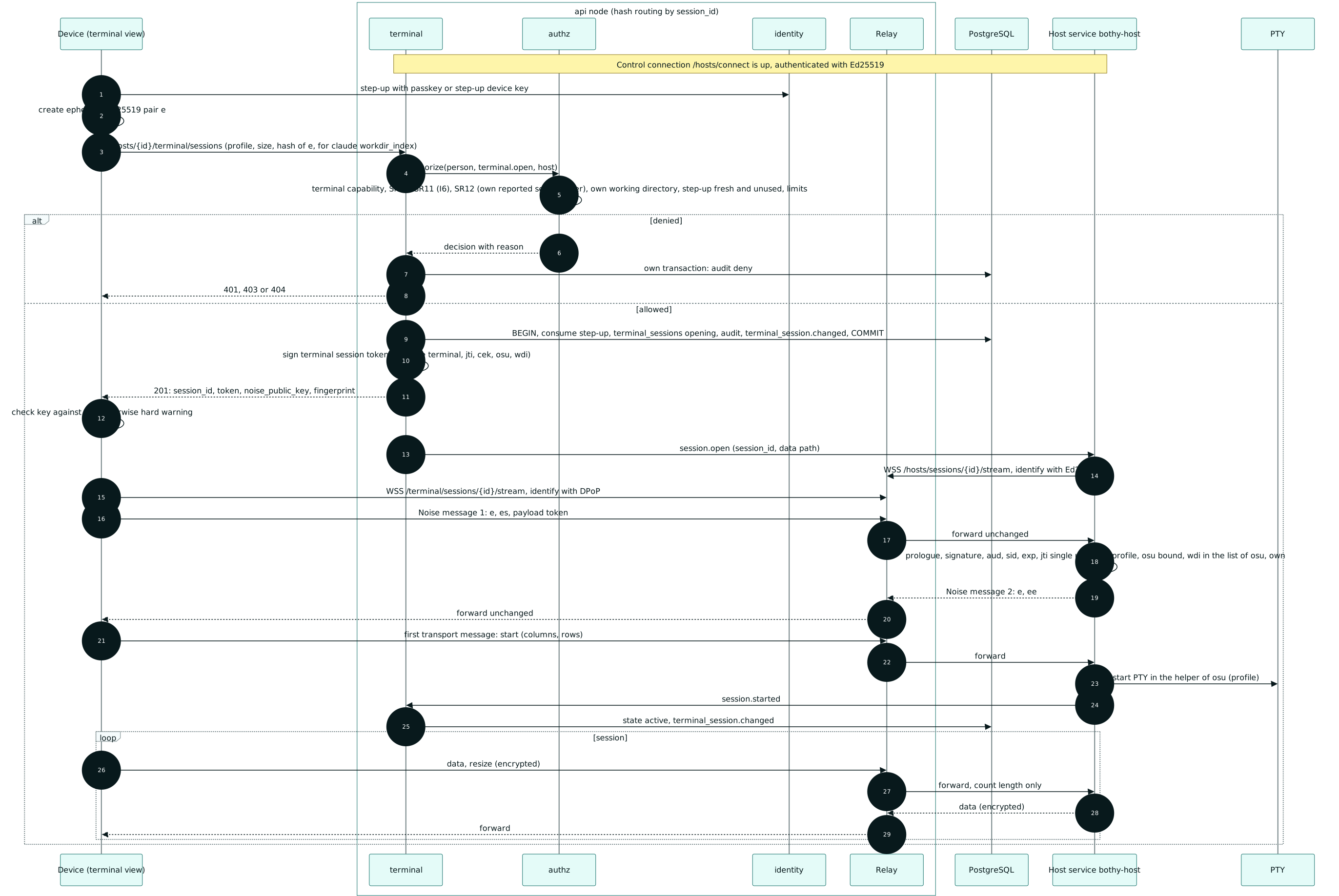
- The device performs a step-up (08, section 6.3) and calls
POST /api/v1/hosts/{host_id}/terminal/sessionswith profile, size and the hash of its ephemeral key (client_ephemeral_key_hash), with the profileclaudealso with the index of the working directory in the reported list of the person's own session user (workdir_index, 11.1). authorize(person, terminal.open, host): permissionterminal(07, section 2.12), SR10, SR11 (I6), SR12 (valid assignment of a session user whose name the host reports), fresh and unconsumed step-up, limits (terminal.max_sessions_per_person,terminal.max_sessions_per_host), hostactiveand connected, profile known, with the profileclaudea working directory of the person's own session user.- In one transaction: consume the step-up (08, section 6.3), row in
terminal_sessionswithstate = 'opening'and the session user of the person (host_session_user_id), audit, eventterminal_session.changed. Response: session ID, token, stream path,noise_public_key,key_fingerprint,key_generation. - The server instructs the host service over the control connection (
session.openwith session ID and data path). The host service opens the data connection/api/v1/hosts/sessions/{session_id}/stream. M2-44: exactly one data connection persession.open(D-M2-44-4);session.opengoes only over a control connection whosereportwas applied, after the commit and after a recheck of the decision (D-M2-44-8); a send that fails after the commit does not fail the request, the deadline of step 6 ends the opening. - The device opens
/api/v1/terminal/sessions/{session_id}/streamand sends message 1. - The relay connects both sides as soon as both are there; if one side does not arrive within
terminal.open_timeout, the session ends withopen_failed. M2-44 (D-M2-44-5): the server cannot see the handshake, so the deadline (grant time plusterminal.open_timeout) is met bysession.startedfor a session that never started and by the pairing for a started one; at the deadline an opening ends withopen_failedandclose_detail = open_timeout(the device gets4102without a host side, else4100). On a host whose lastreportsaysrequire_local_confirm = truethe pairing meets the deadline of an opening, because the consent windowhost_service.local_confirm_timeout(6.4) may be longer; the host service bounds the rest itself and ends a refused or unanswered opening withsession.endedopen_failed; a pairing that ends beforesession.startedgives the slot a new deadline ofterminal.open_timeoutfrom that moment. M2-47 (D-M2-47-8, D-M2-47-14): each side of the relay has its own timer ofterminal.open_timeoutfrom the acceptance of itsidentify, and what happens to a side without its counterpart follows the phase rule of section 9. - After message 2 and the frame
start, the host service starts the PTY; it reportssession.startedover the control connection; the server setsstate = 'active'. M2-44: asession.startedwithout a paired device side makes the sessiondetachedat once. M2-45 (D-M2-45-7, D-M2-45-12, D-M2-45-15): on the host the order is message 2 with the payload{"v":1,"host_version":"<version>","profile":"<prf>"}, then the first transport messagestart, awaited untilHostSessionOpen.expires_at(only this wait), then the gate (HD6 and HD11 of 7.4), then the local confirmation withhost_service.require_local_confirm(6.4), then the PTY in the helper ofosu, thensession.startedonce; an attach sends none. Withoutstartuntilexpires_atno PTY starts, and the host service sendssession.endedwithopen_failedandopen_timeout. Every failure after message 2 and before the PTY runs sendssession.endedwithopen_failedand itsclose_detail, and the host service keeps the data connection open: the server ends the session and closes both sides (host side4100), so the device gets the code of the end (4104forhandshake_failed, else4100) and not4102. Only when the server has not closed the data connection within the length of the opening window (HostSessionOpen.expires_atminus the arrival of thatsession.open) after the report does the host service close it with1000. The same holds for everysession.endedthe host service sends while it holds the data connection.
6.2 Detach and reattach
- If the connection of the device breaks, the PTY on the host stays alive for
terminal.detach_grace; the server setsstate = 'detached'. The scrollback buffer lives only in the memory of the host service (host_service.scrollback_bytes), never in the server. - Reattaching (
terminal.attach) issues a new token and creates a new Noise handshake with a new ephemeral key; the host service plays back the scrollback buffer betweenreplay_beginandreplay_end. The old token is thereby worthless (the server stores only the currentjti). - Step-up: from another device of the same person, always fresh. From the same device in the same
login session within
terminal.quick_reattach_windowafter the disconnect, without a new step-up. Reason: mobile networks often drop briefly; a passkey prompt for every dead spot would train people to confirm blindly. The exception applies only to the same device, whose key proves the request, and that is why it never applies in the web console (client_component = 'console'): there is no device key there, only the cookie of the console. The console needs a fresh passkey for every attach (ADR 0070). - If another device attaches, the server closes the older connection with
4103. - If the control or data connection of the host service breaks, the server sets the session to
detached. The host service keeps the PTY and opens the data connection again as soon as the device attaches (session.open); the device then reattaches withterminal.attach. M2-44 (D-M2-44-4): every grant (open or attach) sends onesession.open, and the host service opens exactly one data connection persession.open, so a new handshake always runs on a fresh pair of connections. Between grants a data connection without an expectation on the node gets1000. - Attach to a session in
opening(M2-44, D-M2-44-4): the PTY never started, so the token saysatt = open; for aclaudeprofile it carries thewdiof the opening, which the relay slot of this node keeps for the life of the opening (03 does not store it); the grant restarts the opening with a new deadline. Without that slot (another node, a restart) the attach answers409 invalid_state_transition. - If the host service restarts (
bothy-host restart,bothy-host session-user addorremove, a crash, a restart of the host), all sessions of the host end. Every PTY helper ends its PTYs including their process tree (6.5) as soon as its channel to the host service breaks. When the control connection logs in, the host service names the sessions that it knows (live_sessionsinidentify): those whose PTY is still running or whose end it could not yet report; it reports this end afterwards withsession.ended. After a restart it knows none. The server ends every other session of the host in stateactiveordetachedwithhost_restarted. Reason: the new process reads its configuration again and checks everything again at start (2.2); a session from the time before would continue unchecked under the old configuration, for example with a removed working directory. Its scrollback buffer was in the memory of the old process. The list inidentifyneeds no state in the server and separates a restart from a network drop, after which the PTYs keep running. - After
terminal.detach_gracewithout an attach, the host service ends the PTY, and the server closes the session withdetach_expired. - A session listed in
live_sessionsthat isclosedfor this host, unknown, or of another host getssession.closeright afterready, with the storedclose_reason, elseaccess_revoked(M2-43, D-M2-43-8): a PTY the server no longer allows ends at the next login, fail closed for IDs the server does not know. Listed sessions inopening,activeordetachedstay; their end comes withsession.ended. - Reactions of the host service (M2-45, D-M2-45-4): it opens at most one data connection for
each
session.open(none for one it cannot use) and never one on its own. Asession.openfor a session ID without a live PTY is an opening, one for a session ID with a live PTY an attach; a newersession.openfor the same session replaces the older data connection, which the host service closes with1000.session.closeand a close of the data connection by the server with4100end the PTY with its tree at once (6.5), or abandon an opening without a PTY; the host service stops the timers of the session, drops its scrollback, removes it fromlive_sessionsand sends nosession.ended, because the server closed the session already. Asession.closefor a session the host service does not know changes nothing. Every other close of the data connection by the server (1000,4002,4013,4014or a code of the login) and its loss, while the PTY lives, make the session detached on the host: idle keeps counting, the detach timer ofterminal.detach_gracestarts, and the host service waits for the nextsession.open; it never redials a data connection on its own. When the detach timer runs out the session ends withdetach_expired. - Replay on the host (M2-45, D-M2-45-14): the host service keeps per session a ring buffer of
host_service.scrollback_byteswith the newest PTY output, only in its memory, and keeps filling it while no device is attached, so the program never blocks on a full PTY. After a successful attach (checks of 5.3,start, local confirmation) it resizes the PTY to the size ofstart, sendsreplay_begin, the buffer as it was whenstartarrived indataframes,replay_end, then the output that arrived sincestartup tohost_service.scrollback_bytes(later output of that interval stays only in the ring buffer), then the live output. When the buffer has wrapped, the replay starts after its first line feed, so no half line, half UTF-8 sequence or half escape sequence opens it; a wrapped buffer without a line feed replays nothing. A refusal with4101leaves a live PTY of that session detached; every refusal with4104of asession.openwhose session has a live PTY (an attach or an open, alsohandshake_failedbefore the token is read) ends that PTY with its tree withoutsession.ended. A faulty first frame or a denied local confirmation of an attach ends the session withopen_failed; an attach withoutstartuntilexpires_atcloses its data connection with1000and leaves the session detached. - Broken channel to a helper (M2-45, D-M2-45-16): when the local channel to a PTY helper breaks,
the helper ends its PTYs with their trees (D-W-90), and the host service ends their sessions
with
session.endedprocess_exitedwithout an exit code.
6.3 Limits
| Limit | Value | Effect |
|---|---|---|
| Idle | terminal.idle_timeout |
without input from the device (frames data, resize); end idle_timeout |
| Maximum duration | terminal.max_session_duration |
from opened_at, also across reattaches; end max_duration |
| Sessions per person | terminal.max_sessions_per_person |
not closed; rejection terminal_session_limit |
| Sessions per host | terminal.max_sessions_per_host |
the same |
| Buffer in the relay | terminal.relay_buffer_max_bytes per direction |
full: the relay stops reading from the sending side until the buffer has room again (the transport holds the sender back); without room within terminal.relay_stall_timeout, or for a message larger than the buffer: close the connection of the slow end with 4014, session detached |
| Rate limit | rl.terminal per person, rl.host per host |
05, section 3 |
The host service measures idle time, because only it sees the frame types; it reports the end over
the control connection. The server additionally measures the time without bytes from the device in
the relay and ends the session itself after terminal.idle_timeout plus terminal.idle_grace.
Reason: a tampered host service must not keep a session open indefinitely. The job terminal.sweep
(02-architecture.md, section 12.3) checks the same limits in the database
and catches sessions of a failed node.
Idle on the host (M2-45, D-M2-45-2): the host service takes terminal.idle_timeout and
terminal.detach_grace from idle_timeout_ms and detach_grace_ms of the hello of the data
connection of the last handshake of a session (2.2 point 5). Idle is the time since the last
input frame of the device (data or resize), also across a detach; when it reaches the value
the session ends with idle_timeout.
Limits in the relay (M2-46, D-M2-46-7, D-M2-46-18): the relay of the api process that holds a
side of a session ends it itself, without the host service, through the one end function with
source server. Idle is measured from the latest of the last binary message from the device that
this process saw after identify (the server cannot see frame types, so every device byte
counts), the stored last_input_at, started_at and opened_at, in every state that is not
closed; the session ends with idle_timeout at that instant plus terminal.idle_timeout plus
terminal.idle_grace. The maximum is opened_at plus terminal.max_session_duration, unchanged
by reattaching (max_duration); in detached the detach limit is detached_at plus
terminal.detach_grace (detach_expired). The instant itself ends a session, one tick before it
keeps it; when device input moved the idle deadline meanwhile, the relay waits for the new one.
The relay learns started_at and detached_at from the committed terminal_session.changed of
the log tail.
Persistence of last_input_at, bytes_in and bytes_out (M2-46, D-M2-46-7): the relay writes
the counts it has not written yet, as additions to the row, at most once per terminal.idle_grace
while bytes flow and when a pairing or the session is released; only for sessions that are not
closed, last_input_at only forward, without a new version and without an event (like
reactions, 04 9 point 3). A failed periodic write keeps the counts for the next one, and the end
adds the counts the committing process has not written yet, so no byte is counted twice. The stored value therefore lags the true
last input by less than terminal.idle_grace, and the job terminal.sweep, which ends at the
stored value plus terminal.idle_timeout plus terminal.idle_grace, never ends a session before
terminal.idle_timeout of real inactivity.
Order of the checks of terminal.sweep (M2-46, D-M2-46-8; 02-architecture.md,
section 12.3): for every session that is not closed the first match ends it, security reasons
before limits: host not active (host_disabled, host_retired, host_rekeyed for pairing and
confirming); login session ended (session_revoked); opening past the last grant plus
terminal.open_timeout (open_failed with open_timeout), except on a host whose last report
says require_local_confirm = true, where the pairing meets the open deadline and the host service
bounds start and consent; max_duration; detach_expired; idle_timeout with the stored
last_input_at. The last grant is the UUIDv7 time of token_jti, which every grant renews and
which the server generates on its own clock, so no column is needed; opened_at would be wrong,
because an attach to an opening restarts the opening. A session whose login session was revoked
or passed expires_at ends with session_revoked (07 4.1 "session revoked or expired"): no event
marks the expiry, so the sweep finds it, as authz.expiry_sweep finds expired grants.
Session limits (M2-46, D-M2-46-10, D-M2-46-17): terminal.open counts the sessions of the person
and of the host that are not closed and is refused with terminal_session_limit (403
terminal_denied, reason session_limit) when a count is at least the value of
terminal.max_sessions_per_person or terminal.max_sessions_per_host. Attaching creates no
session and is not counted. The counts are exact under concurrency: the unit of work of the
opening takes an advisory lock for the person first, then consumes the step-up (the first row
lock), locks the host row and counts again; when the locked counts differ from those of the
decision, the opening starts again with a new decision, at most database.tx_retry_max times,
then 503 unavailable. A denial rolls back, so the step-up stays unconsumed.
Rate limits of the terminal channels (M2-46, D-M2-46-11; 05 3, 02 9.1): openTerminalSession
and attachTerminalSession count against rl.terminal of the person (429 rate_limited with
Retry-After); the device stream counts against the same bucket at identify, after the
credential check; control and data connections of the host service count against rl.host of the
host, after the proof check. A failed check of presented credentials on these channels (device
stream 4004 or 4012, host proof 4110 or 4113) consumes one token of rl.public_auth of the
client address; while that bucket is empty, a connection that presents credentials is closed
before the check. Every channel closes an empty bucket with 4008 and the close text
retry_after=<seconds>.
6.4 Local confirmation
With host_service.require_local_confirm = true, the host service asks on the host before the start
of every PTY (a notification of the operating system to the person logged in on the host) and
starts only after consent within host_service.local_confirm_timeout. The default is off.
Reason: fallback against a malicious instance operator of the server (5.1), only useful if someone
sits at the host.
Built by M2-45 (D-M2-45-15):
- Agent. The host service cannot show anything in the desktop session of another user, so
the person at the machine runs the confirmation agent
bothy-host confirm-agentin their desktop session, started at their login by an autostart entry the operator creates (16-operations.md, section 4.4). It shows a dialog with "deny" as the default: macOS/usr/bin/osascriptwithdisplay dialogandgiving up after; Linux/usr/bin/zenity --question --timeout, else/usr/bin/kdialog --warningyesno; WindowsMessageBoxWwithMB_YESNO,MB_DEFBUTTON2andMB_SYSTEMMODAL. Without a dialog program it denies and logsno_dialog_tool. The text names open or attach, the profile and the session user, nothing else. - Endpoint. The host service opens it only with
host_service.require_local_confirm = true: Linux/run/bothy-host-confirm/confirm.sock(folder fromRuntimeDirectory=bothy-host-confirmof the unit of the host service, owned by the service user), macOS/Library/Application Support/bothy-host/confirm/confirm.sock(folder created byinstall, owned by the service user), Windows the named pipe\\.\pipe\bothy-host-confirmwithPIPE_REJECT_REMOTE_CLIENTS. The socket has mode0666; the pipe gives interactive users read and write access. It is never a TCP or UDP listener. - Peer rule. Access is decided by the user of the connected process, at the connection and
again before every request, not by the mode: it is neither the service user, nor in
host_service.session_users, nor a former session user inbindings.json, and it owns the active console session (Linux: the user of the active session onseat0fromloginctl; macOS: the owner of/dev/console; Windows: the user of the active console session, and the session of the peer's token is that session). Otherwise the connection is closed and logged withconfirm_peer_refused. Reason: a long-running process of a session user must never approve a PTY, and the option means the person sitting at the machine. - Protocol. JSON lines; the service sends
{"op":"confirm","id","kind":"open"|"attach","profile","session_user","timeout_ms"}and{"op":"cancel","id"}, the agent answers{"op":"answer","id","allow"}. A request goes to every accepted agent; the first answer wins and the others getcancel. - What is confirmed. Before every PTY start (after
startand the gate, 6.1 step 7) and before every replay of an attach (afterstart), because an attach hands the scrollback and the live stream to the attaching device, exactly what the option guards against a malicious server. No accepted agent, no answer withinhost_service.local_confirm_timeoutor a denial giveopen_failedwithlocal_confirm_denied; a denied attach ends the session. - Deadline. On a host whose last
reportsaysrequire_local_confirm = true, the server deadline of an opening (grant time plusterminal.open_timeout) is met by the pairing of both sides, not bysession.started, becausehost_service.local_confirm_timeoutmay be longer thanterminal.open_timeout(6.1 step 6). The host service bounds the rest itself:startuntilHostSessionOpen.expires_at, the consent withinhost_service.local_confirm_timeout, and it ends a refused or unanswered opening withsession.endedopen_failed(open_timeoutorlocal_confirm_denied).
6.5 End of a session on the host
The PTY helper starts every session in its own process group and its own session of the operating
system (setsid); under Linux additionally in its own cgroup (systemd scope of the session user),
under Windows in a Job Object with JOB_OBJECT_LIMIT_KILL_ON_JOB_CLOSE. When a session ends,
for whatever reason, it ends the whole tree: under Linux all processes of the cgroup, under
Windows the Job Object, under macOS the process group and then every process of the
session user whose parent chain leads back to the session. Reason: without this, a process started
with nohup, setsid or disown would keep running after a revocation.
Built by M2-45 (D-M2-45-13): every end, whatever its reason, kills the whole tree at once,
without a grace period, because every end is either the person's close or an enforcement that
8.3 wants immediately. The helper starts every PTY in its own POSIX session with a controlling
terminal (Setsid, Setctty) or, on Windows, in a pseudo console (ConPTY).
- Linux. Instead of a systemd scope of the session user, the unit of each PTY helper has
Delegate=yes: a session user without a login session has no user manager that could hold a scope, and a delegated subtree of the helper's system unit gives the same cgroup per session. systemd documents the option as "Turns on delegation of further resource control partitioning to processes of the unit" and "Units where this is enabled may create and manage their own private subhierarchy of control groups" (https://www.freedesktop.org/software/systemd/man/latest/systemd.resource-control.html, retrieved 2026-10-20 [verified]). At its start the helper moves itself into the leaf<its cgroup>/helper, because cgroup v2 keeps processes out of inner nodes, and fails when it may not create cgroups there. Each session gets the cgroup<its cgroup>/s-<session id>; the child is cloned straight into it (CLONE_INTO_CGROUP), so no user code runs outside it, and a kernel that refuses that makes the start fail (pty_failed). The end writescgroup.kill, falls back toSIGKILLof every PID incgroup.procsuntil none is left, and removes the cgroup. systemd also kills the whole subtree when the helper unit stops or restarts. - macOS. At the end the helper takes snapshots of the process table and kills every process
of its user whose POSIX session or process group is the session's or whose parent chain in the
snapshot leads to the session leader, until a snapshot finds none. Because launchd does not end
process groups created with
setsidwhen the helper exits, the helper keeps a run file of its live sessions (leader PID with its start time, process group, POSIX session; mode0600) in the folder<home>/.config/bothy-host/runof its session user (mode0700); at its start it ends every recorded tree by its POSIX session and process group, also when the leader is gone, and skips only an entry whose leader PID now names another process (another start time). Limit, honestly: a process that left the session withsetsidafter its parent ended is not found; it runs in the person's own session user like a long-running process (Limit below, T12). - Windows. The leader is created suspended with the pseudo console attribute, assigned to a
new Job Object with
JOB_OBJECT_LIMIT_KILL_ON_JOB_CLOSEand withoutJOB_OBJECT_LIMIT_BREAKAWAY_OK, and only then resumed, so no process of the session runs outside the job andCREATE_BREAKAWAY_FROM_JOBfails inside it. The end callsTerminateJobObjectandClosePseudoConsole; the job handle belongs to the helper, so the tree also ends when the helper dies. - Exit code of
exitandsession.ended: Unix the exit status, or 128 plus the signal number after a signal; Windows the exit code of the process. - Broken channel. Every helper ends all its PTYs with their trees as soon as its channel to the host service breaks, then waits for the next connection (D-W-90).
Limit: long-running processes that a person sets up as a session user (crontab, systemd services of
the user, LaunchAgent, scheduled task) are not ended by this; they run outside every
session tree. They run in the session user of this person, which no other person ever gets
(2.2, T12), and reach no other person through any shared location (T13), so they reach no session
of another person. After bothy-host session-user remove, however, they can reopen the home of
their user that remove closed; then HD9 refuses the start of the whole host, and the message
names this former session user (2.2, "Reason for HD9"). When the access of a person who is not an
owner is revoked, the console shows the notice to take their session user out of the host service
with bothy-host session-user remove and then to delete it on the host together with its
long-running processes; locking alone does not end them (16-operations.md,
section 4.4 item 1; 2.2 item 3; threat model T-TM-11). The keys are out of reach of such processes (2.2).
6.6 State of a session
state |
Meaning |
|---|---|
opening |
created, handshake running |
active |
PTY running, device connected |
detached |
PTY running, no device connected; reattach possible |
closed |
ended; close_reason set |
7. LLM login and invariant I6
7.1 Why
Anthropic forbids using subscription credentials for other people (https://code.claude.com/docs/en/legal-and-compliance, retrieved 2026-10-10 [verified]; wording in 10-backend-policy.md, section 2). A terminal allows any use of the login that the person's session user has on the host. That is why every person gets their own session user (2.2, T12): a login in it is used only by them. The product cannot check the content of the login. That is why the owner additionally declares per host which login is intended there, and the server enforces who may then open a terminal.
7.2 Declaration
hosts.llm_credentials, set at the confirmation (3.2) and later with host.manage (step-up,
audit, permissions yes):
| Value | Meaning |
|---|---|
none |
There is no LLM login on the host. The profile claude is not offered. |
personal |
The login is the personal subscription of exactly one person (hosts.credential_holder_id). This person logs in themselves in the account of their session user; the host service does not touch the login (7.4). |
organization |
The login is an organization API key from the state directory of the host service. |
The owner declares it with setHostLlmCredentials (PUT /api/v1/hosts/{host_id}/llm-credentials,
M2-40): credential_holder_id exactly with personal, a person who is not deleted (missing with
personal: errors[].code = required; sent with none or organization: not_allowed;
unknown, not a person or deleted: unknown_user), with a mandatory reason and If-Match. The same
declaration the host already has answers 200 without a new version, without an event and without
a new rights version (audit with no_change). A retired host answers 409 conflict, because
retired is final (3.1); every other state takes the declaration, and confirmHost (M2-41) sets it
again at the confirmation (docs/DECISIONS.md D-M2-40-7).
7.3 Invariant I6
I6: If llm_credentials = personal, only credential_holder_id may open or attach a terminal
on the host. This also applies to other owners (owner exception, Ruling T2). On
such a host there is only an individual grant terminal to the holder of the login,
no group grants and no grants to other people.
Enforcement points:
- Transactionally in
grant.createwith targethostand inhost.manage(confirmation, change of the declaration, change of the holder of the login): if afterwards a principal other thancredential_holder_idwould have a valid grantterminalon the host, the transaction rolls back:409 i6_violation(decisioninvariant_violation), auditdeny(03, section 6.8).authzchecks I6 on every rights change like I1 (M2-40), for every host withpersonal: so the check also catchesuser.enableof a person whose dormant grant on a host that has becomepersonalin the meantime would become valid again (docs/DECISIONS.md D-M2-40-5). - On every
terminal.openandterminal.attach: SR11 in 07, fail closed. - On a change to
personalor of the holder, the same transaction ends all sessions of other people on the host (i6_violation).
Distinction from I1 (ADR 0024,
Ruling L22): I1 has no owner exception, because owners inherit trigger on all targets and an
agent is triggered on many targets. A terminal is access to a specific host, not an
inherited level. Without the owner exception, a personal host would be impossible with two owners.
The exception restricts owners; it extends nothing. ADR 0068
records this.
7.4 Enforcement on the host
- The load-bearing element is the separate session user per person (2.2, Ruling T12): a
subscription login that is created in a session user is used only by the person to whom that
session user is assigned; no session of another person runs there. This does not depend on any
result of HD6 and also applies if HD6 is faked or switched off. It requires that no location
connects the accounts again (Ruling T13, 2.2 item 6); the setup holds this, and HD11 checks it
for every configured path. HD6 is an additional check: it uncovers a
declaration of the owner that does not match the host, and reports it. An empty
host_service.claude_binor a faked result of HD6 does not weaken the enforcement. bothy-host doctor(HD6) asks the coding agent for its active login, never for values: with Claude Code,claude auth statuswith the fieldauthMethod(none,claude.ai,oauth_token,api_key,api_key_helper,third_party; https://code.claude.com/docs/en/cli-reference, retrieved 2026-10-10 [verified]). In addition, it reports only the presence of known login locations:~/.claude/.credentials.jsonunder Linux,%USERPROFILE%\.claude\.credentials.jsonunder Windows, under macOS the keychain with fallback to the same file,CLAUDE_CONFIG_DIR,CLAUDE_CODE_OAUTH_TOKEN(https://code.claude.com/docs/en/authentication, retrieved 2026-10-10 [verified]). The source does not name the keychain entry; the host service therefore checks it only throughclaude auth status[assumed: no documented way without the agent].- HD6 never calls the coding agent through the
PATHof the session user, but only through the absolute pathhost_service.claude_bin, with an environment that the PTY helper sets itself:HOMEorUSERPROFILEandCLAUDE_CONFIG_DIRof the respective check, no startup files of the session user and a fixed search list asPATH, namely the folder in whichhost_service.claude_binlies according to the configuration (resolved according to 2.2 item 6, not the folder that a linkclaudepoints to), then/usr/binand/bin(Windows:%SystemRoot%\System32). Reason for the configured folder: the instance operator chose it, and HD10 checks it anyway as a folder on the way tohost_service.claude_bin; the folder of the target of a link would depend on how a package manager installs [derived]. HD10 checks the file, every folder on the way there, every folder of the search list and, for a script (first line#!), the interpreter, so with#!/usr/bin/env nodebothenvand thenodethatenvfinds in this search list, like the binary of the helper: ownership by a trusted owner, writable for no session user, everything after resolution (2.2 item 6). HD10 checks every folder of the search list so that nobody places a different interpreter in an earlier folder of the list ahead of the checked one. If the search list does not find the interpreter,host_service.claude_bincounts as empty for HD6 and the profile (below): HD6 calls nothing, and withorganizationthere is no profileclaude; HD10 still checks the file and its folders. Reason: thePATHof the profile continues after the search list;envwould then find the interpreter in a folder that HD10 never checked, and this program would run in every session user [derived]. Modules that the interpreter then loads are not checked by HD10 [derived: their search path depends on the interpreter]; an installation in a folder of a trusted owner also keeps them out of reach. Under Windows,host_service.claude_binis an.exe; a batch file (.cmd,.bat) does not pass HD10, because it carries no#!and its interpreter and the programs it starts would otherwise remain unchecked [derived]. Claude Code is available under Windows asclaude.exe(https://code.claude.com/docs/en/setup, retrieved 2026-10-11 [verified]). If the value is empty or counts as empty (the interpreter is missing from the search list, or the path cannot be resolved, 2.2 item 6), HD6 queries only the login locations, anddoctorwarns withauth_status_unchecked(no start ban); under macOS the keychain then remains unchecked, and withorganizationthere is no profileclaude(HD7, warning; 11.1). Reason: a session user can replace a program in theirPATHor in their startup files with one that conceals the subscription login. Residual limit: the same user ID can change the data that the real program reads, for example create a login only between two checks (threat model T-TM-08, RK-84). Both affect only the account of the person themselves, because they share their session user with nobody (T12). - With
noneororganizationand a detected subscription login in a session user (authMethodequal toclaude.aioroauth_token, or one of the credential files present),bothy-hostdoes not start (Ruling T2). Before that, it reports the result with every affected session user to the server, andbothy-host doctornames the same names on the host (2.2, "Message on a refused start"). - Enforcement points: every PTY helper runs HD6 in the account of its session user, namely at the
start of the service, before every start of a PTY and every
host_service.credential_check_interval; each time in the home of the session user and in theCLAUDE_CONFIG_DIRof the profileclaude(withorganizationthe fixed folder in the home of the same session user, see below). Reason: in a running shell someone can startclaudeand log in with a subscription via/login. The login lands in the home of their own session user and reaches no session of another person (T12, T13); but it contradicts the declaration of the owner, and HD6 makes this visible so that the owner corrects the declaration or has the login removed. - Hit during operation: the host service rejects new sessions (
open_failedwithclose_detail = subscription_login_detected), ends all running sessions of the host (close_reason = host_policy_violation, sameclose_detail) and reports the result throughreportto the server (HD6 failed, one entry per affected session user with its name, 2.2). The server writes an audit entry (host.connect) and sendshost.updatedto all owners; the console shows each of these session users and the person of its assignment. There are sessions again only when HD6 passes in every session user fromhost_service.session_users. Consequence, stated honestly: a single person with a terminal can thus shut down the host for everyone, for example with/loginin their own session. This stays so, because Ruling T2 forbids the start of the host service on a contradiction to the declaration. The standstill ends in one of two ways (16-operations.md, section 4.4; threat model T-TM-14): the instance operator removes the login in the named session user, or the owner ends its assignment and the instance operator takes the session user out of the host service withbothy-host session-user remove(2.2 item 3); after that, HD6 no longer runs in this account. Then the instance operator deletes the user together with its long-running processes; otherwise one of them can reopen the home and bring the host to a standstill again through HD9 (2.2, "Reason for HD9"). Only locking the user on the host or only ending its assignment is not enough: its PTY helper keeps running, and HD6 checks every name fromhost_service.session_users. - The profile
claudebuilds its environment like the runner (09-agents.md, section 18.3): withorganization,ANTHROPIC_API_KEYfrom the state directory (the host service passes the value at start over the local channel to the PTY helper), its ownCLAUDE_CONFIG_DIRwithout a subscription login, the OAuth variables removed; withpersonalno API keys; withnonethe profile does not exist. Withorganization, the profile starts exactly the resolved path ofhost_service.claude_binthat HD10 checked, and thePATHof the profile begins with the fixed search list of HD6, so that a#!/usr/bin/env nodefinds the same interpreter that HD10 checked; because the value counts as empty without an interpreter in the search list (above),envnever searches the rest of thePATH. Ifhost_service.claude_binis empty or counts as empty, the host service does not offer the profile withorganization(HD7, warning). Reason: this program runs in every session user and is therefore a location for everyone (2.2 item 6); aclaudefrom aPATHcould lie in a folder that belongs to another account. Withorganization, the PTY helper sets theCLAUDE_CONFIG_DIRto the fixed folder.config/bothy-host/claudein the home of the session user of the person (under Windows%USERPROFILE%\.config\bothy-host\claude); it belongs to this session user and has mode0700or an ACL only for it, never a folder for the whole host (Ruling T13, HD11). Withpersonal, the session user's own value from its login shell applies (see below); the holder chooses it, and only the holder opens a terminal there (I6). After resolution (2.2 item 6) it must lie in the home of the session user; if it is not set, the default folder of the coding agent in this home applies. Before every start of the profile, the PTY helper queries only this value in a separate login shell of the session user (never another variable, so never a token), checks it and sets it again to exactly this value in the start command after the startup files; this way the coding agent runs with the checked folder. If the value lies outside the home or cannot be resolved (it is missing, or a link points nowhere; 2.2 item 6), the profile does not start (open_failedwithclose_detail = shared_location); the profileshellremains, so that the holder can correct their startup files or create the folder. In the home, the home itself protects it, which HD11 checks as a location of this session user. Reason: a shared folder would be a location at which a/loginof one person reaches all others. Withpersonalthere are only sessions of the holder (I6), but long-running processes of other session users keep running (6.5), and after a change toorganizationother people get sessions again; a readable folder outside the home would give them the subscription login of the holder [derived]. Limit: the value is set by the startup files of the holder. The check catches a misconfiguration, not the holder themselves; in their shell they can start the coding agent with any folder (2.2, limit). - With
personal,bothy-hostdoes not touch any login: the service user never opens, reads, copies or passes it on, and the state directory contains only the keys of the host, the bindings of the session users to people (only IDs and names, 2.2) and, withorganization, the API key. The holder logs in themselves in the account of their session user with the unmodified coding agent, either in a session with/loginor with a long-lived token fromclaude setup-token, which they store in a file of the session user and set asCLAUDE_CODE_OAUTH_TOKENin its login shell. Withpersonal, the profileclaudestarts, through the login shell of the session user, theclaudefrom itsPATH, with the session user's ownCLAUDE_CONFIG_DIRin the home (above), so that this login applies. The holder chooses program and folder; because only the holder gets sessions on this host (I6), this program is not a location for everyone. The login belongs to the session user of the holder; only the holder reaches it, because I6 gives sessions only to the holder and T12 assigns this session user only to the holder. Evidence (retrieved 2026-10-10):claude setup-token"Prints the token to the terminal without saving it" (https://code.claude.com/docs/en/cli-reference [verified]); the token is a one-year OAuth token for environments without a browser that can only make model requests (https://code.claude.com/docs/en/authentication [verified]). Whether/logincan use the keychain under macOS for a user without a login session, the source does not say; when the keychain refuses the write, the coding agent stores the login in the file (evidence in the next point, M2-45). Whether the token is intended for an interactive session of the same person, the source does not say either; that is the owner question OQ-03 (Ruling T10, narrowed in D-W-17). - OQ-03 check before the build (M2-45, D-M2-45-1), pages retrieved 2026-10-20:
- Path A, a token from
claude setup-tokeninCLAUDE_CODE_OAUTH_TOKEN: "For CI pipelines, scripts, or other environments where interactive browser login isn't available, generate a one-year OAuth token withclaude setup-token"; "It does not save the token anywhere; copy it and set it as theCLAUDE_CODE_OAUTH_TOKENenvironment variable wherever you want to authenticate"; "This token authenticates with your Claude subscription and requires a Pro, Max, Team, or Enterprise plan." (https://code.claude.com/docs/en/authentication [verified]). "claude setup-token| Generate a long-lived OAuth token for CI and scripts. Prints the token to the terminal without saving it. Requires a Claude subscription." (https://code.claude.com/docs/en/cli-reference [verified]). - Path B,
/loginwith the login in a file of the home or in the keychain: "On Linux, credentials are stored in~/.claude/.credentials.jsonwith file mode0600."; "On Windows, credentials are stored in%USERPROFILE%\.claude\.credentials.jsonand inherit the access controls of your user profile directory"; "On macOS, credentials are stored in the encrypted macOS Keychain. When the Keychain rejects the write, such as when it's locked in an SSH session, Claude Code stores your login in~/.claude/.credentials.jsonwith file mode0600instead, the same storage it uses on Linux."; "If you've set theCLAUDE_CONFIG_DIRenvironment variable, Claude Code keeps the.credentials.jsonfile under that directory instead, including the file the macOS fallback writes, and keys the macOS Keychain entry to that directory too" (https://code.claude.com/docs/en/authentication [verified]). - Use by the subscriber: "OAuth authentication is intended exclusively for purchasers of
Claude Free, Pro, Max, Team, and Enterprise subscription plans and is designed to support
ordinary use of Claude Code and other native Anthropic applications."; "Nor does it prevent
an end user from signing in to the unmodified Claude Code binary with their own Claude
subscription, including where a platform hosts Claude Code as described under Can customers
offer Claude Code in their products? above."; "Advertised usage limits for Pro and Max plans
assume ordinary, individual usage of Claude Code and the Agent SDK."
(https://code.claude.com/docs/en/legal-and-compliance [verified]). No sentence of the three
pages restricts a token of
claude setup-tokenor a/loginto non-interactive use; the authentication page recommends the token "for CI pipelines and scripts where browser login isn't available" [verified 2026-10-20]. - Finding: path A and path B are documented, so the profile
claudewithpersonalis built as described above. Whether the owner wants it stays the owner question OQ-03.
- Path A, a token from
- Start of
claudewithpersonal(M2-45, D-M2-45-9, D-M2-45-10): before every start the PTY helper runs the login-shell probe of HD6 as the session user, bounded byhost_service.auth_status_timeout; the probe prints only whetherCLAUDE_CODE_OAUTH_TOKENis set and the value ofCLAUDE_CONFIG_DIR, never a token (Windows: from theEnvironmentkey of the user's registry hive, where only the presence of the valueCLAUDE_CODE_OAUTH_TOKENis read, and%NAME%references of the stored value are expanded from the user's environment block). Unset means the default folder<home>/.claude. The helper resolves the value as the session user; it must be absolute and lie in the home or below it after resolution. A value outside, a link leading outside, a dangling link or a missing folder giveopen_failedwithshared_location; a timeout or a failed shell givepty_failed. The start command sets the checked value again after the start files (Unix:export CLAUDE_CONFIG_DIR=<quoted value>; exec claudeorunset CLAUDE_CONFIG_DIR; exec claude, with the forms offishandcshfor those shells; Windows:powershell.exe -NoLogo -Commandwith$env:CLAUDE_CONFIG_DIR = '<value>'orRemove-Item Env:\CLAUDE_CONFIG_DIR -ErrorAction SilentlyContinue, then& claude); the working directory is the one ofwdi, and no key is set. - Start of
claudewithorganization(M2-45, D-M2-45-11): the service user reads the key fileclaude_api_keyofhost_service.state_dirfor each such start and sends the value only in thatpty.startof the local channel; a missing or empty file givespty_failed. The helper puts it only into the environment of that child asANTHROPIC_API_KEYand clears it from the start request and the start environment after the start; it never reaches a log, a file or another start.CLAUDE_CONFIG_DIRis<home>/.config/bothy-host/claude(Windows%USERPROFILE%\.config\bothy-host\claude) and must resolve to exactly that folder, elseshared_location. The program is the resolvedhost_service.claude_binof the last check of the helper, andPATHis the search list of HD6 followed by the cleanedPATHof the profile without the folders of the search list. Thepty.startnames the declaration and the path of the working directory thatwdinames in the list after HD7; the helper starts only when that path is in the working directories of its last check and its identity equals the one it reported then, elseshared_location. On Windows the environment block of the session user contains every user and system variable, so the helper removesANTHROPIC_AUTH_TOKEN,CLAUDE_CODE_OAUTH_TOKEN,ANTHROPIC_PROFILE,CLAUDE_CODE_USE_BEDROCK,CLAUDE_CODE_USE_VERTEXandCLAUDE_CODE_USE_FOUNDRYfrom it; on Unix they are never on the allow list (11.1). - Gate in operation (M2-45, D-M2-45-12): before every PTY start (after
start, before the local confirmation) the host service runs oneLightrun that asks only the helper ofosu(HD6 and HD11 without the entry scan) together with its own checks, including HD11 for the places for all; the other helpers keep their last answer, whose age the periodicLightrun of every helper eachhost_service.credential_check_intervalbounds. Consequences: HD10 failed or a failed peer check of a session channel givehelper_untrusted(no new session, all running sessions end withhost_policy_violation); HD6 failed givessubscription_login_detected(all end); HD11 failed at a place for all givesshared_location(all end); HD11 failed for one session user givesshared_locationfor that session user only; any other finding that refuses a start refuses new sessions withpty_failedand ends no running session (thedoctorrun of the administrator ends the service for those, M2-42). Every change of the result sendsreport. - Fail closed and unknown declaration (D-M2-42-9): a value of
authMethodoutside the six of the list, an output that is not JSON, a timeout afterhost_service.auth_status_timeoutor an exit code other than0and1givesauth_status_unknown, which counts like a finding. Before anyreadywas stored the declaration is unknown: a finding then gives the warningdeclaration_unknown, and the local output names the accounts.host_service.auth_status_timeoutalso bounds the probe of the login shell, which prints only whetherCLAUDE_CODE_OAUTH_TOKENis set. - Reason: the product does not collect, store or broker Claude.ai credentials (10-backend-policy.md, section 2, consequence 3; I5). A token in the state directory of the host service that the host service passes into the session would be exactly that.
- Limit: anyone who has a session of the profile
claudecan read the API key or the token from the environment of their own process. This cannot be prevented with an interactive agent. Therefore: withorganizationa separate key per host with a spending limit at the provider, and after the access of a person who is not an owner is revoked, a new key (threat model T-TM-08; console notice as in 6.5).
8. Permissions
8.1 Target host and capability terminal
- New target
hostingrants.target_kind(03). On this target there is no level (grants.levelis absent) and exactly one capability:terminal. Recipients onlyuserandgroup, neveragentorapp(check). The targethostlies outside the treeinstance->space->channel; a grant on the instance gives no terminal. - Only the owner creates grants on hosts;
managedoes not exist on hosts. - Owners have
terminalimplicitly on every host, unless I6 blocks it (7.3).
8.2 Protection rules
The rules are in 07-permissions.md:
- SR10 Terminal only on own host (Ruling T1): a non-owner gets a terminal
only on a host whose assignee they are (
hosts.assigned_user_id), or on their own ready dev environment (hosts.dev_environment_id, milestone "Multi-user dev environment"). On the server host only owners. Grants to others can be created; the preview says that they do not take effect (hintterminal_not_effective). Reason: 21-dev-isolation.md rejects the OS user as the sole boundary between people, and a shared home shares LLM logins. - SR11 I6 (7.3).
- SR12 Own session user (Ruling T12):
terminal.openandterminal.attachonly with a valid assignment of the person to a session user of this host (host_session_users) whose name the host reports (hosts.reported_session_users), also for owners; otherwiseterminal_deniedwithreason: no_session_user. Reason: without a separate session user, the session would run in an account whose logins another person also uses (2.2). - Agents and apps never open a terminal: the actions require a person in a session; an agent that is controlled by prompt injection reaches no host.
8.3 Revocation
Revocation of the grant, expiry, leaving the group, removal of the owner role, disabling of the
person or revocation of the device, revocation or end of the login session, logout, disabling or
re-pairing of the host, end of the assignment of the session user or a report without its name
(SR12), and a change that violates SR10 or I6: running sessions end immediately (fail closed
like Ruling L23). The server closes the connections (4100) and instructs the host service to end
the session; the PTY helper ends the whole process tree (6.5). close_reason names the
reason (section 10.3).
M2-46 (D-M2-46-1 to D-M2-46-6): every kind of revocation ends the sessions in the transaction that
causes it, through the one end function of the module; the first committed end wins, and a later
report or job for a closed session changes nothing. Revocations from outside terminal arrive
through three in-transaction subscriptions of the module: authorize.AccessChanged (a removed
target of kind host ends that person's sessions on the host; a lost owner status ends every
session that SR10 no longer allows), identity.DeviceRevoked (the sessions whose current
device_id is the device) and identity.SessionEnded (the sessions of the ended login sessions,
with logout, user_disabled, device_revoked or session_revoked). After the commit every api
process that holds a connection of the session closes it with 4100 and the close_reason as
close text, and the process holding the host's control connection sends session.close; a host
service that was offline gets it at its next login (live_sessions, 6.2). An established stream
ends with 4100 and the reason also after an identity revocation, while 4012 stays the answer
at identify when the credential is already revoked (04 6.4); the client learns the identity
revocation from its gateway connection.
8.4 Owner on another person's host
If an owner opens or attaches on a host whose hosts.assigned_user_id is another
person, the client shows a warning before the step-up: the session does run in the owner's own
session user (T12), but on a host that this person uses and sets up; with a
local privilege escalation, that person's processes can read along and control it (2.2, limit).
Only after explicit confirmation does the client request the step-up. The server itself sets
foreign_assignee = true in the audit entry of terminal.open or terminal.attach, because it
knows the assignee and the person. Reason: SR10 protects non-owners from each other,
but owners have terminal everywhere; without a warning, an owner would type passwords on a host
that another person controls, and the separation of the session users is not a
complete boundary (threat model T-TM-12).
9. Multiple nodes
With cluster.mode = multi (02-architecture.md, section 16), the following
applies (Ruling T6):
- The control connection of the host service lands on any node. The node that
handles
terminal.opensends the instructionsession.openthroughNOTIFY ephemeral, only with IDs, to the node of the control connection (03, section 6.6). - The host service opens a separate data connection per session on
/api/v1/hosts/sessions/{session_id}/stream; the device connects to/api/v1/terminal/sessions/{session_id}/stream. - The proxy routes both paths of the same session by a hash over the session ID to the same node (operational requirement in 16-operations.md, section 4.4). There the relay connects the two sides in memory.
- If one side lands on another node, it finds no counterpart within
terminal.open_timeoutand closes with4102; the node counts this in the metricbothy.terminal.relay.unpaired(signals.md) and keeps reporting/readyzas ready. Reason: a misconfiguration of the proxy should fail visibly, not silently route data through a broker.
Reason: 02-architecture.md forbids a broker, and the event log is not suitable for byte streams. With one node, everything is trivial.
Build details (M2-47; the rows D-M2-47-<n> of DECISIONS.md give the reasons).
With cluster.mode = single nothing of this runs and no NOTIFY is sent; one node uses the same
handler with a local transport (D-M2-47-4).
Signals between nodes (D-M2-47-3, R-TM-31). A use case that acts on a live connection after its
commit stages a signal in its transaction; with several nodes it is a NOTIFY ephemeral in that
transaction, which PostgreSQL delivers only after the commit and never after a rollback, and every
node, the sender included, receives it through its listener. A signal is compact JSON with exactly
kind, host_id and, per kind, session_id or conn_id, each a UUID; never a token, jti,
profile, name, path, address or byte of a stream (03, section 6.6). Decoding is strict: unknown or
missing members, a value that is no UUID or an unknown kind with the prefix terminal. drop the
payload with one log record; a kind outside that prefix is ignored, because M7-17 adds its own kinds
to the channel. A receiver always reads the state from the database, so a signal that arrives late,
twice, out of order or forged causes nothing the committed rows do not allow.
| Kind | Sent by | Receivers |
|---|---|---|
terminal.session_open (host_id, session_id) |
the units of terminal.open and terminal.attach (in their transaction) |
every api node registers the expectation of a session of that host that is not closed, with the device of the row and its own receipt time as the grant time of the deadline, so the node the edge hashes the session to holds it, whichever node served the request; the node with an eligible control connection of an active host also sends session.open (D-M2-47-12), after the probation of 3.4 |
terminal.host_close (host_id) |
every transition out of active, a re-pairing, the fallback of the confirmation after terminal.fingerprint_max_attempts and the duplicate verdict of 3.4 (in their transaction) |
every node closes the control connections of the host it holds with the code of the state read now: 4110 back in pairing, 4111 disabled or retired, 4112 disabled with duplicate_connection; a host that may stay connected keeps them (D-M2-47-13) |
terminal.host_present (host_id, conn_id) |
the node of a control connection after its first report and after each heartbeat (outside any unit) |
every other node renews the entry in its presence view; rules b and c of 3.4 |
terminal.host_gone (host_id, conn_id) |
the node of a control connection when it closes (outside any unit) | every node removes this one entry |
terminal.session_paired (host_id, session_id) |
the node whose relay pairs both sides of a session in opening on a host with require_local_confirm = true (outside any unit) |
every other node marks its expectation of that session as paired elsewhere |
The end of a session has no signal. Every end, from any module, process or node, writes
terminal_session.changed in its transaction; the log tail of every api process (02, section 11.2)
hands it to the relay, which closes the device stream and the host data connection held there and
sends session.close on the node of the control connection. That path reaches every api process in
both modes, also for an end committed in a worker; data connections and device streams of a host
that leaves active close the same way, because the transition ends the sessions in the same
transaction.
Presence across nodes (D-M2-47-6). "Host connected" (6.1 point 2, 13) is an eligible control
connection on this node or a counting entry of another node in the node's presence view. An entry
counts while no more than terminal.host_heartbeat_interval times
terminal.host_heartbeat_miss_limit has passed since its last terminal.host_present: the silence
after which the holder closes the connection itself. A node that dies without terminal.host_gone
keeps its entries counting for at most that window; an opening let through in it ends open_failed
with close_detail = open_timeout. After a start or a reconnect of the listener the view is
complete within one terminal.host_heartbeat_interval; until then an opening may get
409 host_unavailable for a host connected elsewhere, which the next attempt corrects.
The lone side and the phase rule (D-M2-47-8, D-M2-47-14, D-M2-47-15). The same rules hold on one
node and on several. A side whose identify was accepted and that finds no counterpart on its
node has its own timer of terminal.open_timeout from that acceptance; at the deadline, inclusive,
it is unpaired, closes with 4102, is counted in bothy.terminal.relay.unpaired with
bothy.terminal.side (client or host) and writes one log record without any ID. A side that
was paired once never counts as unpaired. What else happens depends on the phase of the session as
the node knows it (phase rule):
opening: a lone device stream and a lone host data connection both close with4102, and the session endsopen_failedwithclose_detail = open_timeout. The end is a compare-and-swap onopening, so when both sides time out on two nodes the second end writes nothing (one audit entryterminal.terminate, one event). A lone side whose own timer has not run yet when that end reaches it still counts once as unpaired with its side, whichever way the end arrives first: the log tail of its node, or its own connection ending (the host service closes its data connection on thesession.closeof the end, the device on its own).- started (
activeordetached): a lone device stream closes with4102and the session staysdetached(attach again later); a host data connection waits for an attaching device until the session ends (terminal.detach_grace) and is not unpaired.
A node counts a session as started once it has seen session.started (only the node of the control
connection does), once its log tail delivered terminal_session.changed with active or
detached (D-M2-47-22), or once the deadline of its expectation read a state other than opening
from the database. A side that reaches a node before terminal.session_open did builds the
expectation of the current grant from the row; an expectation carries its grant (the token jti),
and the same grant again changes nothing, so the signal and the side may arrive in either order
(D-M2-47-21). A node that still relays both sides of a started session makes it active again when
another node detached it because its control connection of the host ended (D-M2-47-25). The deadline of an expectation waits while an unpaired side is present, because that
side's own timer decides; an expectation without sides ends a session still in opening through the
same compare-and-swap. On a host whose last report says require_local_confirm = true an
expectation without sides that received terminal.session_paired only removes itself at its
deadline, because the pairing met the opening deadline on its own node and the host service bounds
consent itself (6.1 step 6). With several nodes session.started detaches a session only on the
node that paired it. Frames of a lone side never leave its node: not into the database, the event
log, a signal or another node. No readiness check is involved; /readyz stays ready.
Listener (D-M2-47-5; since M7-17 shared, D-M7-17-2). Every api process (roles api and
all) with cluster.mode = multi reads the notifications of its one LISTEN ephemeral
connection (application name bothy-ephemeral, shared with the gateway) in order and hands each
terminal signal to the relay. The worker sends signals but runs no listener, because it holds no connection. On the loss
of the connection the listener logs once, tries again at once and then every
database.listen_reconnect_backoff_cap. Only after LISTEN succeeded again, so nothing committed
in between is missed later, the node reconciles: it reads the state of the hosts of all its control
connections and relay sides, closes the control connections of every host that is no longer
active with the codes above, and announces each of its eligible control connections at once. The
listener is a soft dependency like the LISTEN of the log tail (02, section 14.4): no readiness
check, /readyz unchanged; it stops with the log tail (02, section 15.3).
What is lost while a node's LISTEN ephemeral connection is down: NOTIFY keeps no backlog, so the
node misses every signal sent meanwhile. Its control connections of a host disabled, retired or
re-paired elsewhere stay open until the reconciliation (the sessions of that host still end on every
node through the log tail, which has its own LISTEN and poll); an opening whose session.open should
go through its control connection is not sent and ends open_failed with
close_detail = open_timeout (its sides still build their expectation from the row); its presence view ages, so its entries expire after the window above
and a newer control connection on another node is probed only after the reconnect and the next
announcement; a missed terminal.session_paired lets a side-less expectation end an opening that
waits for local confirmation on another node. Signals the node itself sends still reach the other
nodes.
Edge requirement. Several nodes need an edge that routes both stream paths of a session by
consistent hashing over {session_id} to one node, with the timeouts of
16-operations.md, section 4.4; infra/compose/compose.multi-node.yaml with
infra/compose/edge/nginx.conf is the example. A side the edge sends elsewhere fails visibly with
4102 after terminal.open_timeout (TM-T15).
10. Audit, events, privacy
10.1 Audit
| Action | When | Details (audit_details.v1) |
|---|---|---|
host.manage |
every change | host_id (resource), operation (create, update, pairing_code, confirm, llm_credentials, state, session_user), old and new values as codes (from_assigned_user_id, to_assigned_user_id, name_changed, from_state, to_state, disabled_reason), with session_user one entry per assignment or end with change (assigned, revoked), user_id and the name of the session user in the reserved field os_user; with pairing_code from_state, to_state, old_fingerprint (when keys were discarded), key_generation, sessions_ended; with confirm result (confirmed, fingerprint_mismatch, fingerprint_max_attempts), fingerprint, key_generation, attempts_remaining (on failed attempts), llm_credentials, credential_holder_id, declared_server_host; reason; without effect no_change; never the name of the host, the code, its HMAC or a key; fingerprints in lower case without hyphens |
host.pair |
allow and deny | host_id, fingerprint, old_fingerprint (when one was stored), key_generation, platform; refusals aggregated with unauthenticated |
host.connect |
denials; allow only on a change of reported_is_server_host, reported_doctor or reported_session_users; second control connection (3.4) |
host_id, check codes, with the name of every account that the message names (rule for names, 2.2: for HD6, HD10 and HD11 session users, for HD9 former ones), added and removed names of the session users, code duplicate_connection |
terminal.open, terminal.attach |
allow and deny | host_id, session_id, profile, device_id, pin_changed, foreign_assignee |
terminal.close |
allow and deny | session_id, who closed |
terminal.stream |
denials (for example identify from a device that does not belong to the current token) |
session_id, device_id, reason code |
terminal.terminate |
every end by the server or the host | actor system; session_id, close_reason, close_detail (when set), bytes_in, bytes_out, duration_ms |
Never in the audit: terminal content, commands, environment variables, paths, profile command lines.
10.2 Events
Durable in the event log (05-actions.md, section 6): host.updated (to everyone
with host.read) and terminal_session.changed (personally to the person of the session).
Ephemeral: host.presence_changed (connected, disconnected). The stream itself is not an event and
never appears in the event log. Reason: the log is for states, not for byte streams, and the server
and the backups read everything in the log in plain text.
10.3 Reasons for ending (terminal_sessions.close_reason)
| Code | Trigger |
|---|---|
client_closed |
frame close or terminal.close by the person |
closed_by_owner |
terminal.close by an owner |
process_exited |
process of the PTY ended |
idle_timeout, max_duration, detach_expired |
limits from 6.2 and 6.3 |
access_revoked |
revocation according to 8.3 (grant, group, owner role, SR10, end of the assignment or name no longer reported according to SR12) |
i6_violation |
change of the declaration or of the holder (7.3) |
host_disabled, host_retired, host_rekeyed |
state change of the host (3.1, 3.3) |
host_restarted |
restart of the host service: it no longer names the session at login (6.2) |
user_disabled, device_revoked, session_revoked, logout |
identity (08) |
open_failed |
handshake, token, timeout on opening or rejection by the host service; code in close_detail |
host_policy_violation |
check of the host service failed during operation (HD6, HD10, HD11; 2.2, 7.4); code in close_detail |
What the host service sends (M2-45, D-M2-45-8, D-M2-45-16): only client_closed,
process_exited, idle_timeout, detach_expired, open_failed and host_policy_violation.
A fault of the encrypted stream after the opening, also in a running session, is open_failed
with handshake_failed (5.4); a session whose helper channel broke ends with process_exited
without an exit code.
close_detail takes only codes from a closed list: token_invalid, token_expired,
token_replayed, handshake_failed, profile_unknown, session_user_unknown, session_user_mismatch,
server_host_owner_only, local_confirm_denied, subscription_login_detected, helper_untrusted,
shared_location, pty_failed, open_timeout.
M2-46 (D-M2-46-2): close_detail is set exactly with open_failed (any code of the list) and
host_policy_violation (subscription_login_detected, helper_untrusted, shared_location),
and never with another reason, for every writer: host reports, the relay, the job
terminal.sweep and every end by the server; any other pair is an internal error and never stored.
10.4 Privacy
- There is no content recording.
terminal_sessionsholds only metadata with retention classsecurity(20-privacy.md). - Telemetry: only counters and durations without IDs of people and without host names; no spans per frame.
- No agent reads terminal content; search, push and run context do not know the terminal.
- Whether record-keeping obligations require a recording is an owner question (default: no, only metadata).
11. Profiles
11.1 Definition
Profiles are in the configuration of the host service (host_service.profiles), not in the server.
The server knows only name, display name and kind from the report of the host service
(hosts.reported_profiles, schema host_profiles.v1). A client cannot send a command
line.
| Profile | Kind | Start |
|---|---|---|
shell |
shell |
login shell of the session user, working directory its home |
claude |
claude |
unmodified coding agent: with organization exactly host_service.claude_bin (empty or counting as empty according to 7.4: no profile claude, HD7 with warning), with personal claude through the login shell of the holder (7.4); in a working directory that the person chooses from the working directories of their own session user in host_service.claude_workdirs (2.2 item 6), started in the resolved path; environment according to 7.4 |
| others | command |
fixed command from the configuration with an absolute program path (HD7, HD11) |
The environment of every profile is an allow list like for the runner (09, section 18.2) plus
TERM. Login shells (profile shell, profile claude with personal, 7.4) then read the
session user's own startup files; what is there belongs to the session user, not to the host
service. The working directory of the profile claude is in the request as an index
(workdir_index), never as a path. The index counts only in the list of the person's own session
user in hosts.reported_session_users, which carries only display names; the token carries it as
wdi, and the host service resolves it in exactly the list of osu that it reported, that is,
according to HD7 (2.2 item 6, 5.3, Ruling T13).
Start specifications on the host (M2-45, D-M2-45-9, D-M2-45-10): every environment is built
from scratch, never by removing from an inherited one, and TERM is xterm-256color for every
profile, because the renderer of the clients is xterm (12).
- Unix allow list:
HOME,USER,LOGNAMEandSHELLof the session user,PATHcleaned from the helper's own environment (only absolute, existing folders that are not writable by group or others, judged after resolution as the session user, without duplicates), andLANG,LC_*andTMPDIRfrom the helper's environment when present, thenTERM. - Windows: the environment block of the helper's token without inheritance (the user and system
variables, the equivalent of a login) plus
TERM. shell: the login shell of the session user, working directory the home. Unix: the shell of the user database, started withargv[0]set to-plus the base name of the shell (the convention of login(1)); a shell that is not an absolute path listed in/etc/shellsgivespty_failed. Windows:%SystemRoot%\System32\WindowsPowerShell\v1.0\powershell.exe -NoLogo.command: the resolved path ofprogramwithargs, working directory the home.claude: 7.4 ("Start ofclaudewithorganization" and "withpersonal"); the profile is offered withorganizationonly with a usablehost_service.claude_bin, withpersonalas long as OQ-03 found a documented login path, never withnoneor an unknown declaration, and only when at least one session user has a working directory after HD7.
11.2 Rendering
Escape sequences that leave the device or send data back are blocked by default in the renderer: OSC 52 (clipboard), OSC 8 (opening hyperlinks without confirmation), answers to queries of window titles. The view shows hyperlinks with their target and opens them only after a click and confirmation (SEC-TERM-6 in 19).
11.3 Claude Code sessions
In this version, "Claude Code session" means: interactive claude in the terminal, separate from
the runner (Ruling T5). Taking over a thread of the runner in the terminal is possible only once
the runner and the host service run as the same user in a dev environment (milestone after V2).
Reason: the runner locks sessions and runs with secrets of the instance operator
(21-dev-isolation.md, section 1).
12. Clients
| Client | Milestone | Special feature |
|---|---|---|
| Desktop (macOS, Windows) | M4 | hardware keyboard, keyboard shortcuts without conflict with the shell (app shortcuts only with the platform modifier) |
| Mobile (iOS, Android) | M5 | extra keys bar: Esc, Tab, Ctrl, Alt, arrows, \|, ~, /, -; hardware keyboard |
| Web console | M6 | step-up only by passkey with userVerification = required (ADR 0070); same CSP (19, section 5); ports and measured state below (M6-18) |
One Flutter widget for all clients. Renderer: package xterm by TerminalStudio, MIT, version
4.0.0, for Android, iOS, Linux, macOS, Web and Windows (https://pub.dev/packages/xterm, retrieved
2026-10-10 [verified]). According to pub.dev, the last release was about two years ago
[verified]. Check of the build ticket M4-35 on 2026-10-20 [verified]:
- Release: 4.0.0 is the latest, published 2024-02-27, MIT; it depends on
convert,meta,quiver,equatable^2.0.3 andzmodem0.0.6 (MIT) (https://pub.dev/packages/xterm, https://pub.dev/api/packages/xterm). - Maintenance: the repository https://github.com/TerminalStudio/xterm.dart is not archived, last push 2025-06-19, 109 open issues and pull requests.
- Security reports: none. OSV (https://api.osv.dev, query for ecosystem
Pub, packagexterm) lists no vulnerability; the GitHub advisory database (https://github.com/advisories?query=ecosystem%3Apub+xterm) has no entry; the issues hold no security report for OSC 52, OSC 8, hyperlinks, the clipboard or titles. - Behavior and bugs of 4.0.0, read in its source: 15-client-architecture.md, section 23.4.
The package is taken as is; the blocks of 11.2 live in terminal_ui in front of the renderer and
hold with own tests (TM-T14), independent of the renderer version (docs/decisions.d/M4-35.md).
Web console (M6-18, ADR 0070): the console runs the same view with its own ports (15-client-architecture.md
section 23.1): the browser WebSocket on the same origin, authenticated by the cookie of the upgrade
with an identify without token; pinned host keys in IndexedDB of the origin (database
bothy.terminal.pins), deleted at logout and on the clearing cookie; the step-up only by passkey
with userVerification = required, without a passkey a notice; no HostEvents (reload through
REST). The view says that pinning in the browser does not protect against the server itself
(section 5.1). Measured on 2026-10-21 by phase 3 of make console-e2e in headless Chromium 156
with the CSP enforced, which prints these values on every run (a measurement, no gate,
D-M6-18-6 in docs/decisions.d/M6-18.md): xterm 4.0.0 renders under Flutter Web without a CSP exception
and without HTML from terminal output; frame-to-paint p95 about 20 ms from the write into the
model to the end of the next frame (desktop target client.perf.terminal_frame_to_paint_p95),
throughput between about 2.1 and 3.3 MiB/s in two runs for an unthrottled burst of 4 MiB (desktop minimum
client.perf.terminal_throughput_min). Since 2026-10-24 the burst goes in 64 acknowledged chunks of
64 KiB, because an unacknowledged burst outran a slow machine and the host disconnected the reader
(D-M6-18-9); one run of that form measured about 1.5 MiB/s with one acknowledgement round trip per
chunk and a frame-to-paint p95 of 17 ms. Later on 2026-10-24 the chunks shrank to 8 KiB (512 chunks,
the same 4 MiB): the host's send queue counts messages, one per PTY read, fold flushes each line,
and a 64 KiB chunk could exceed the queue on a loaded runner; the throughput of this form includes
512 round trips and is not comparable with the earlier values. cryptography 2.9.0 runs the handshake in the tab. OSV
(https://api.osv.dev, ecosystem Pub) listed no vulnerability for xterm or cryptography on
2026-10-21 [verified].
Every client shows: session list per host with state, reattach, fingerprint of the host, badge of the LLM login ("Personal", "Organization", "None"), remaining time until the maximum duration.
PTY on the host: Unix PTY on macOS and Linux; Windows through ConPTY (CreatePseudoConsole),
available from Windows 10 version 1809 and Windows Server 2019
(https://learn.microsoft.com/en-us/windows/console/createpseudoconsole, retrieved 2026-10-10
[verified]). The minimum version Windows 10 2004 of the apps (Ruling L12) is above that.
13. Errors
| Problem code | Status | When |
|---|---|---|
terminal_denied |
403 |
permission present, but a guard rule or a limit blocks; reason: not_host_assignee, server_host_owner_only, i6_holder_only, no_session_user, session_limit, profile_unknown |
step_up_required |
401 |
step-up missing, older than terminal.step_up_max_age, already consumed or, in the console, not by passkey (reason: passkey_required) |
host_unavailable |
409 |
host not active or host service not connected |
fingerprint_mismatch |
409 |
confirmation with a wrong fingerprint; attempts_remaining names the attempts left, 0 means the fallback to pairing (3.2) |
i6_violation |
409 |
change would violate I6 (hint) |
conflict |
409 |
assignment of a session user that on the host already belongs or belonged to a person, or a second valid assignment of the same person (reason: session_user_taken, 2.2); host.pair with the login key of another host (reason: host_key_in_use) or with the discarded keys of this host (reason: host_key_reused, 3.3) |
validation_failed |
400 |
assignment of a name that the host does not report (errors[].code = session_user_not_on_host, 2.2 item 5); assignee, person of an assignment or holder of the LLM login unknown, not a person or deleted (errors[].code = unknown_user); assigned_user_id together with clear_assigned_user = true (errors[].code = mutually_exclusive); credential_holder_id with none or organization (errors[].code = not_allowed, 7.2) |
not_found |
404 |
no read permission on the host or the session |
Close codes of the terminal channels (source of the names and client reactions in English:
x-close-codes of the channels terminalStream, hostControl and hostData in
asyncapi.yaml); in addition, the codes from 04 section 6.4 named there apply:
| Code | Name | Channel | Meaning and reaction |
|---|---|---|---|
4000 |
unknown_error |
control and data connection | internal error of the server (a panic, an error without a better code); reconnect with backoff (M2-43) |
4100 |
terminal_closed |
stream, data connection | session ended, reason in close_reason (10.3); do not reconnect, the host service ends the PTY |
4101 |
terminal_token_stale |
stream; data connection, from the host service (M2-44) | terminal session token expired (token_expired) or already used (token_replayed); open or attach again with a new step-up (5.3) |
4102 |
terminal_host_unavailable |
stream, data connection (M2-47) | counterpart missing (host service disconnected or no counterpart on this node, 9); a started session is detached, attach later; an opening ends with open_failed (M2-44), open a new session. M2-47 (D-M2-47-8), phase rule of 9: an opening session ended open_failed with close_detail = open_timeout (open again), a detached one stays detached (attach again later); on the data connection: do not reopen it, wait for the next session.open |
4103 |
terminal_replaced |
stream | another device has attached (6.2); do not reconnect automatically |
4104 |
terminal_handshake_failed |
stream; data connection, from the host service (M2-44) | any other error of the token or of the handshake (5.3); hard warning, no new attempt |
4110 |
host_unpaired |
control and data connection | key unknown or replaced by a re-pairing (3.3); stop, run bothy-host pair again |
4111 |
host_disabled |
control and data connection | host disabled or retired (3.1); end all PTYs, reconnect only after a long backoff |
4112 |
host_duplicate |
control and data connection | second live control connection with the same keys (3.4); host disabled, do not reconnect |
4113 |
host_auth_failed |
control and data connection | signature over the challenge from hello invalid or too late (terminal.host_auth_timeout); check clock and keys, reconnect with backoff |
4114 |
host_version_unsupported |
control and data connection | version below the minimum version (18-release.md); update the host service, do not reconnect |
Reactions of the host service on a data connection (M2-45, D-M2-45-4, D-M2-45-7): the server
closes it with 4100 when the session ended; the host service ends the PTY with its tree and
sends no session.ended. Every other close by the server (1000, 4002, 4013, 4014, a code
of the login) and a lost connection leave a live PTY detached until the next session.open or
terminal.detach_grace (6.2); the host service never redials. The host service itself closes a
data connection with 4101 or 4104 and the close_detail as close reason when it refuses a
handshake (5.3), with 1000 when a newer session.open replaces it or when the server has not
closed it within the opening window after a session.ended (6.1 step 7), and with 4002 when its
hello lacks a usable server value (2.2 point 5).
14. Tests
| ID | Test | Expected |
|---|---|---|
| TM-T01 | Conformance of the handshake in Go and Dart with the entries for Noise_NK_25519_ChaChaPoly_SHA256 from the vector files in 5.2 |
identical bytes |
| TM-T02 | Mutual handshake Go against Dart, with a wrong prologue, a wrong static key, a swapped host ID | only the correct one succeeds |
| TM-T03 | Relay replays message 1 (same token) | host service rejects (token_replayed, 4101), no second PTY |
| TM-T04 | Token with a wrong aud, sid, cek, a foreign kid, the typ of the invocation token; expired token |
no PTY; 4104 with token_invalid; expired: 4101 with token_expired |
| TM-T05 | Messages 1 and 2 complete, but no start |
no PTY |
| TM-T06 | Relay capture, server logs, database dump and telemetry after a session with a canary value | canary nowhere (19, SEC-T10) |
| TM-T07 | terminal.open without step-up, with one that is too old, with one already consumed, in the console with a password step-up |
401 step_up_required |
| TM-T08 | Non-owner with a grant on someone else's host, on their own host, on the server host | 403 terminal_denied not_host_assignee, allowed, 403 terminal_denied server_host_owner_only |
| TM-T09 | I6: grant to a second person, grant to a group, switching to personal with an existing grant to others, a second owner opens |
409 i6_violation or 403 terminal_denied i6_holder_only, respectively |
| TM-T10 | Revocation of each kind from 8.3 during an active session in which a background process runs with setsid or nohup (Windows: detached child process) |
connections closed, PTY and background process ended, close_reason correct, audit |
| TM-T11 | Idle, maximum duration, detach beyond terminal.detach_grace, tampered host service without an idle report |
end with the correct reason, also without a report from the host service |
| TM-T12 | Reattach: another device without step-up, the same device within and after terminal.quick_reattach_window, web console within the window without a passkey |
401, allowed, 401, 401 with reason: passkey_required |
| TM-T13 | bothy-host doctor as root, in group sudo, in group docker, with a writable Docker socket, with passwordless sudo, with a subscription login with organization, with the same service and session user, with an empty host_service.session_users, with two identical session users |
start refused with a code |
| TM-T14 | Renderer: OSC 52, OSC 8, title query | nothing into the clipboard, no link without confirmation, no response |
| TM-T15 | Two api nodes with hash routing; then without hash routing | session runs; without routing 4102 and a metric |
| TM-T16 | Chaos: restart of the server, network loss of the device, network loss of the host service during a session; then a restart of the host service (bothy-host restart) during a session in which a background process runs |
PTY survives up to terminal.detach_grace, reattaching replays the scrollback; after the restart of the host service the session ends with host_restarted, PTY and background process are ended, and attaching fails (6.2) |
| TM-T17 | Agent or app token calls a terminal action | 403 forbidden with reason subject_kind_not_allowed, audit |
| TM-T18 | Re-pairing: a device with a pinned old key opens | hard warning, connection only after confirmation, audit pin_changed |
| TM-T19 | Pairing with a wrong fingerprint up to terminal.fingerprint_max_attempts |
host back to pairing, key discarded |
| TM-T20 | Pairing code twice, expired, with a wrong checksum | rejected; wrong checksum without database access |
| TM-T21 | Standstill through HD6 (T-TM-14): (a) in a shell session on a host with organization, a first person logs in with a subscription; then a second person opens; (b) the second person also logs in with a subscription in their account; (c) the instance operator removes the login of the second person, locks the session user of the first only on the host, then the owner ends their assignment; (d) the instance operator takes this session user out with bothy-host session-user remove, whose home is readable by all; (e) bothy-host session-user add with the removed name; (f) bothy-host session-user add with a new name while the second person has a session, then the owner assigns the new name to a third person; (g) while the host service is stopped, a subscription login file lies in the account of the second person, then the host restarts; then the instance operator removes the file and calls bothy-host restart |
(a) running sessions end with host_policy_violation, opening fails with subscription_login_detected, audit and host.updated; reported_doctor names, for HD6, the session user of the first person; (b) reported_doctor has two HD6 entries, each with one of the two names; (c) the host stays blocked, reported_doctor still names the first name; (d) the home of the removed session user is then accessible only to that user, the restart passes HD9 and HD6, the host no longer reports the name, the second person opens again, the first gets 403 terminal_denied with reason: no_session_user; (e) rejected, because the name is bound to the first person in the state directory; (f) the session of the second person ends with host_restarted, after the next report the new name is in reported_session_users without any further step, and the assignment succeeds; (g) bothy-host does not start, but sends report first: reported_doctor names, for HD6, the name of the second person, and the console shows it with the person while the host stays disconnected; bothy-host doctor on the host names the same name and ends with an exit code other than 0; the service manager does not restart the host service on its own (exactly one login at the server); after bothy-host restart HD6 passes, and the second person opens again |
| TM-T22 | Read host_service.state_dir and the key file from a session; start a PTY helper with read permission on the directory |
access denied; start refused (HD8) |
| TM-T23 | Second control connection with the same keys, the older one answers; then the older one does not answer | host disabled with duplicate_connection, both closed with 4112, audit; without an answer the older one closed with 4009, the new one accepted |
| TM-T24 | Foreign home folders (2.2 item 4): bothy-host doctor with a session user who can list the home folder of a user who is not a session user (under macOS: member of staff with default permissions on the home folders); then without this permission; then session user A, in a session, sets up a long-running process (an entry in their crontab, under Windows a scheduled task) that reopens their home to everyone at a fixed time after the following remove, and opens their home to all others while B has a session; then the host service restarts; then the instance operator takes A out with bothy-host session-user remove; then the long-running process opens the home of A, and the instance operator calls bothy-host doctor; then the instance operator removes the long-running processes of A, ends its processes, deletes A together with its home and calls bothy-host restart |
start refused with a code (HD9), the output on the host names the user with the readable home, the entry in reported_doctor names no name; without the permission passed; with the open home of A, HD11 not passed with the name of A, only the sessions of A end, the one of B keeps running; after the restart the host starts, HD9 passes, and HD11 still names A; after session-user remove the home of A is accessible only to A, and the start passes HD9; with the reopened home HD9 does not pass, doctor ends with an exit code other than 0, the host service reports report and exits, reported_doctor has an entry HD9 with the name of A, and the console names it with the person of its assignment; after the deletion and bothy-host restart HD9 passes, and B opens again |
| TM-T25 | llm_credentials = personal, canary token in the file of the session user; start and end profile claude |
canary neither in the state directory nor in the local channel nor in messages to the server; the service user opens no file in the home of the session user (system call trace); claude auth status in the session reports oauth_token |
| TM-T26 | A process of the session user ends the helper and listens on the endpoint of the channel, or creates the named pipe first; a second one tries to attach to the running helper (ptrace, task_for_pid, OpenProcess with write access); an owner opens on another person's host |
the fake helper gets no frame and no plaintext, HD10 not passed, and reported_doctor names this session user for HD10, no session; attaching fails; the client shows the warning before the step-up (widget test), audit foreign_assignee = true |
| TM-T27 | llm_credentials = organization, subscription login in the account of a session user; a program claude in the PATH and in the startup files of the session user reports authMethod = api_key; then host_service.claude_bin pointing to a file that the session user can write; then host_service.claude_bin as a script with #!/usr/bin/env node, a fake node in the PATH of the session user, then a node in the search list that the session user can write; then, under Linux, the checked node in the folder of host_service.claude_bin, but /bin writable for the session user |
HD6 calls only host_service.claude_bin and detects the subscription login, no session; with the writable file HD10 not passed; the fake node never runs (trace of the process starts); with the writable interpreter and with the writable folder of the search list HD10 not passed (7.4) |
| TM-T28 | One session user per person (T12): (a) owner and host assignee with grant terminal, both without an assignment, open; (b) the owner assigns a session user that already belongs or belonged to one person to a second person, and gives a person a second valid assignment; (c) token with an osu outside host_service.session_users; token with an osu that the host service has already given to another sub (assignment changed in the database, bypassing the server); (d) macOS, llm_credentials = organization, host_service.claude_bin empty, A is owner, B is host assignee with grant terminal, both with their own assignment; A starts a claude from their PATH in their shell session and logs in with a subscription using /login (keychain), then B opens a shell on the same host and calls claude auth status there; (e) confirmHost and updateHost with a name that the host does not report; then the instance operator removes an assigned name from host_service.session_users, and its person opens |
(a) 403 terminal_denied with reason: no_session_user, audit; (b) 409 conflict with reason: session_user_taken, nothing changed; (c) no PTY, 4104 with session_user_unknown or session_user_mismatch, respectively; (d) doctor warns with auth_status_unchecked, and the host reports no profile claude (HD7, warning); B's session runs in B's own session user, claude auth status in B's session reports authMethod = none, and B's helper cannot read the home and keychain of A (HD11 for the home of A); (e) 400 validation_failed with errors[].code = session_user_not_on_host, nothing stored; after the next report 403 terminal_denied with reason: no_session_user, no 4104 |
| TM-T29 | No shared locations (T13): (a) a working directory of B that A can write, and A creates .claude/settings.json there with a hook and an apiKeyHelper, then B opens the profile claude there; (b) a folder above a working directory of B that A can write; (c) a working directory under two session users in host_service.claude_workdirs, placed first in the list of B, followed by a further folder of B; (d) a CLAUDE_CONFIG_DIR of the profile claude of B that A can read; (e) an entry in the working directory of B that belongs to A; then the instance operator removes it, a periodic run passes, then they call bothy-host doctor; then a home of B whose check of the entries at start takes longer than host_service.entry_scan_timeout, and A opens during this run; (f) the program of a profile command that a session user can write; one that belongs to another user of the host who is neither a session user nor a trusted owner; one in a folder that belongs to such a user; with organization the same three cases for host_service.claude_bin, for example in a folder of a package manager that belongs to the account of a person with administrator rights; under Windows host_service.claude_bin as a .cmd; in addition, the program of a profile command that becomes writable for a session user only during operation, while A and B have sessions; (g) B sends a workdir_index outside their own list; a token with a wdi outside the list of osu (server bypassing the host service); (h) in a folder above a working directory of B, a CLAUDE.md that belongs to A; there a CLAUDE.md of root that A can write; there a folder .claude that belongs to A; (i) Windows 10 and Windows 11 with default permissions on C:\, helper under C:\Program Files\bothy-host, host_service.claude_bin under C:\Program Files, home and working directory of B under C:\Users, plus a test folder in C:\ whose DACL carries an inherited entry before an explicit one: doctor before bothy-host install; install with the confirmation refused, then with it given; then A tries mkdir C:\.git; then a C:\.git that A created before the installation; (j) a working directory of B whose configured path leads, through a link owned by root, into a folder of A that B can traverse; above a working directory of B, a CLAUDE.md as a link owned by root to a file of A; the same working directory for A and for B outside the home folders, for B through a link, under macOS and Windows additionally in different upper and lower case; B has further working directories in their home, and one working directory of B leads through a link into a working directory of A in the home of A (mode 0700), another one is missing; (k) llm_credentials = personal, the login shell of the holder sets CLAUDE_CONFIG_DIR to a folder outside their home, then to a link in the home that points outside, then to a link in the home that points nowhere, then to a folder in the home; (l) llm_credentials = organization, another claude in the PATH of the session user and of the service, B opens the profile claude; then host_service.claude_bin as a script with #!/usr/bin/env node, no node in the search list, a node only in the remaining PATH of the profile, B opens the profile claude |
(a), (b), (d), (e) and (h) HD11 not passed with the name of B, B gets no session (open_failed with shared_location, running ones end with host_policy_violation), hook and apiKeyHelper never run (trace of the process starts), other session users still get sessions; with (e), B stays blocked after the removal of the entry beyond the periodic run and gets sessions again only after bothy-host doctor, and with the long run HD11 does not pass for B (entry_scan_timeout with the name of B), while A already gets a session before the end of this run; (c) HD7 not passed, the folder is missing from both lists, pair and report report the lists without it, and the index of the further folder in the reported list of B starts claude in exactly this folder; (f) in all cases start refused (HD10, HD11); during operation the host rejects new sessions, those of A and B end with host_policy_violation and shared_location, the report names no session user, and after the correction both open again after the next periodic run; (g) 403 terminal_denied with reason: profile_unknown; with the token no PTY, 4104 with profile_unknown; (i) before install and after a refused confirmation HD11 not passed with drive_root_writable, start refused, the ACL of C:\ unchanged; after the confirmation only the entry (AD) is missing at C:\, the remaining entries stand in the same order with the same control bits, and the security descriptor of every direct subfolder of C:\ is the same before and after, including that of the test folder, which a propagation of the inheritance would have reordered or protected (2.2 item 6), HD10 and HD11 pass, mkdir C:\.git as A fails; with the old C:\.git HD11 not passed for every other session user with their name, passed after the entry is removed (T-TM-14); (j) the first two like (a), the third like (c); the folder in the home of A and the missing folder are missing only from the reported list of B (HD7, warning), the list of A keeps its folder, HD11 passes for A and B, and B opens the profile claude in their working directories in the home (their PTY helper resolved them); (k) in the first three cases the profile claude does not start (open_failed with shared_location), the profile shell opens; in the fourth claude runs with exactly this folder as CLAUDE_CONFIG_DIR; (l) exactly the resolved path of host_service.claude_bin starts, the other claude never (trace of the process starts); with the script without node in the search list the host reports no profile claude (HD7, warning), doctor warns with auth_status_unchecked, opening fails with 403 terminal_denied and reason: profile_unknown, and the node from the remaining PATH never runs (trace of the process starts) |
The cases from TM-T07 to TM-T10, TM-T17 and TM-T28 (a) also appear in the test matrix of 07 (AZ-M54 to AZ-M61).
Where the tests run (M2-48): the tests of this table run data driven in
services/server/test/terminal. Scenario files with literal expectations from this chapter run
end to end in every make check against the real server, built from the worktree with its image,
real host services bothy-host in Linux containers with systemd and a Go test device that speaks
Noise through the host service's own packages. The host-local parts (the doctor matrix, the PTY
and process tree tests and the parts that need macOS, Windows or a case-insensitive file system)
are the platform suite services/host/test/platform: it runs in a Linux container in every
make check and also on disposable macOS, Windows 10 and Windows 11 test machines. TM-T16 runs in
make check and again under load in make perf (services/server/test/chaos). TM-T01 and TM-T02
stay the vector and cross tests of M2-38, and the module tests of the implementing tickets stay
where they are. The catalogue services/server/test/terminal/catalogue.yaml is the list of places:
for every ID of this table it names each run, the implementing ticket and the threats of
threat model 6.7; make docs holds it equal to this table.
15. Milestones
| Milestone | Content |
|---|---|
| M2 | Module terminal (hosts, pairing, sessions, relay), bothy-host (PTY for macOS, Linux, Windows; doctor; profiles), Noise and terminal session token, I6 and permissions, conformance and chaos tests, red team terminal |
| M4 | Terminal view of the desktop app |
| M5 | Terminal view of the mobile app with extra keys |
| M6 | Terminal in the web console (ADR 0070) |
| Multi-user dev environment | hosts.dev_environment_id, SR10 for own environments |
Red team points at the end of M2, M4, M5 and M6 (threat model, section 6.7).
16. Decisions of this chapter
| No. | Decision | Reason |
|---|---|---|
| R-TM-01 | Separate host service with only an outbound connection instead of SSH or an inbound port. | Works behind NAT and without requiring Tailscale; the server remains the authorization point. |
| R-TM-02 | Noise NK with a prologue and a one-time token in the first packet. |
Small, reviewed standard with test vectors; token and cek close off replay and relay swapping. |
| R-TM-03 | Protection goal stated honestly, without the malicious server; pinning per device and local confirmation as a fallback. | NK proves only the distributed key (Ruling T3). |
| R-TM-04 | Target host without a level, only the capability terminal, only for people and groups. |
Levels have no meaning on a host; agents and apps never. |
| R-TM-05 | SR10: non-owners only on their own host. | An OS user alone is no boundary between people (Ruling T1, ADR 0046). |
| R-TM-06 | I6 with an owner exception, transactional and on every opening. | Personal subscriptions only for one's own use; personal hosts possible with several owners (Ruling T2). |
| R-TM-07 | Step-up fresh and consumed per opening; quick reattach from the same device without a new step-up, never in the web console. | The owner requires confirmation when opening; dead zones should not train people to confirm blindly. |
| R-TM-08 | Profiles only in the configuration of the host service. | A client cannot inject a command line. |
| R-TM-09 | Separate data connection per session and hash routing in the proxy for several nodes. | No broker (02); one node holds both ends (Ruling T6). |
| R-TM-10 | No content in log, audit, telemetry; no recording in this version. | Data minimization; recording is a question for the owner. |
| R-TM-11 | The host service measures idle time, the server additionally checks roughly. | Only the host service sees frame types; a tampered host service must not keep sessions open. |
| R-TM-12 | Service user with the keys and session user for the PTYs separated, connected through a local channel. | Otherwise a shell would have the keys of the host and could impersonate it from elsewhere after a revocation. |
| R-TM-13 | A second live control connection disables the host instead of displacing the older one. | Copied keys become visible; silent displacement would give an attacker all later sessions. |
| R-TM-14 | HD6 before every PTY and periodically; a hit ends all sessions of the host; the report names every affected session user with its own entry. | A subscription login can come into being during a session (I6, Ruling T2). Because one person can thus bring the host to a standstill for everyone, the instance operator must know in which account to search (D-W-64, threat model T-TM-14). |
| R-TM-15 | Every session in its own process group, cgroup or Job Object; the end ends the whole tree. | Revocation should also end background processes; long-running processes remain as an honestly stated limit. |
| R-TM-16 | Expired or consumed token 4101, every other error of the token or of the handshake 4104. |
A case without an attack must not be reported as tampering. |
| R-TM-17 | HD9 checks with a read test that the session user cannot list the home folder of any user who is not a session user, instead of checking groups; HD11 checks the home of a session user as that user's location. | Under macOS the default group staff opens foreign home folders; which group or which permissions do that on other platforms differs per host, the result of the read test does not. An open home of a session user is an error in that user's account: HD11 blocks only that user and names them, instead of HD9 refusing the start of the whole host (D-W-88). HD9 lists the homes of root, the service user, every former session user and every person account; other system accounts have system folders as homes that every user may list by design (D-M2-42-6). |
| R-TM-18 | The PTY helper is a system service under the session user, with binary, definition and channel endpoint owned by a trusted owner (2.2 item 6); bothy-host verifies the peer through user and process ID from the service manager (HD10); owners get a warning with confirmation on another person's host. |
A helper that the session user can replace forges checks and reads later sessions along; the same user ID remains a shared trust zone (D-W-18). |
| R-TM-19 | With personal, bothy-host does not touch any subscription login; the holder logs in themselves in the account of their session user. |
The product stores and brokers no Claude.ai credentials (10, consequence 3; D-W-17). |
| R-TM-20 | HD6 queries the coding agent only through the absolute path host_service.claude_bin with a fixed search list; HD10 checks file, folder chain and interpreter like the helper. |
The session user can replace a program in their PATH themselves and make it conceal the subscription login (D-W-45, D-W-57). |
| R-TM-21 | One session user per person and host, never shared, not even after an assignment ends; without an assignment no terminal (SR12); the host service binds every session user to the first person. HD6 is only an additional check. | Third round of the same error class: an oracle in the account of a shared user can be forged or is switched off; only separate accounts make "no other person's subscription login" true independently of any check (Ruling T12, D-W-57). |
| R-TM-22 | No shared locations between session users: working directories and CLAUDE_CONFIG_DIR per session user, the index of the working directory (wdi) counts only in the reported list of osu after HD7, programs including their folder chain owned by a trusted owner, one check HD11 for every configured path including folder chain and chain files. |
A shared working directory or configuration folder connected the separated accounts again; one general rule instead of a patch per location (Ruling T13, D-W-62). |
| R-TM-23 | The host service reports the names of its session users; the server assigns only reported names, and an assignment takes effect only as long as the name is reported. | A typo should not show up as a tampering warning 4104 (R-TM-16, D-W-63). |
| R-TM-24 | bothy-host session-user remove takes a session user out of host_service.session_users and host_service.claude_workdirs, removes its PTY helper, closes its home and restarts the host service; the binding to its person stays, and session-user add rejects a bound name. |
HD6 runs in every name from host_service.session_users; locking the user or ending the assignment does not end the standstill caused by a subscription login (D-W-67). The name stays taken (T12). |
| R-TM-25 | HD7, HD10 and HD11 use fixed terms per platform: trusted owners (Linux and macOS root; Windows SYSTEM, Administrators, NT SERVICE\TrustedInstaller); "writable" includes, for folders, creating, deleting and renaming entries and, for everything, appending and changing attributes, permissions and ownership; every path is fully resolved before the check, locations of a session user by their PTY helper, locations for all by the service user; a path that cannot be resolved counts as not present; links count like their target, HD7 compares folders by their identity, which every helper reports (under Windows with the 128-bit file ID). Under Windows, bothy-host install, after confirmation, removes the entry Authenticated Users:(AD) at the root of every drive with a location and writes only the DACL of the root, without propagation to the folders below; otherwise HD11 reports drive_root_writable. |
Without this ruling HD11 would never pass under Windows with default permissions, or one person could block all others with a folder C:\.git; the system folders belong to TrustedInstaller; a check without resolution would let a link into another person's folder pass; the service user cannot get into the locations of a session user; a propagation of the inheritance would change the whole drive (D-W-80, D-W-83, D-W-84, D-W-86, D-W-87). |
| R-TM-26 | With organization, the profile claude starts exactly host_service.claude_bin (empty: no profile) with the search list of HD6 at the front of PATH; the search list starts with the configured folder of host_service.claude_bin, HD10 checks each of its folders, and if it does not find the interpreter of a script, the value counts as empty for HD6 and the profile. With personal it starts claude through the login shell of the holder, and the holder's CLAUDE_CONFIG_DIR must be resolvable and lie in the home. |
The program runs in every session user and is a location for all; without an interpreter in the search list, env would find an unchecked one in the remaining PATH; a CLAUDE_CONFIG_DIR outside the home would be a location with a login that HD11 does not know (D-W-81, D-W-82, D-W-85). |
| R-TM-27 | A restart of the host service ends all sessions of the host (host_restarted); at login the host service names the sessions it still knows (live_sessions). session-user add and remove restart it themselves, every other change of the configuration takes effect after bothy-host restart. |
The new process reads the configuration again and checks everything again; a session from the time before would continue unchecked under the old one. Without a restart after add, the server would reject the new name until someone restarts by hand (D-W-90). |
| R-TM-28 | HD11 during operation: a violation at a location for all ends all sessions and allows no new ones; the check of the entries runs per session user, only that user waits for it, host_service.entry_scan_timeout limits it, and only a later full run lifts its finding. |
For a location for all no consequence during operation was defined; a large home should hold up only its own session user, and only this check sees whether an entry is still there (D-W-89). |
| R-TM-29 | bothy-host doctor names the affected names on the host and ends with an exit code other than 0; if it refuses the start at startup, the host service first reports the result with report and exits without a session, with its own exit code after which the service manager does not restart it. |
Otherwise, after a hit at start, the console would show only a disconnected host, and the names from HD6 and HD11 would not reach the instance operator; a restart fixes none of these violations (D-W-91). |
| R-TM-30 | Rule for names: If a person with a terminal, also a former one, can cause a violation, the message to the server names the account in which the instance operator has to search (HD6, HD10 with a wrong peer, HD11 at a location of a session user, HD9 for a former session user); names of other users never go to the server. After bothy-host session-user remove the instance operator deletes the user together with its long-running processes; locking alone is not enough. |
A long-running process of a former session user can reopen its home after remove and so prevent the start of the whole host through HD9, and a process of a person that takes the place of their helper brings the host to a standstill through HD10; without a name the instance operator would find the account only on the host. One rule instead of an addition per check. Locking ends no running process (D-W-109). |
| R-TM-31 | Signals between api nodes through NOTIFY ephemeral only with kind and IDs, also for state transitions, probe and presence; the end of a session reaches every node through the log tail; one path for one and for several nodes (M2-47, D-M2-47-3, D-M2-47-4). |
The receiver reads the state from the database, so a late, repeated, reordered or forged signal causes nothing the committed rows do not allow, and no token or content leaves a node; the log tail already reaches every api process in both modes, also for an end committed in a worker, so a second path for ends would act twice; one handler for both modes keeps the single-node behavior the multi-node behavior with a local transport. |
17. Configuration values of this chapter
Column "Place": Server = configuration reference of the server; Host service = configuration of
bothy-host on the host.
| Name | Place | Default | Meaning |
|---|---|---|---|
terminal.pairing_code_ttl |
Server | 15m |
Validity of a pairing code for a host |
terminal.fingerprint_confirm_chars |
Server | 8 |
this many characters of the fingerprint the owner types for the confirmation |
terminal.fingerprint_max_attempts |
Server | 3 |
failed attempts at the confirmation, then fallback to pairing |
terminal.report_label_max_chars |
Server | 100 |
longest profile name, display name, name of a working directory and operating system version that a host reports (3.2) |
terminal.report_max_entries |
Server | 64 |
at most this many entries per reported list: profiles, session users, working directories of a session user (3.2) |
terminal.step_up_max_age |
Server | 60s |
the step-up for terminal.open and terminal.attach must be at most this old |
terminal.session_token_ttl |
Server | 30s |
Validity of a terminal session token |
terminal.open_timeout |
Server | 20s |
Deadline until both sides are connected in the relay and the handshake is complete |
terminal.detach_grace |
Server | 15m |
this long a detached session stays attachable |
terminal.quick_reattach_window |
Server | 60s |
Reattach from the same device without a new step-up within this time after the detach |
terminal.idle_timeout |
Server | 30m |
without input from the device for this long, the session ends |
terminal.idle_grace |
Server | 2m |
Extra time after which the server itself ends the session because of idleness |
terminal.max_session_duration |
Server | 12h |
Maximum duration of a session |
terminal.max_sessions_per_person |
Server | 5 |
open sessions per person |
terminal.max_sessions_per_host |
Server | 10 |
open sessions per host |
terminal.relay_buffer_max_bytes |
Server | 262144 |
Buffer of the relay per direction and session |
terminal.relay_stall_timeout |
Server | 10s |
While the buffer toward one side is full, the relay stops reading from the other side for at most this long; then 4014 for the receiver |
terminal.host_heartbeat_interval |
Server | 20s |
Interval of the heartbeats of the control connection (reported in hello) |
terminal.host_heartbeat_miss_limit |
Server | 3 |
missing heartbeats until the control connection is closed |
terminal.host_auth_timeout |
Server | 10s |
Deadline between hello and identify of the control and data connection |
terminal.sweep_interval |
Server | 30s |
Interval of the job terminal.sweep (02-architecture.md, section 12.3) |
terminal.host_duplicate_probe_timeout |
Server | 5s |
this long the server waits for the answer of the older control connection (3.4) |
host_service.state_dir |
Host service | /var/lib/bothy-host (Windows: %ProgramData%\bothy-host) |
State directory with the keys of the host, the bindings of the session users to people and, with organization, the API key of the profile claude; also the pairing record and the last declaration from ready, both without secrets (D-M2-42-4); never a subscription login (7.4) |
host_service.auth_status_timeout |
Host service | 30s |
bound of one call of claude auth status and of the login shell probe of HD6; a timeout gives auth_status_unknown (7.4, D-M2-42-3) |
host_service.session_users |
Host service | empty | Session users of this host, one per person; one PTY helper per entry; never the service user; empty means: HD1 not passed; read only at start, changed with bothy-host session-user add and remove, which restart the host service for this (2.2) |
host_service.extra_forbidden_groups |
Host service | empty | further groups that HD2 blocks in addition to the fixed list |
host_service.credential_check_interval |
Host service | 60s |
Interval of the checks HD6 and HD11 during operation (2.2, 7.4) |
host_service.entry_scan_timeout |
Host service | 10m |
Maximum duration of the check of the entries of HD11 per session user; after that their PTY helper aborts it, and HD11 does not pass for them (entry_scan_timeout, 2.2) |
host_service.profiles |
Host service | [shell] |
offered profiles (11.1) |
host_service.claude_bin |
Host service | empty | absolute path of the coding agent that HD6 calls for claude auth status and that the profile claude starts with organization; belongs, with folder chain, interpreter and the folders of the search list, to a trusted owner (2.2 item 6, HD10); under Windows an .exe; empty means: HD6 checks only the login locations and warns, with organization there is no profile claude, enforcement rests on the person's own session user (7.4); for HD6 and the profile the value also counts as empty if the path cannot be resolved or the search list does not find the interpreter of a script |
host_service.claude_workdirs |
Host service | empty | Working directories of the profile claude per session user (name from host_service.session_users -> list of folders with display names; only the display names are reported); each folder belongs to exactly this session user (Ruling T13, HD7, HD11); a folder with two session users drops out of both lists, the list after that is reported and used for wdi; read only at start, a change takes effect after bothy-host restart; without an entry no profile claude for this session user, empty means no profile claude |
host_service.scrollback_bytes |
Host service | 1048576 |
Scrollback buffer per session, only in memory |
host_service.require_local_confirm |
Host service | false |
every PTY only after consent on the host (6.4) |
host_service.local_confirm_timeout |
Host service | 60s |
Deadline for the consent on the host |
host_service.reconnect_backoff_base |
Host service | 1s |
first delay of the exponential backoff with full jitter before a new control connection (3.5) |
host_service.reconnect_backoff_cap |
Host service | 5m |
largest delay of that backoff; also the total time the login of a refused start keeps trying (3.5) |
Values of other chapters that this chapter refers to: auth.clock_leeway
(08-identity.md), cluster.mode (02-architecture.md),
ratelimit.rl.terminal.* and ratelimit.rl.host.* (05-actions.md),
retention.security_after_end (20-privacy.md).